
Comparing Verb Production Across Pictureless and Picture Description Discourse Tasks
Emily Ciurleo
Co-Presenters: Elizabeth Alvarez, Sara George
College: The College of Health Professions and Human Services
Major: Speech-Language Pathology (M.A.)
Faculty Research Mentor: Christa Akers
Abstract:
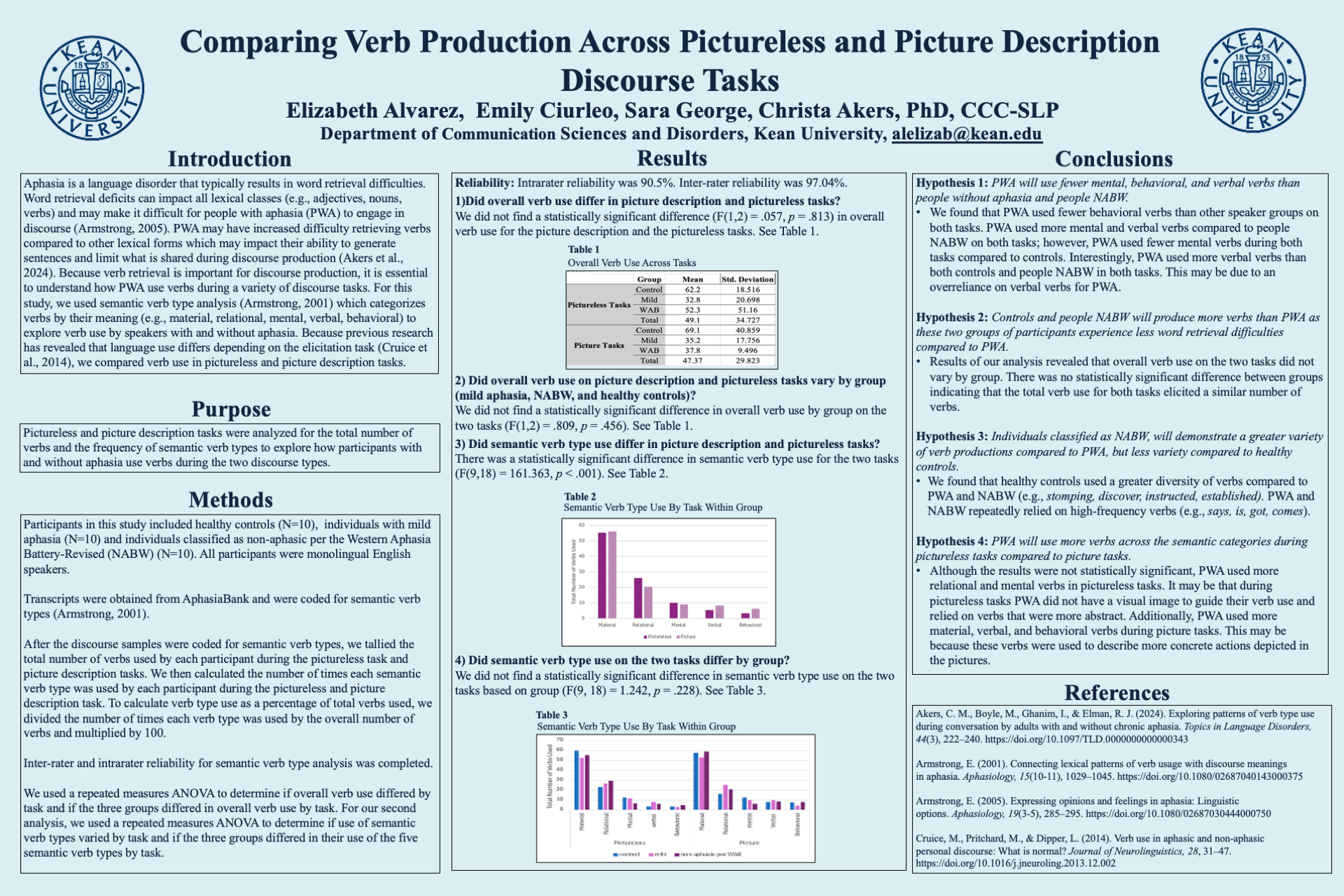
Introduction:A hallmark characteristic of aphasia is reduced word retrieval, which can affect word retrieval across lexical classes (e.g., adjectives, nouns, and verbs). A variety of methods have been used to investigate verb use by persons with aphasia (PWA). Semantic verb type analysis classifies verbs into five different categories: material, relational, mental, verbal, or behavioral. Each verb classification serves a specific function within discourse. Material verbs describe actions (e.g., drive). Relational verbs describe the process of being and having (e.g., is). Mental verbs describe thinking and feeling (e.g., think). Verbal verbs describe the process of saying (e.g., say). Lastly, behavioral verbs describe physiological processes (e.g., dream). In our research, we will be investigating how speakers use verbs in two discourse tasks: pictureless and picture description tasks, as previous research has revealed that language use differs according to different tasks.Methods:We use semantic verb type analysis to analyze 30 transcripts obtained from AphasiaBank, a database of audio, video, and transcript recordings of interactions between researchers and participants. Our research participants consist of three groups including people with aphasia, people without aphasia, and people classified as non-aphasic per a commonly used aphasia assessment. We will examine verb use in pictureless and picture description tasks. In pictureless tasks, participants were asked to retell the story of Cinderella after looking through a wordless picture book. In picture description tasks, participants were asked to describe a picture scene or sequence of pictures.Conclusion:Semantic verb type analysis is underway and will be completed in time for poster submission. It is our hypothesis that people with aphasia will use more verbs across the semantic categories during pictureless tasks compared to picture tasks. We hypothesize that PWA will use fewer overall verbs and use fewer verbs across all categories compared to all other participant types.