
Deep Ritz Method: Leveraging Deep Learning for Solving Variational Problems
Zaire Meachem
Co-Presenters: Individual Presentation
College: The Dorothy and George Hennings College of Science, Mathematics and Technology
Major: Computational Science & Engineering - STEM 5 Year B.S./M.S.
Faculty Research Mentor: Ensela Mema
Abstract:
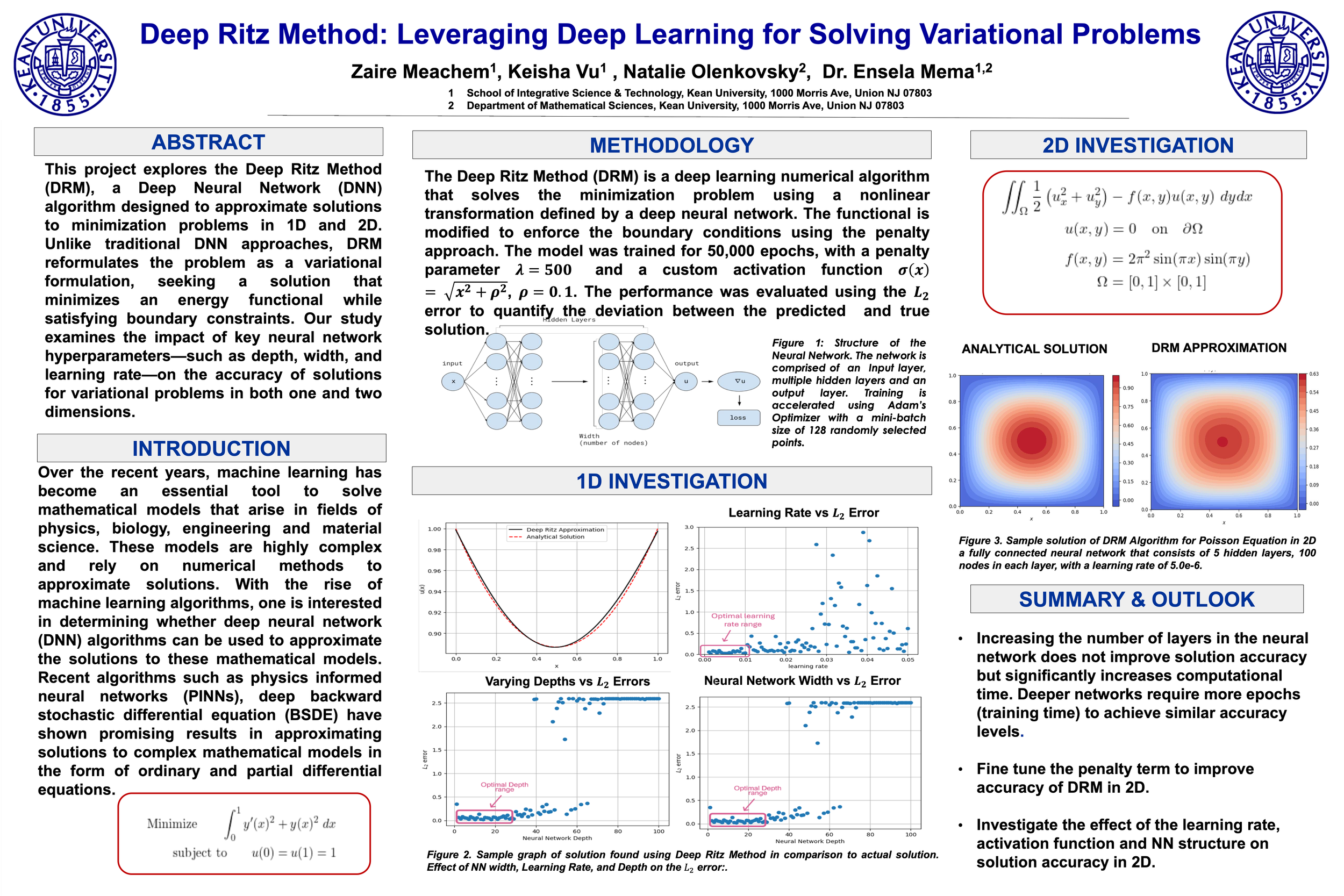
Over the recent years, machine learning has become an essential tool to solve mathematical models that arise in fields of physics, biology, engineering and material science. These models are highly complex and rely on numerical methods to approximate solutions. With the rise of machine learning algorithms, one is interested in determining whether deep neural network (DNN) algorithms can be used to approximate the solutions to these mathematical models. Recent algorithms such as physics informed neural networks (PINNs), deep backward stochastic differential equation (BSDE) have shown promising results in approximating solutions to complex mathematical models in the form of ordinary and partial differential equations. Our project focuses on a novel DNN algorithm called the Deep Ritz Method (DRM) and its ability to accurately approximate the solution to elliptic partial differential equations (PDEs). Unlike other DNN algorithms, the DRM reformulates the PDE as a variational problem where the solution minimizes an energy functional subject to boundary constraints. Our study investigates how neural network hyperparameters—such as depth, width, and learning rate—affect the accuracy of solutions for variational problems in both one and two dimensions. The algorithms’ approximations are compared to the analytical solutions of each minimization problem with the accuracy assessed through the 2 error metric. Our study offers insights into the optimal hyperparameters needed to approximate solutions to variational problems accurately and efficiently, playing a crucial role in modern scientific computing.