
Empowered Voices: Occupational Therapists’ Perceptions of “PD Movers” as an Intervention Tool in Addressing Social Determinants of Health in Minority Populations
Bailey Kasbarian
Co-Presenters: Kelly Barry, Rhea San Diego, Rachel Alessandra-Cordasco, Caraid McGovern
College: The College of Health Professions and Human Services
Major: Occupational Therapy (M.S.) or (OTD)
Faculty Research Mentor: Alissa Pacheco
Abstract:
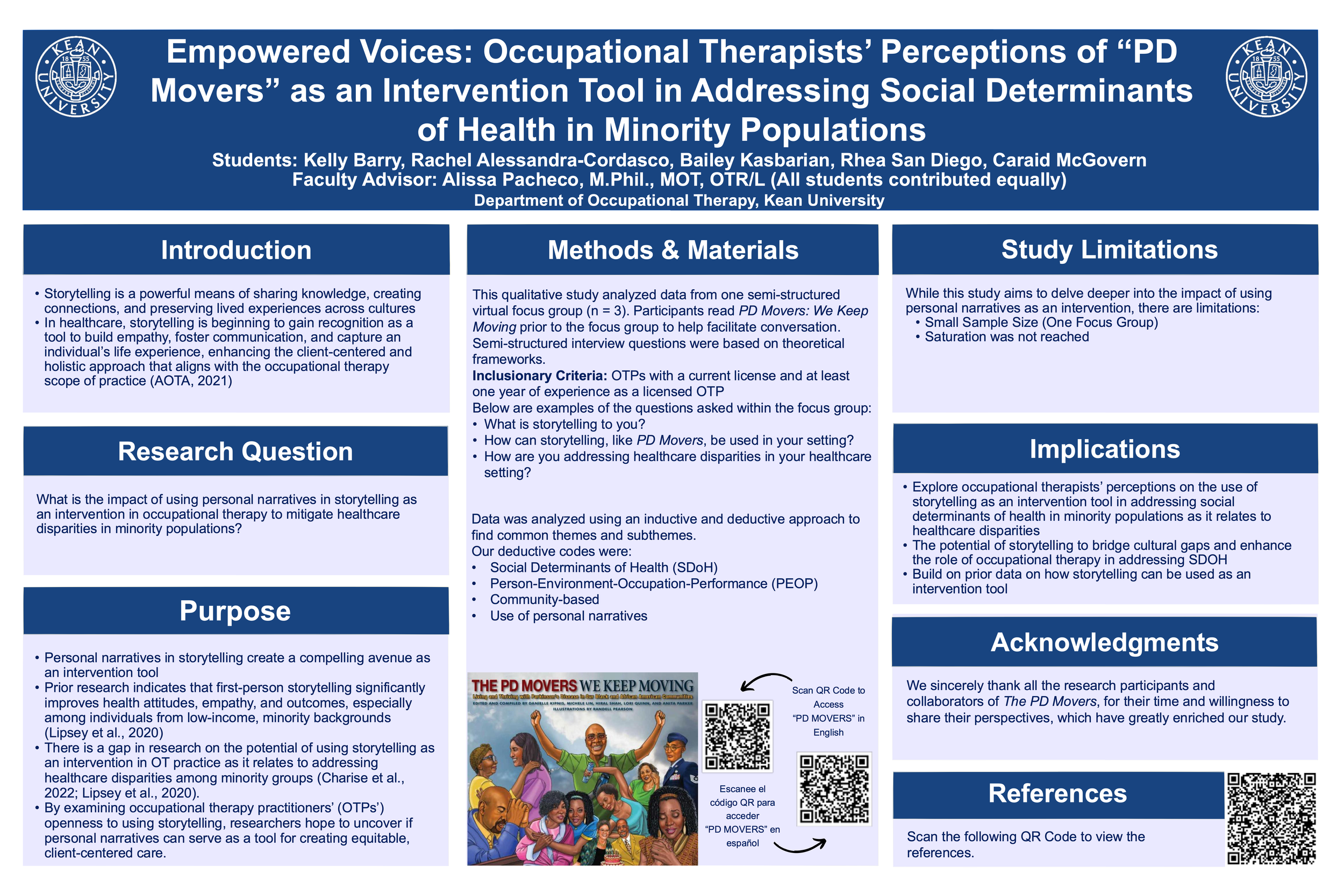
This study explores occupational therapists’ perceptions on the use of storytelling as an intervention tool in addressing social determinants of health (SDoH) in minority populations as it relates to healthcare disparities, health literacy, and client-practitioner communication. The literature has shown that personal narratives in storytelling can be particularly impactful in addressing SDoH in minority groups. These groups face compound challenges related to economic stability, access to healthcare, education, and social context, which can exacerbate health disparities. Employing narrative methods to educate patients, community members, and healthcare providers can enhance cultural competence and sensitivity, which are essential for effectively addressing SDoH in minority populations.One group of three occupational therapy practitioners (OTPs), with at least 1 year of experience, were presented with “PD Movers,” a collection of personal narratives used to connect, empower, and educate African American and Black diaspora individuals who have Parkinson's Disease. This study employs a qualitative design, specifically grounded theory, utilizing a virtual focus group to identify participants' perceptions and experiences regarding storytelling and SDoH, followed by thematic analysis to identify key insights and patterns.Through this lens, the study addresses a salient question: What is the impact of using personal narratives in storytelling as an intervention in occupational therapy (OT) practice to mitigate healthcare disparities in minority populations? Data analysis is ongoing.This study hopes to increase OTPs’ awareness in using storytelling as an intervention and broaden the application of “PD Movers” to other diagnoses and cultures, furthering education and empowering individuals to share their stories.
Keywords: Social Determinants of Health, Occupational Therapy, Parkinson’s Disease, Storytelling