
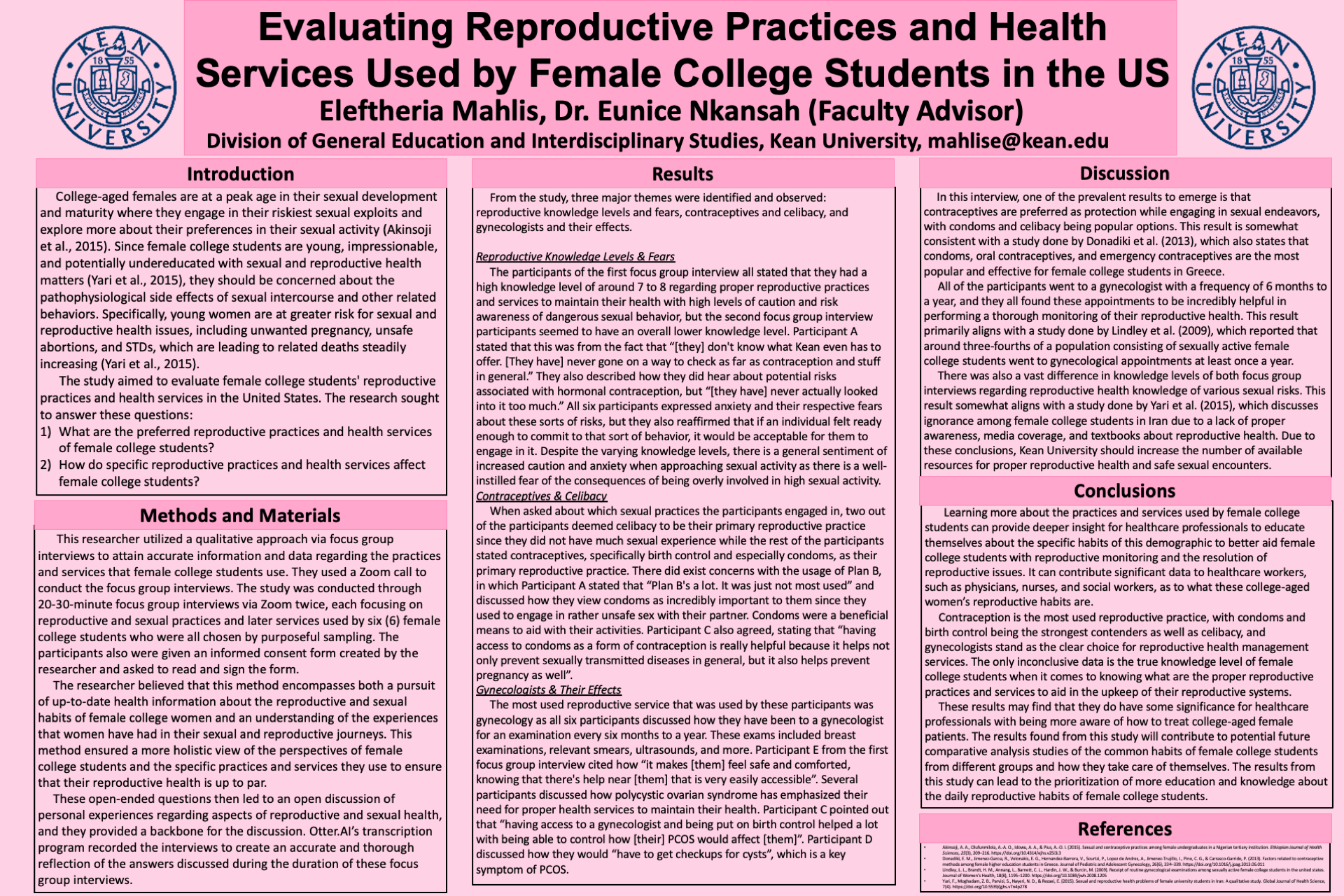
Evaluating the Reproductive Practices and Health Services Used by Female College Students in the United States
Eleftheria Mahlis
Co-Presenters: Individual Presentation
College: The Dorothy and George Hennings College of Science, Mathematics and Technology
Major: Biotechnology/Molecular Biology - STEM 5 Year B.S./M.S.
Faculty Research Mentor: Eunice Nkansah
Abstract:
Female reproductive health stands as a fundamental part of the everyday life of women around the world, and female college students are a population that requires guidance about how to properly navigate sexual encounters and proper reproductive health maintenance. This study evaluates the reproductive practices and health services used by female college students in the United States. This study aimed to learn more about the individual reproductive practices and services that are used by female college students frequently, the effects that these practices and services can have on these students, and the reasons why these methods are so prevalent among this particular population. The data for this study was collected via two semi-structured interview sessions where a qualitative approach was taken by the usage of focus group interviews. The participants who were recruited for this study were primarily second or third-year students ranging from the ages of 19 to 21 who all attended Kean University at its Union Campus in Union, New Jersey. The interview sessions had eight questions that varied from inquiring about personal reproductive practices and services that are used frequently, the perceived risks of risky sexual behavior, general knowledge about proper reproductive practices and services, and recommendations that individuals who are not as knowledgeable about these sorts of habits. The focus group interviews consisted of six participants. The study’s themes were all linked to varied opinions on personal reproductive knowledge and elevated fears of reproductive risks. All participants expressed similar fears about unintended pregnancy, STDs, and other potential reproductive risks. However, their knowledge of proper reproductive practices and services to maintain themselves varies from relatively confident to lacking confidence. Most of the participants in the interviews went to a gynecologist with a frequency of around 6 months to a year with Planned Parenthood only being resorted to as an emergency service. Based on the findings, Kean University should invest in measures to educate students more about the proper reproductive practices and services that they should be using to maintain their health.