
Gendered Differences in Young Adults Between Neuroticism and Symptoms of Social Anxiety: Self-Compassion as a Potential Moderator
Anahita Sheriyarji
Co-Presenters: Individual Presentation
College: College of Liberal Arts
Major: Forensic Psychology (M.A.)
Faculty Research Mentor: Christine Doyle
Abstract:
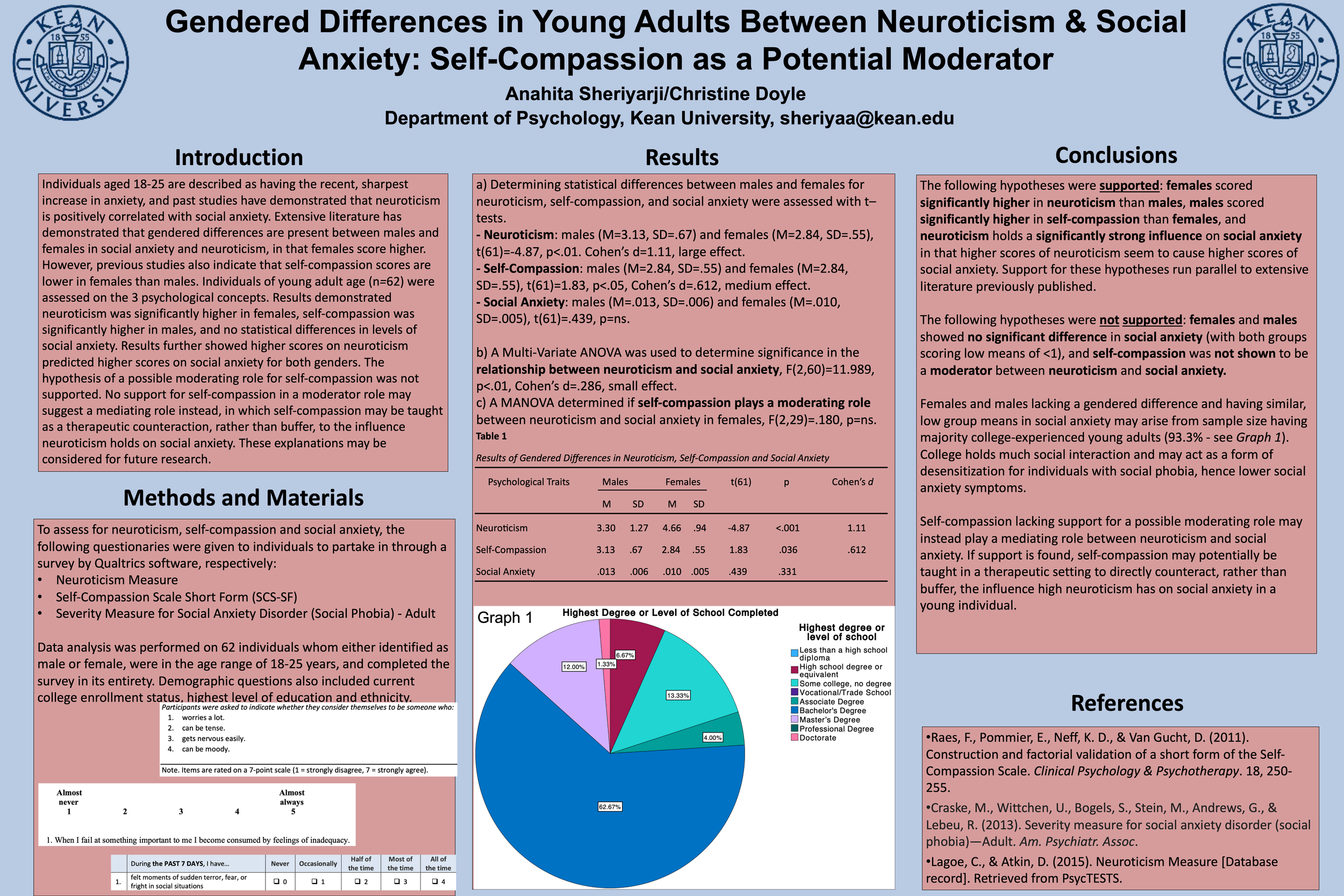
Individuals aged 18-25 have experienced a recent sharp increase in anxiety, including social phobia. Neuroticism, an over-encompassing trait of negative affect, has repeatedly been shown to have a positive correlation with social anxiety. Extensive literature has demonstrated gender differences regarding levels of social anxiety and neuroticism, with females scoring higher than males in both aspects. However, the trait of self-compassion is shown to be at lower levels in females than males, and previous literature demonstrates that self-compassion has a negative correlation with social anxiety. This current study uses an online survey sent to participants, consisting of questions from the Self-Compassion Scale Short Form (SCS-SF), Severity Measure for Social Anxiety Disorder (Social Phobia) – Adult, and a series of questions assessing neuroticism. It is hoped that this study runs parallel to other literature in that neuroticism and social anxiety are shown to be higher in females than males but reversed pattern with levels of self-compassion, and that there lies a significant relationship between neuroticism and social anxiety in both genders. Most importantly, this literature aims to study if, within the females who score high on neuroticism, self-compassion acts as a moderator that results in relatively lower levels of social phobia. This study hopes to identify gender discrepancies in the different psychological aspects, as well as figure if self-compassion can be a taught, therapeutic buffer for those with high levels of neuroticism, in social situations.