
Quantitative Micellar Morphological Characterization of Complex Block Copolymers
Ethan Jimenez
Co-Presenters: Individual Presentation
College: The Dorothy and George Hennings College of Science, Mathematics and Technology
Major: Chemistry
Faculty Research Mentor: Brian Ree
Abstract:
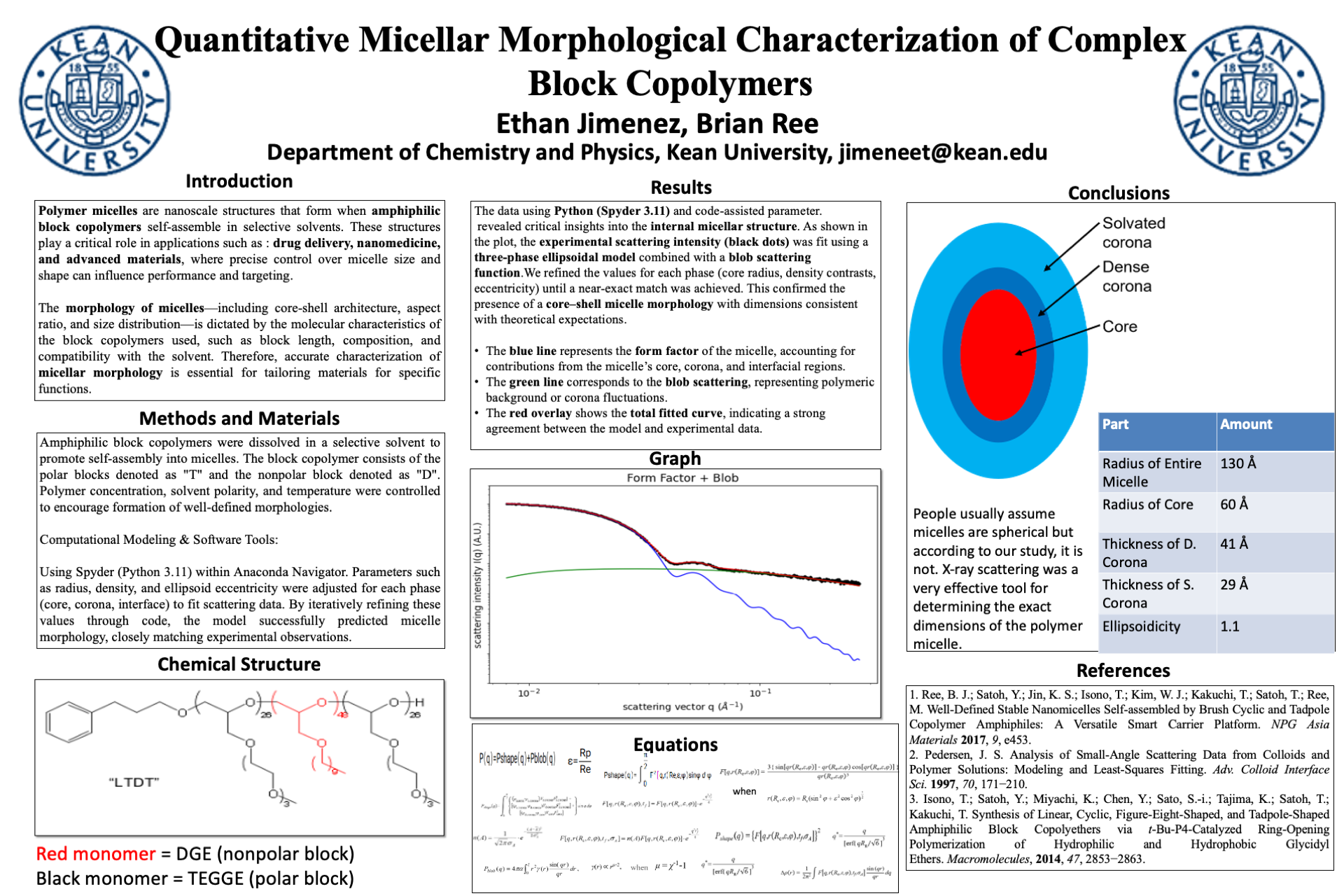
PURPOSE: Polymer micelles are nanoscale structures that form when amphiphilic block copolymers self-assemble in selective solvents. These structures play a critical role in applications such as : drug delivery, nanomedicine, and advanced materials, where precise control over micelle size and shape can influence performance and targeting.The morphology of micelles—including core-shell architecture, aspect ratio, and size distribution—is dictated by the molecular characteristics of the block copolymers used, such as block length, composition, and compatibility with the solvent. Therefore, accurate characterization of micellar morphology is essential for tailoring materials for specific functions.METHODS:Amphiphilic block copolymers were dissolved in a selective solvent to promote self-assembly into micelles. The block copolymer consists of the polar blocks denoted as "T" and the nonpolar block denoted as "D". Polymer concentration, solvent polarity, and temperature were controlled to encourage formation of well-defined morphologies.Computational Modeling & Software Tools:Using Spyder (Python 3.11) within Anaconda Navigator. Parameters such as radius, density, and ellipsoid eccentricity were adjusted for each phase (core, corona, interface) to fit scattering data. By iteratively refining these values through code, the model successfully predicted micelle morphology, closely matching experimental observations.
CONCLUSIONS: People usually assume micelles are spherical but according to our study, it is not. X-ray scattering was a very effective tool for determining the exact dimensions of the polymer micelle.
SIGNIFICANCE/NOVELTY: Understanding micellar morphology is critical for tailoring polymeric materials to biomedical and industrial applications. This research contributes to the optimization of micellar characterization techniques, ensuring reliable data for the development of functional polymeric nanomaterials.