
Verb Production in People with Aphasia during Personal Narratives and Picture Tasks
Danielle Avino
Co-Presenters: Marissa Quinn, Alexa Brown
College: The College of Health Professions and Human Services
Major: Speech-Language Pathology (M.A.)
Faculty Research Mentor: Christa Akers
Abstract:
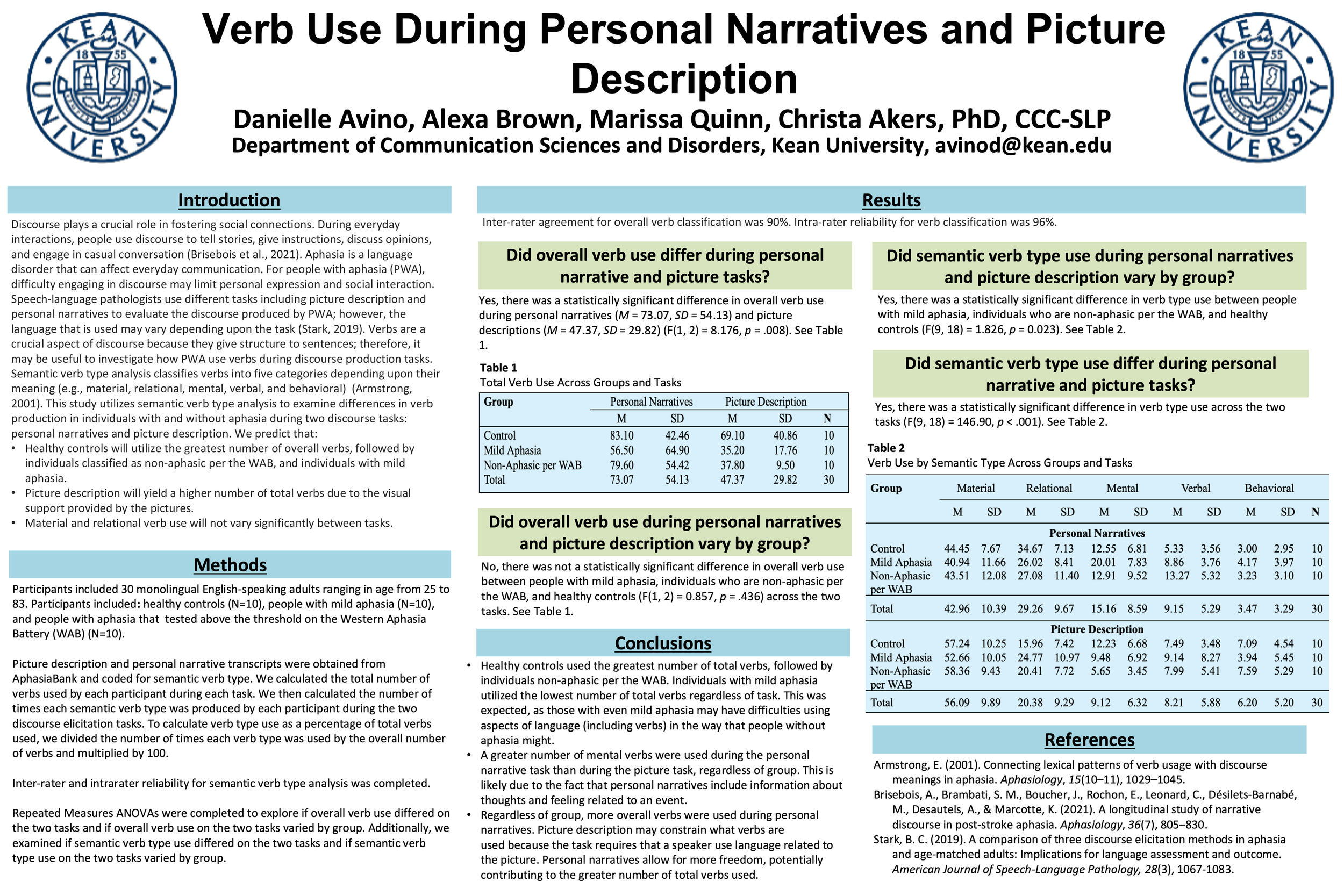
Discourse plays a crucial role in shaping personal identity and fostering social connections. In everyday interactions, discourse takes forms such as storytelling, sharing experiences, discussing ideas, and engaging in conversation. Speech-language pathologists analyze discourse through elicitation methods like picture tasks and personal narratives. During picture description, individuals describe what they see in an image or sequence of images. Personal narrative tasks involve the recount of a personal experience, (e.g., significant life event) and require greater language demands. Previous research regarding discourse production focused on noun usage in people with aphasia (PWA). Verb usage in PWA has begun to gain attention, however, research about verb use in PWA is needed to inform treatment and future research. Verbs are a crucial aspect of discourse, as verbs give structure to sentences and are important for effective communication. According to semantic verb type analysis, verbs can be classified into five categories. Material verbs express actions (e.g., eat). Relational verbs express being and having (e.g., is). Mental verbs describe feeling and thinking (e.g., understand). Verbal verbs describe talking (e.g., said). Behavioral verbs describe physical or psychological processes (e.g., sleep). This study examines how the presence of aphasia impacts verb use during different discourse tasks.Methodology:This study examines three groups of individuals: healthy controls, people with mild aphasia, and people with aphasia that have tested above the threshold on a common assessment. Using previously collected discourse samples produced by 30 adults with and without aphasia, verbs will be classified by semantic category during personal narratives and picture tasks.Conclusions:Semantic verb analysis is underway and will be completed in time for poster submission. It is our hypothesis that healthy controls will use the greatest number of overall verbs, followed by individuals who have aphasia and tested above the threshold, and individuals with mild aphasia will utilize the fewest overall verbs. Additionally, we hypothesize that discourse produced during picture tasks will yield a higher number of total verbs than discourse produced during personal narratives. Discussion will focus on how speakers use verbs across semantic categories.
Keywords: Aphasia, Discourse, Verbs