
Echinacea Purpurea: Cannabimimetic Effects on the Immune System of Calves, Broiler Chickens, and Hybrid Snakehead Fish: A Systematic Review of the Literature
Hafsa Syed
Co-Presenters: Emily Collado, Saniya Williams, Shiuli Roy, Chiamaka Emelumba
College: Hennings College of Science Mathematics and Technology
Major: BA.BIOLOGY
Faculty Research Mentor: Rana Zeine
Abstract:
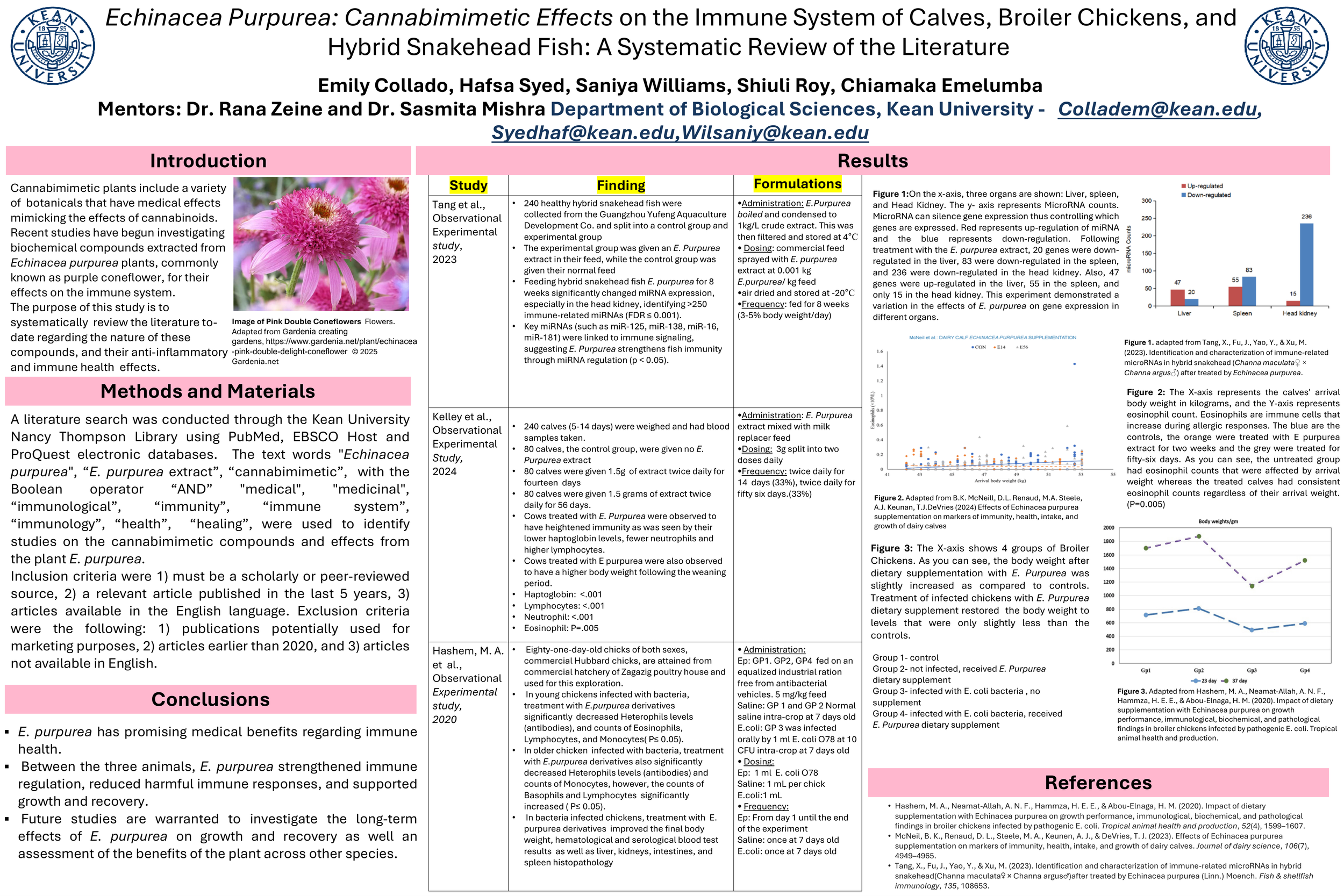
The aim of this systematic review is examining the cannabimimetic effects of Echinacea Purpurea (EP) on immune response and growth of various young animals, including calves, broiler-chickens, and hybrid-snakehead fish. In one such study, 240 male calves were separated into 3 groups of 80 in a controlled experiment. The researchers gave one group no EP, one group 3gEP (with milk replacer) twice daily for 56 days, and one group 3gEP (with milk replacer) twice daily from days 14-28. The calves were weaned off the MR/EP mixture, and their height, blood samples, and temperature records were updated. In another study, EP was filtered into a drug and then sprayed onto feed for half of 240 snakehead fish over an eight-week period. After, the 240 fish were sacrificed, and their kidneys, livers, and spleens were harvested. The organs were then used for RNA extraction. Lastly, Eighty-day-old chicks were separated into four groups. Control, EP (5mg), E.Coli (1ml), and EP+E.Coli. Blood samples were collected twice, and after 42 days, the chicks were sacrificed; their kidneys, spleens, livers, and intestines were harvested. Dietary supplementation with Echinacea purpurea (EP) showed immunomodulatory and protective effects across multiple animal subjects. EP improved growth performance, hematological and serum biochemical effects, and reduced the adverse hepatic and immune changes of E. coli. Molecular analyses (Gene Ontology and KEGG) indicated that EP influenced important immune response pathways. The results highlighted that immune-related miRNA targets were involved in the treatment response. In calves, EP supplementation was linked to reduced inflammation and immunomodulation, shown through blood markers, with benefits most evident when administered throughout the milk-feeding period. Collectively, these findings support the efficiency of Echinacea purpurea as a natural immunomodulator that increases immune system resilience and reduces infection in livestock. The findings derived from the experiments highlight the significance of Echinacea Purpurea in enhancing immunity and growth across different species. The data observed in the immune response suggest EP has potential benefits across industries as research develops.