
Evaluation of Niclosamide Treatment on the Inflammatory Prolife of Human Monocytes
Anuja Misser
Co-Presenters: Individual Presentation
College: Hennings College of Science Mathematics and Technology
Major: MS.BIOTECH/SCI
Faculty Research Mentor: Dante Descalzi, Salvatore Coniglio
Abstract:
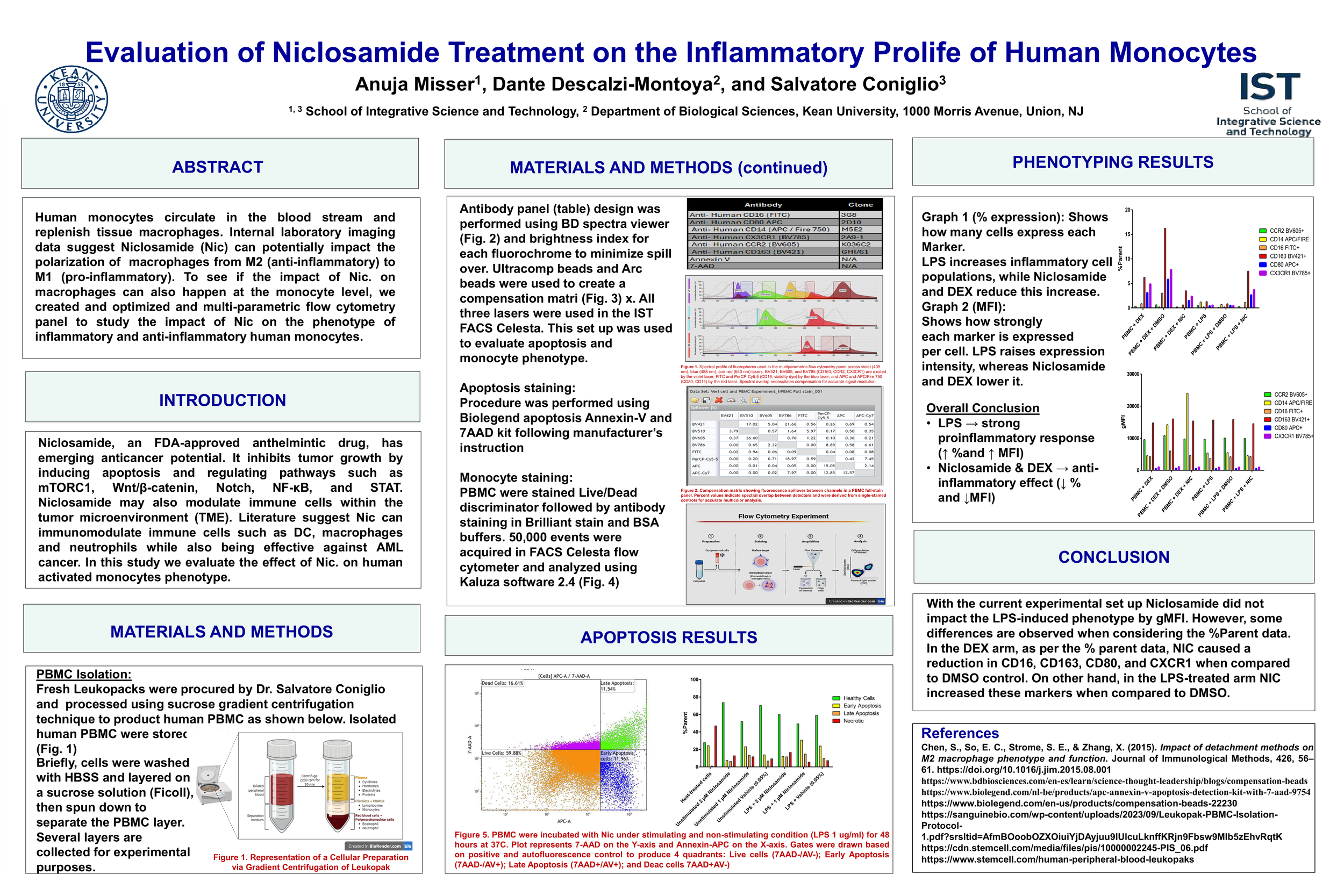
Niclosamide is an anthelmintic drug that has been approved for more than 50 years for the treatment of tapeworm infections. In addition to its established antiparasitic activity, numerous studies have proposed new clinical applications for niclosamide based on its therapeutic effects in cancer, bacterial and viral infections, metabolic disorders, and autoimmune diseases. In cancer, niclosamide has been shown to induce apoptosis and mitochondrial uncoupling and to modulate multiple signaling pathways that are essential for tumor cell survival and proliferation, including mTORC1, Wnt/β-catenin, Notch, NF-κB, and STAT signaling.Our primary interest in niclosamide lies in its potential impact on the tumor microenvironment (TME), which comprises diverse immune cell populations such as T cells, macrophages, myeloid-derived suppressor cells (MDSCs), dendritic cells (DCs), and natural killer (NK) cells that play distinct roles in tumor progression and immune regulation. Recent microscopy-based imaging studies suggest that niclosamide exerts an activating effect on monocytes, promoting a shift from a less inflammatory to a more inflammatory phenotype, thereby enhancing their antitumor activity (internal communication). In tissues, monocytes differentiate into inflammatory M1 macrophages, which function as key effector cells in the TME by secreting pro-inflammatory cytokines and chemokines, including IL-1, IL-6, TNF, and CXCL8.Based on these observations, we hypothesize that niclosamide promotes a phenotypic and functional shift in monocytes and/or macrophages from an anti-inflammatory to a pro-inflammatory state, representing a potential anticancer mechanism of action. To test this hypothesis, we will first evaluate the effects of niclosamide on human monocyte phenotypes under stimulatory conditions. We will then differentiate human monocytes into M1 and M2 macrophages using defined culture conditions. Following polarization, M2 macrophages will be treated with niclosamide to determine whether they undergo repolarization toward an M1 phenotype. The study will employ multiparametric flow cytometry, quantitative PCR (qPCR), and ELISA to characterize phenotypic and functional changes.Keywords:Niclosamide; tumor microenvironment; monocytes; macrophage polarization; M1 macrophages; M2 macrophages; inflammation; immunometabolism; anticancer mechanism; flow cytometry