
Lateral Ankle Sprains Rehabilitation and Recovery: A Literature Review
Seaerra Michalsky
Co-Presenters: Individual Presentation
College: College of Health Professions and Human Services
Major: DPT.PHYSTHERAPY
Faculty Research Mentor: Thomas Koc Caitlyn Boyko
Abstract:
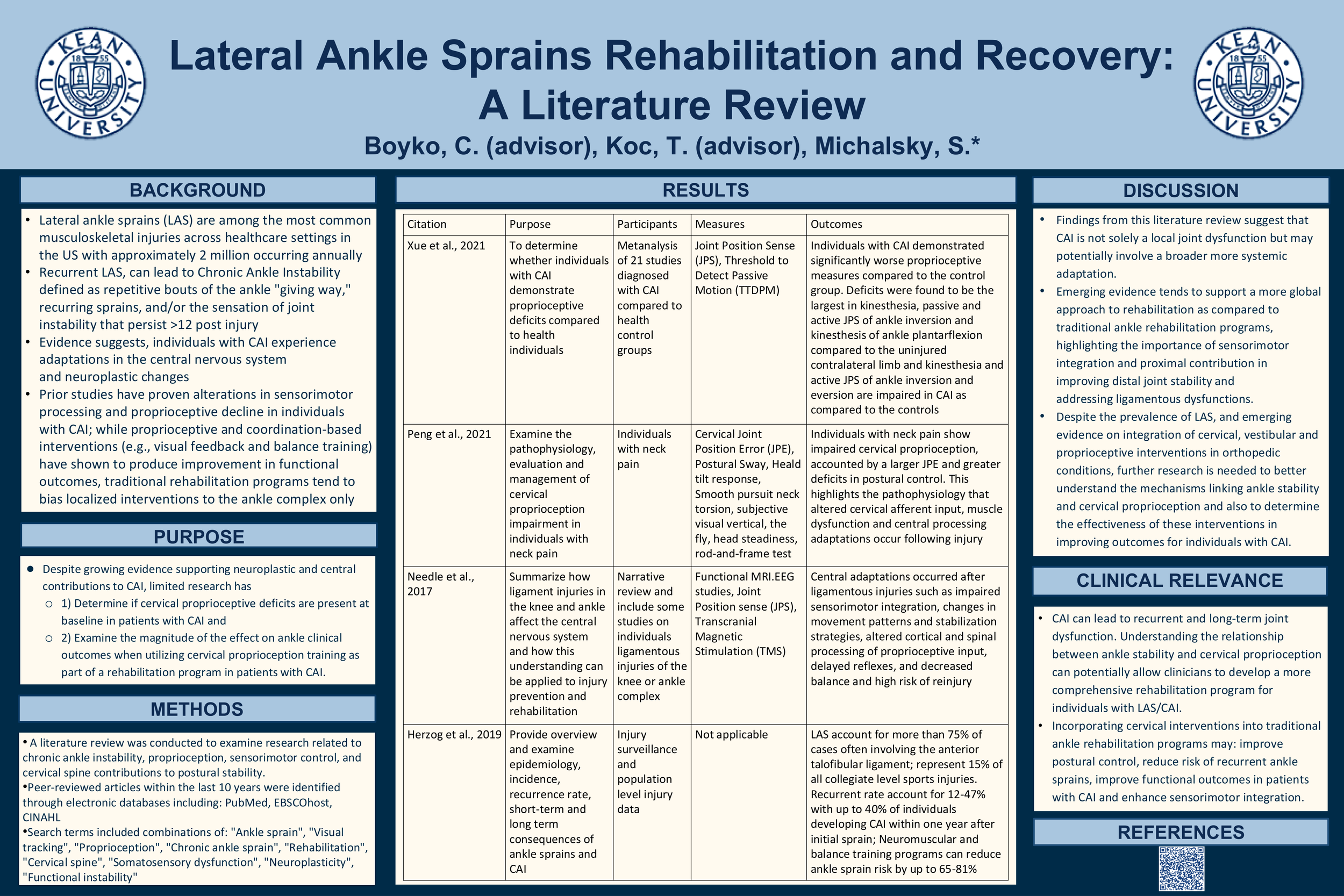
Lateral ankle sprains (LAS) are among the most common musculoskeletal injuries seen in orthopedic clinics, primary care, and emergency room visits across the United States. Recurrence of injury is a frequent sequela in lower extremity musculoskeletal injuries, especially with LAS. As a result, recurrence of LAS is categorized as Chronic Ankle Instability (CAI), defined as repetitive bouts of the ankle “giving way”, recurring sprains, and/or the sensation of joint instability. Evidence suggests that individuals who have CAI should be looked at from a bigger perspective rather than just an ankle sprain as adaptations in the central nervous system and neuroplastic changes occur in these individuals. Previous studies have demonstrated alterations in sensorimotor processing, and proprioceptive decline in individuals with CAI. Proprioceptive and coordination-based interventions, including visual feedback and balance training, have shown to produce improvements in functional outcomes; however, traditional rehabilitation programs in LAS/CAI bias localized interventions to the ankle complex only. Current literature on cervical proprioception indicates that the cervical spine plays a critical role in postural control, spatial orientation, and sensorimotor integration. Which reintroduces the idea of central adaptation and functional interdependence; in which after an injury, problem with senses and movements in one area of the body can affect the stability of joints further away. Despite growing evidence supporting neuroplastic and central contributions to CAI, limited research has 1) determine if cervical proprioceptive deficits are present at baseline in patients with CAI and 2) examine the magnitude of the effect on ankle clinical outcomes when utilizing cervical proprioception training as part of a rehabilitation program in patients with CAI. This literature review integrates current findings on ankle instability, neuroplasticity, and cervical proprioception to establish a rationale for integrating cervical proprioceptive and visual feedback training into rehabilitation protocols for individuals with CAI.Key Words: Ankle sprain, Visual tracking, Proprioception, Chronic ankle sprain, Rehabilitation, Cervical spine, Somatosensory dysfunction, Neuroplasticity, Functional instability