
Speech-Language Pathologist & Occupational Therapists Perspectives on RTI/MTSS Using Goodson’s Educational Change Model
Rebecca Roberman
Co-Presenters: Keyara Davis
College: College of Health Professions and Human Services
Major: MA.SPEECH-LNGPATH
Faculty Research Mentor: Iyad Ghanim, Melissa Jacob
Abstract:
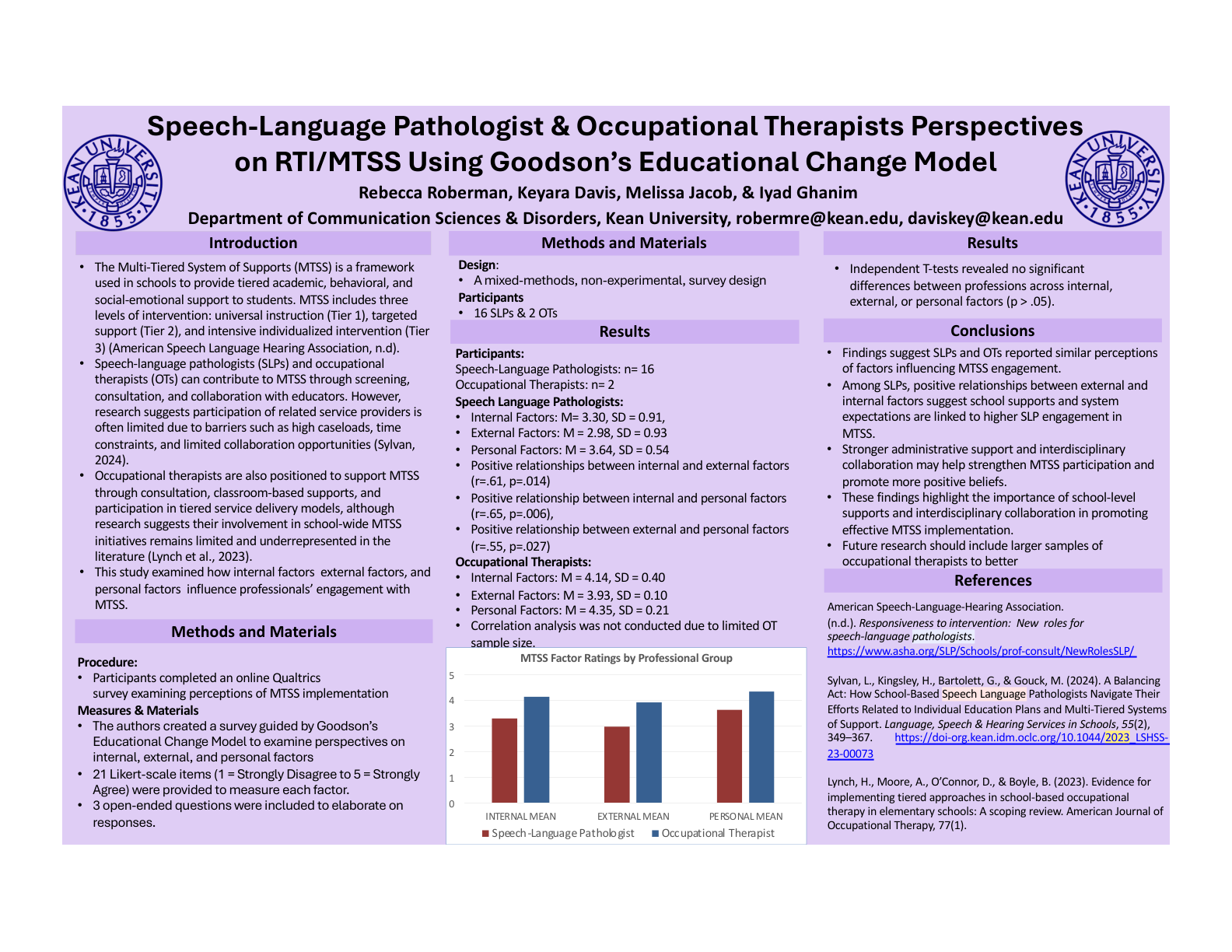
Multi-Tiered Systems of Support (MTSS) and Response to Intervention (RTI) are widely usedframeworks designed to support student academic, behavioral, and social-emotionaloutcomes. Despite the need for MTSS, speech-language pathologists (SLPs) and occupationaltherapists (OTs) inconsistently engage with the framework due to structural barriers) e.g. lack ofadministrative support and time) or personal beliefs about the effectiveness of MTSS. UsingGoodson's Educational Change Model, this study seeks to examine perspectives on external,internal, and personal factors in both SLPs and OTs. School-based SLPs and OTs were recruitedand completed a 21-item Likert scale survey examining their perspectives on external factors(e.g. community support), internal factors (e.g. administrative support), and personal factors (e.g.attitudes about MTSS). Three open-ended questions were provided to elaborate on their effect onMTSS. Planned data analyses include correlational analyses to examine relationships betweenfactors in SLPs and OTS, respectively. Further, independent sample t-tests will also becompleted to determine differences in perspectives in each factor between SLPs and OTs. Athematic analysis will be completed on open-ended responses to identify common themesbetween SLPs and OTs. Findings are expected to contribute to a clearer understanding of howschool-based conditions and professional perspectives influence MTSS engagement, whileidentifying differences in how SLPs and OTs perceive MTSS and RTI implementation.