
A Quantitative Research Study Analyzing University STEM Students’ Opinions About the Role of Artificial Intelligence (AI) Assistants in Programming Productivity
Franklin Oguama
Co-Presenters: Individual Presentation
College: Hennings College of Science Mathematics and Technology
Major: BA.BIOLOGY
Faculty Research Mentor: Eunice Nkansah
Abstract:
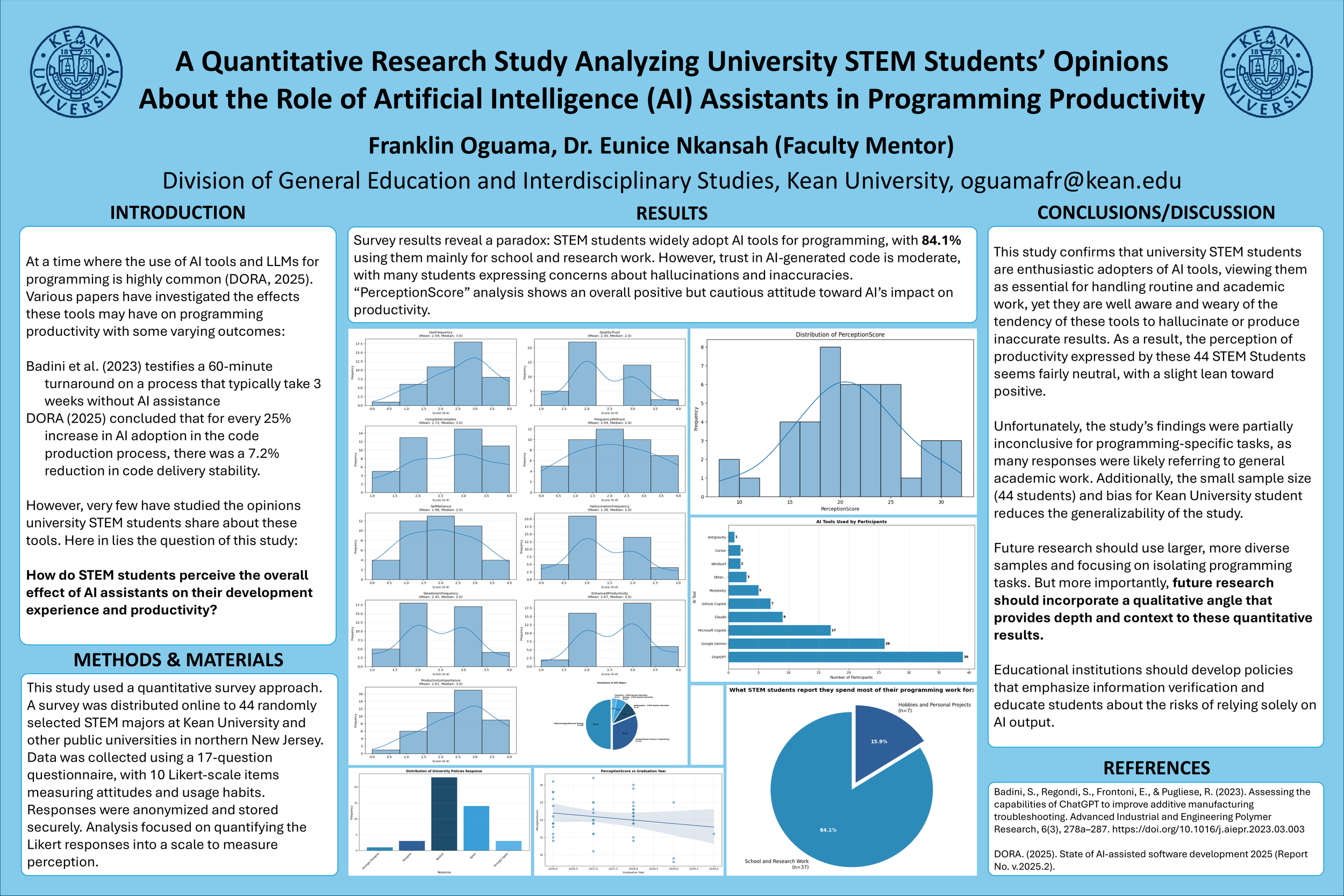
The rapid integration of Artificial Intelligence (AI) into software development has fundamentally altered the programming landscape, yet the specific productivity perceptions of the future workforce – undergraduate university STEM students - remain under-researched. This study investigated the opinions of undergraduate STEM students regarding the role of AI assistants in programming productivity, seeking to understand the motivators and deterrents influencing adoption. Utilizing a quantitative research methodology, data was collected primarily through online questionnaires from forty-four STEM students at Kean University and other undergraduate students from different public universities to analyze their frequency of AI use, trust in AI-generated code, and perceptions of long-term field impacts.
The results revealed a significant paradox: while AI adoption for productivity is high among participants, it is countered by a high awareness of hallucinations and inaccuracies. Analysis of “Perception Scores” indicated an overall positive but cautious view of AI’s effect on productivity. However, the findings were partially inconclusive regarding purely programming-specific tasks due to participants conflating general academic aid with software development.
The study concluded that while STEM students find AI essential for offloading mundane tasks, they do not view it as a replacement for human oversight due to reliability concerns. To address these challenges, the researcher recommends that educational institutions implement clear AI policies emphasizing information verification and that future studies employ larger sample sizes and more precise performance metrics to better isolate AI programming productivity.
Keywords: ChatGPT, Artificial Intelligence (AI), college students, university, Productivity, Development, Programming, AI Assistants.