
VR-TSST: Understanding Stress Responses in Adolescents and Young Adults
Aamillya Joseph
Co-Presenters: Individual Presentation
College: College of Liberal Arts
Major: BS.PSY/PSYCREHAB
Faculty Research Mentor: Yu Sun Chung
Abstract:
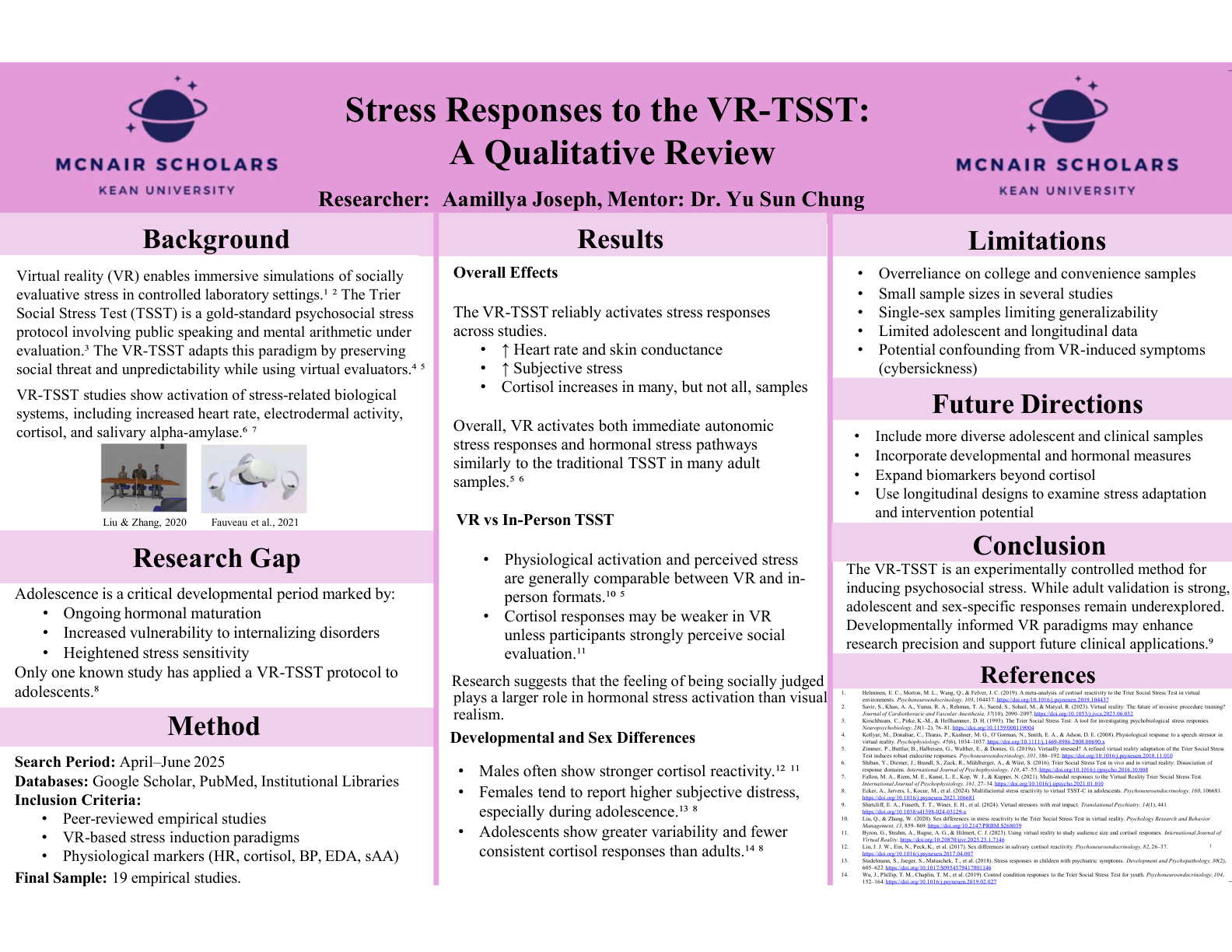
Virtual reality (VR) technology has emerged as a valuable tool for inducing and measuring stress
responses due to its immersive and controllable environments. VR stress paradigms, particularly
the Virtual Reality Trier Social Stress Test (VR-TSST), reliably trigger physiological and
psychological responses such as increased heart rate and activation of the
hypothalamic-pituitary-adrenal (HPA) axis in adults. However, the effects of VR-TSST on
adolescents and young adults remain underexplored, despite adolescence being a critical period
of vulnerability to stress-related psychopathology. This review examined 19 empirical studies: 13
using VR-TSST in adults, 5 using the TSST-Children, and 1 using the standard TSST. Findings
indicate that VR-TSST reliably elicits stress responses comparable to in-person TSST, with men
showing greater physiological reactivity and women reporting higher perceived stress. Few
studies have included adolescents, who show attenuated physiological responses compared to
adults. Future research should recruit more diverse populations, measure pubertal status and
hormonal influences, and assess additional biomarkers such as immune function. VR also holds
potential as an intervention tool for building stress resilience in youth. Longitudinal studies are
needed to understand adaptation to VR-induced stress and its implications for mental health
outcomes.
Keywords: Virtual Reality, Trier Social Stress Test, VR-TSST, Adolescents, Stress Reactivity,
HPA Axis, Psychosocial Stress, Internalizing Psychopathology, Immune Function, Stress
Intervention