
Why Are Investors Blamed for Corporate Harm? Character-Based and Association-Based Judgments Towards Unethical Investors.
Aamillya Joseph
Co-Presenters: Grace Geyer
College: College of Liberal Arts
Major: BS.PSY/PSYCREHAB
Faculty Research Mentor: Peter Kardos
Abstract:
Individual investors are sometimes blamed for investing in harmful companies, despite lacking control over company actions or intent to cause harm. The current study examined the psychological processes underlying blame toward individual investors in the context of unethical corporate behavior.
Two theoretical explanations of moral blame were tested. The first is a character-based approach, which holds that blame arises from inferences about what an action reveals about an individual’s moral character rather than from causal responsibility or intent (Uhlmann et al., 2015). From this perspective, investing in a company believed to engage in harmful practices may signal questionable moral values. The second is an association-based approach, which proposes that individuals may be blamed because they are perceived as connected to a wrongdoer, even without direct involvement in the harm (Lickel et al., 2003).
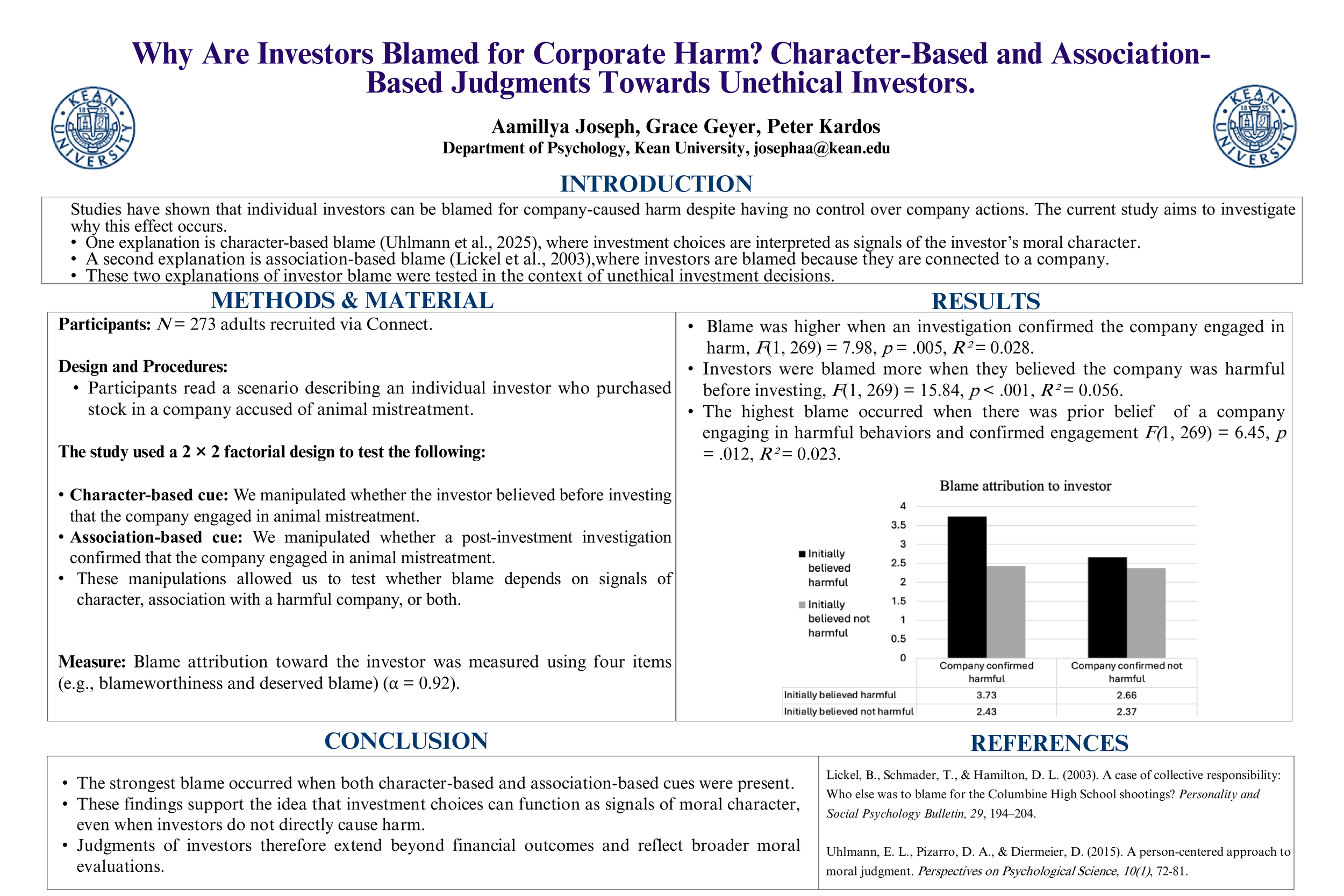
To test these explanations, we used a factorial design that manipulated whether the investor believed the company engaged in animal mistreatment before investing, as knowingly investing despite such beliefs would signal poor moral character. We also manipulated whether a post-investment investigation later confirmed the harm, as confirmation strengthens perceived association with the harmful company. Participants (N = 273) read a brief scenario and rated the investor’s blameworthiness.
Results showed that both prior beliefs about harm and confirmed harm increased blame. Blame was highest when the investor was believed to have invested despite believing the company was harmful and when the harm was later confirmed, suggesting that blame reflects inferences about moral character and perceived association with wrongdoing.