
A Study of Vegetable Growth in Deep Water Culturing (DWC) Hydroponics
Beatriz Cruz
Co-Presenters: Tommy Kober
College: Hennings College of Science Mathematics and Technology
Major: BS.BIO/ENVIR
Faculty Research Mentor: Dongyan Mu
Abstract:
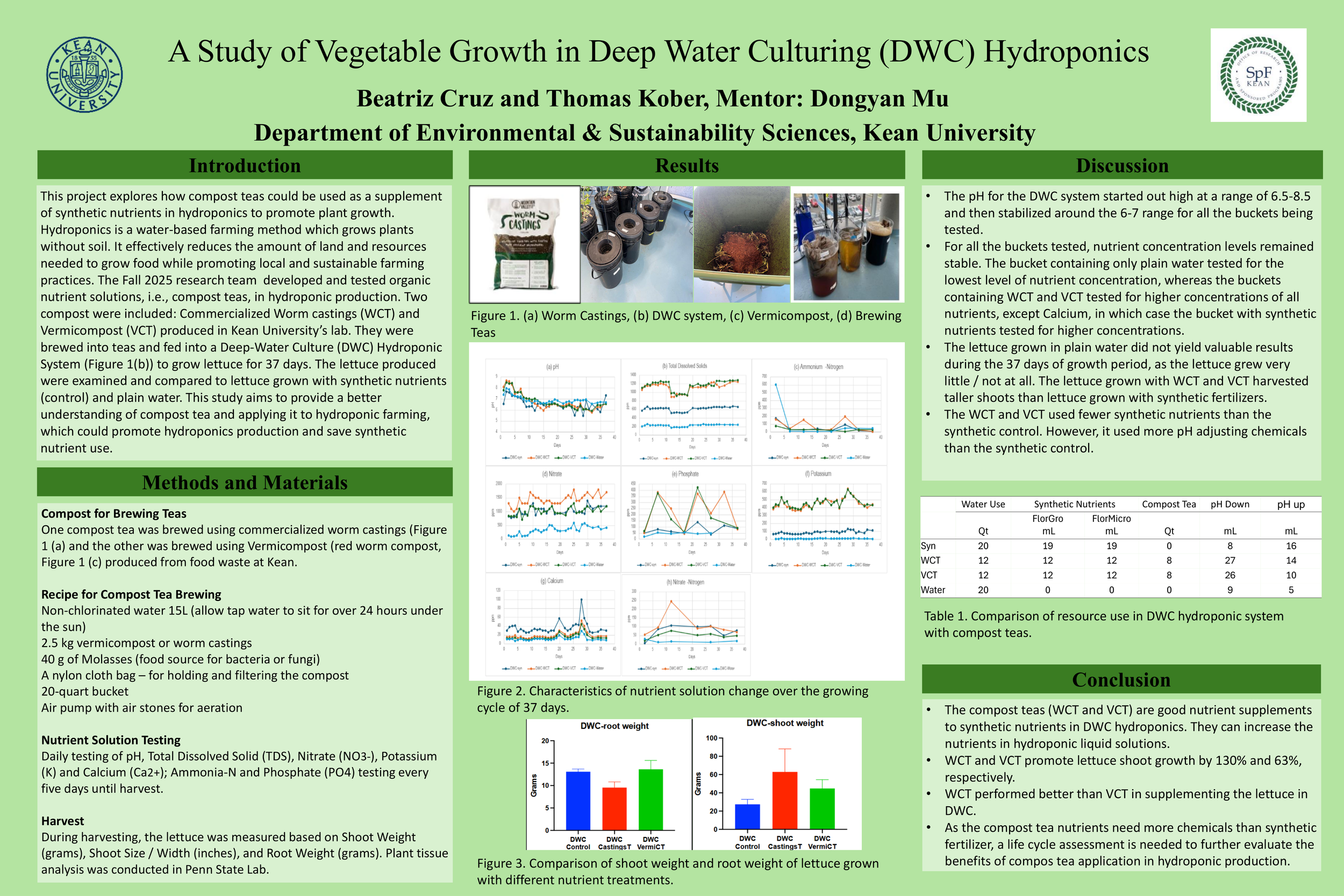
With an ever growing population, food production is becoming more necessary than ever and with it comes the challenge of securing more land and resources for this production. Hydroponics effectively reduces the amount of land and resources needed to grow the same amount of food while promoting local and sustainable farming practices. In addition, if organic nutrients can be used in hydroponics, it can increase organic food production and farming at the same time. The main purpose of this research is to test the vermicompost, an organic nutrient produced at Kean and evaluate it as a nutrient alternative to synthetic fertilizers in hydroponic production. Vermicompost is produced through a red worms' digestion process and contains nutrients and microbes that are essential for plant growth. In this research, various vermicompost produced from food waste or animal waste were brewed into compost teas and tested using DWC (Deep Water Culture) hydroponics: One for store bought worm castings and one for vermicompost produced at Kean University. During the study we grew lettuce with the two compost teas and measured / tested the water samples in the DWC buckets over the entire 36 day growing cycle. DWC also had buckets set up for synthetic nutrients and plain water to use as a control for the two compost teas. This research is expected to expand information regarding compost tea application in hydroponic systems making hydroponics, as a growing method, more viable in communities; it will also provide practical guidance to farmers running hydroponics with organic nutrients.