
Ageist Language in Job Advertisements
Jasmin Langomas
Co-Presenters: Sherwin Prince, Gata Goumou
College: College of Business and Public Management
Major: BS.MANAGEMNT-GENBUS
Faculty Research Mentor: Irina Gioaba, Nazif Durmaz
Abstract:
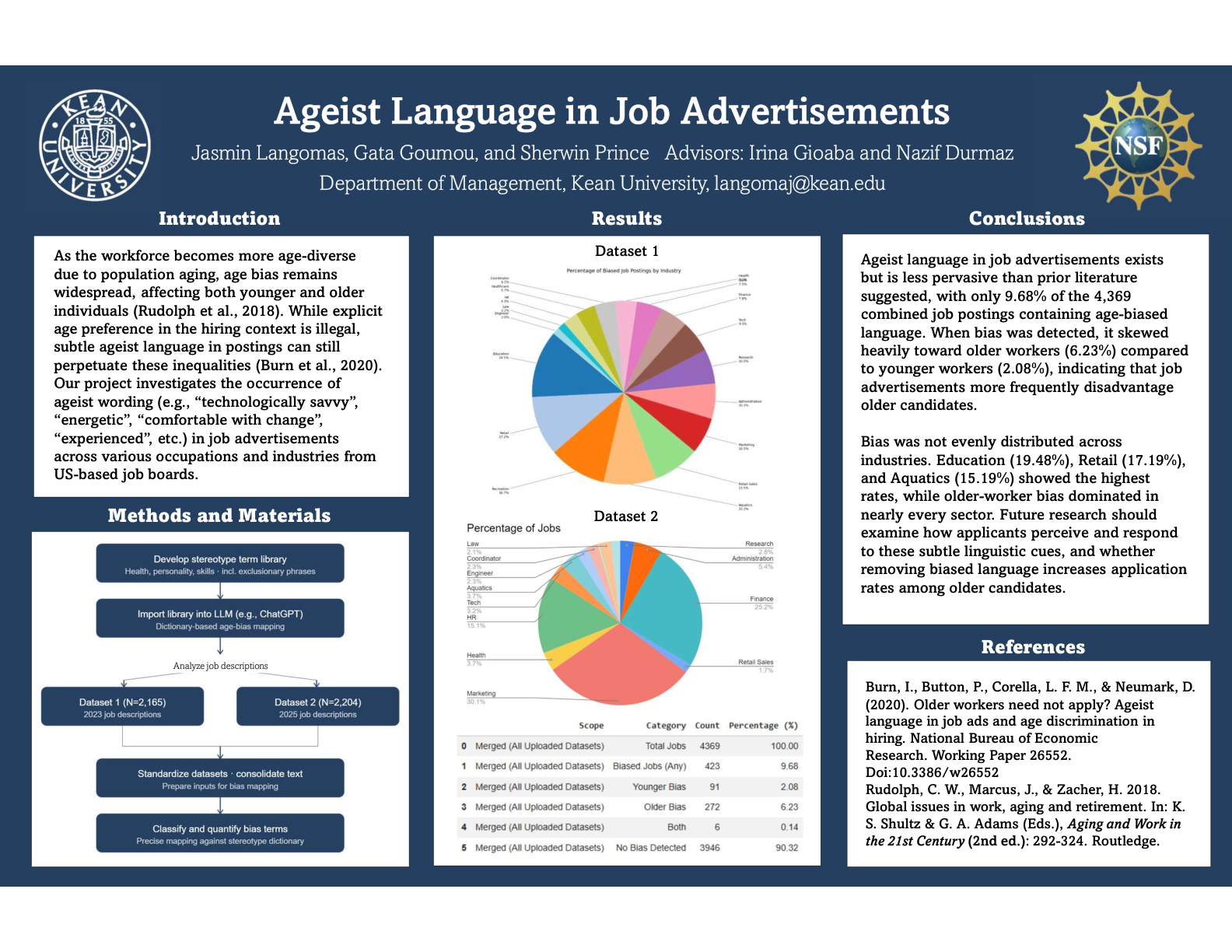
As the workforce becomes more age-diverse due to population aging, age bias remains widespread, affecting both younger and older individuals. While explicit age preference in the hiring context is illegal, subtle ageist language in postings can still perpetuate these inequalities. Our project investigates the occurrence of ageist wording (e.g., “technologically savvy”, “energetic”, “comfortable with change”, “experienced”, “etc.) in job advertisements across various occupations and industries. We analyze the content of a large number of job advertisements spanning multiple industries and occupations. Using data collected from US-based job boards (approx. 4,000 job ads), we developed a library of terms based on common older and younger worker stereotypes identified in the literature. This library was imported into an AI large language model (e.g., ChatGPT) which analyzed and coded the content of the job descriptions. Our results indicate that 11.25% of the job ads contained language that indicated preference for either the older or younger job applicants.