
Can Role‑Play Support Early Professional Identity? A Pilot Study with Undergraduate Speech Language Pathology Students
Alyona Kladova
Co-Presenters: Individual Presentation
College: College of Health Professions and Human Services
Major: SLPD.SPCHLANGPATH
Faculty Research Mentor: Karen Villanueva
Abstract:
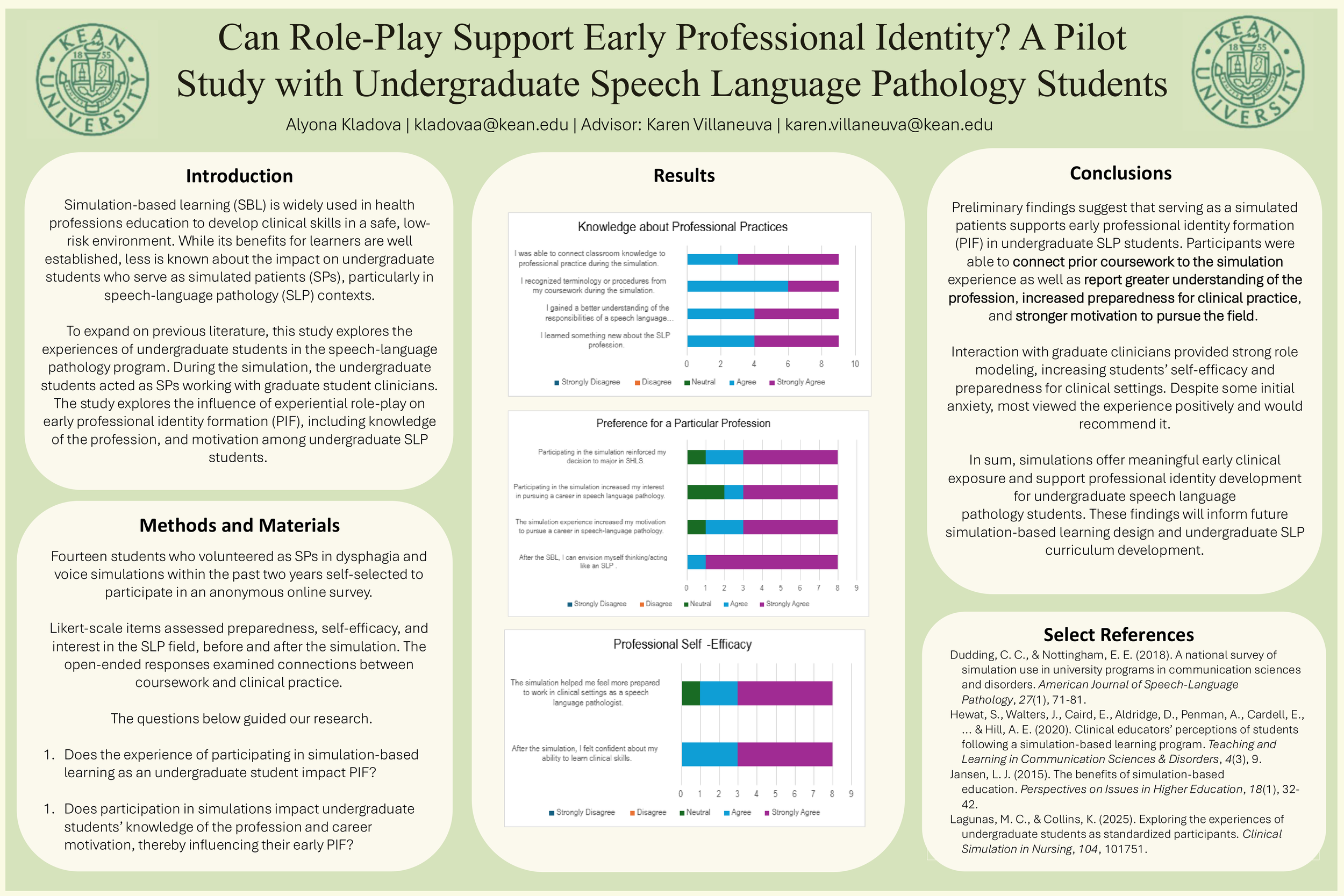
Simulation-based learning (SBL) is widely used in health professions education to support clinical skill development in a safe, low-risk environment. While the benefits of SBL for learners are well known, little is known about the benefits of undergraduate students acting as simulated patients (SPs), particularly in speech-language pathology (SLP) contexts.
This goal of this research is to explore how experiential role-play contributes to early professional identity development, knowledge of the profession, and motivation within the profession among undergraduate and preprofessional speech-language-hearing sciences students. Students who volunteered to participate as simulated patients in dysphagia and voice simulations within the past two years completed an anonymous survey regarding their experience. Quantitative data including Likert-scale measures were used to evaluate preparedness, confidence, interest in the SLP field, and open-ended questions were used to explore connections between coursework and clinical practice following participation in a simulated learning experience.
Preliminary analysis suggests that students were able to make connections between previous coursework and the SBL experience. Additionally, students reported that participation in the simulation deepened their understanding of the profession, contributed to them feeling more prepared for future clinical practice, and increased their motivation to pursue the field. Findings are expected to help guide the design of future simulation-based learning experiences in speech-language pathology contexts as well as inform curriculum design within the undergraduate program.