
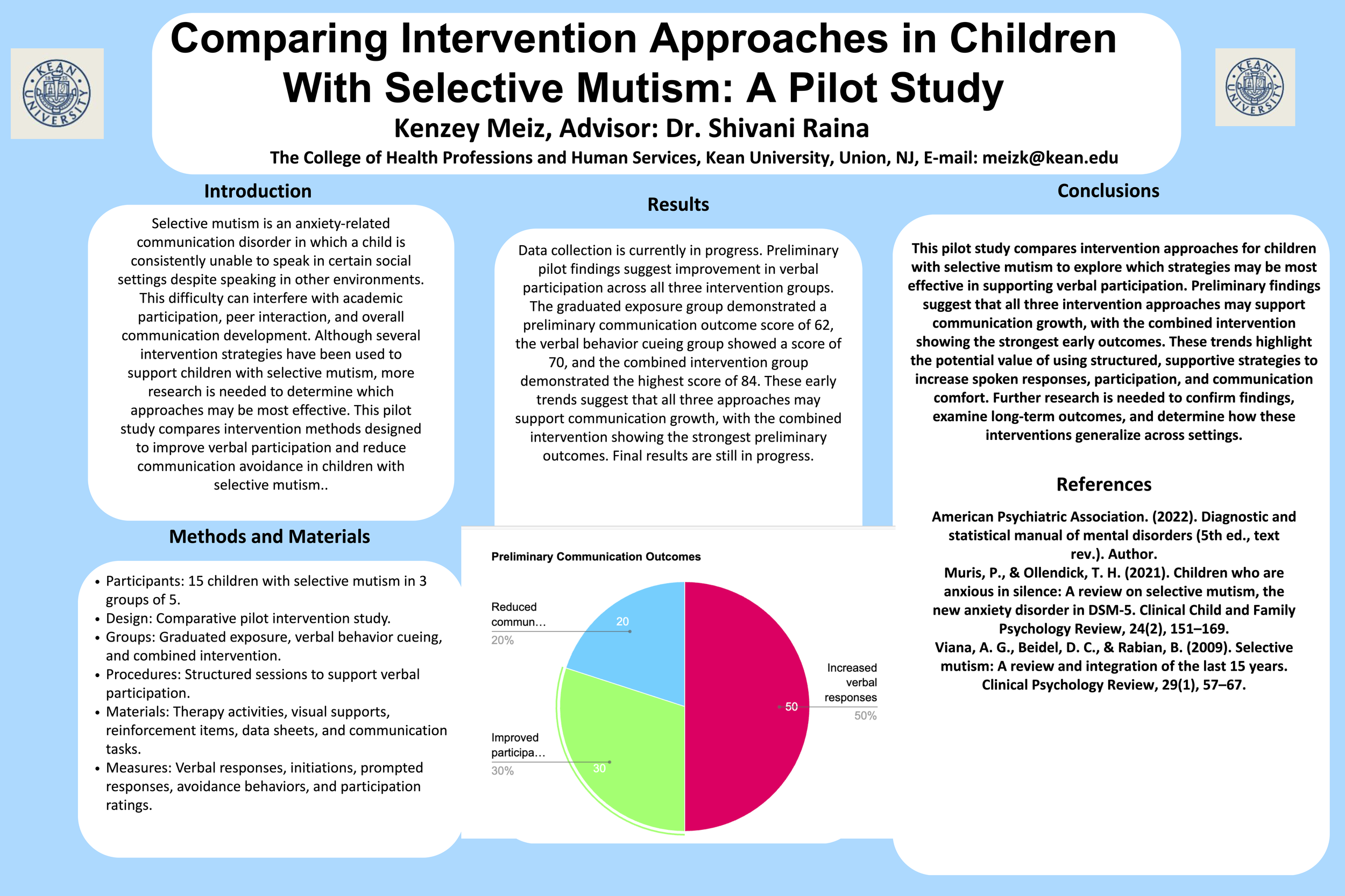
Comparing Intervention Approaches in Children With Selective Mutism: A Pilot Study
kenzey meiz
Co-Presenters: Individual Presentation
College: College of Health Professions and Human Services
Major: BA.SPCHLANG/HESCI
Faculty Research Mentor: Shivani Raina
Abstract:
Selective mutism (SM) is an anxiety-based communication disorder that significantly restricts a child’s verbal participation across educational and social contexts, often leading to long-term academic, emotional, and social consequences if left untreated. Despite growing awareness of SM, there remains a need for more empirically supported, clinically applicable intervention approaches within speech-language pathology.
This pilot study examines the clinical outcomes of a combined intervention model using Graduated Exposure (GE) and Verbal Behavior Cueing (VBC) to increase functional verbal communication in children with selective mutism. A single-subject design was employed to evaluate changes in verbal participation, avoidance behaviors, and communicative responsiveness across structured therapeutic contexts. Intervention procedures included systematic exposure hierarchies, reinforcement strategies, shaping, modeling, and clinician-mediated communication tasks. Data were collected through direct behavioral observation as well as parent and clinician report measures.
Preliminary findings indicate meaningful improvements in verbal engagement, increased spontaneous communication attempts, and reduced avoidance behaviors following implementation of the combined GE and VBC framework. These outcomes suggest that integrating behavioral exposure techniques with structured communication cueing may provide an effective, clinically feasible approach for supporting children with SM.
This research contributes to the growing body of trauma- and anxiety-informed intervention practices and offers practical implications for speech-language pathologists working with children who experience significant communication anxiety. The study supports the importance of early, evidence-based intervention to promote communicative competence, social participation, and overall well-being.