
Comparing the Effects of Static and Dynamic Stretching in Relation to Speed and Agility in Athletic Performance: A Narrative Review
Julien Pereira
Co-Presenters: Individual Presentation
College: College of Health Professions and Human Services
Major: MS.EXERCISESCI
Faculty Research Mentor: Pragya Sharma
Abstract:
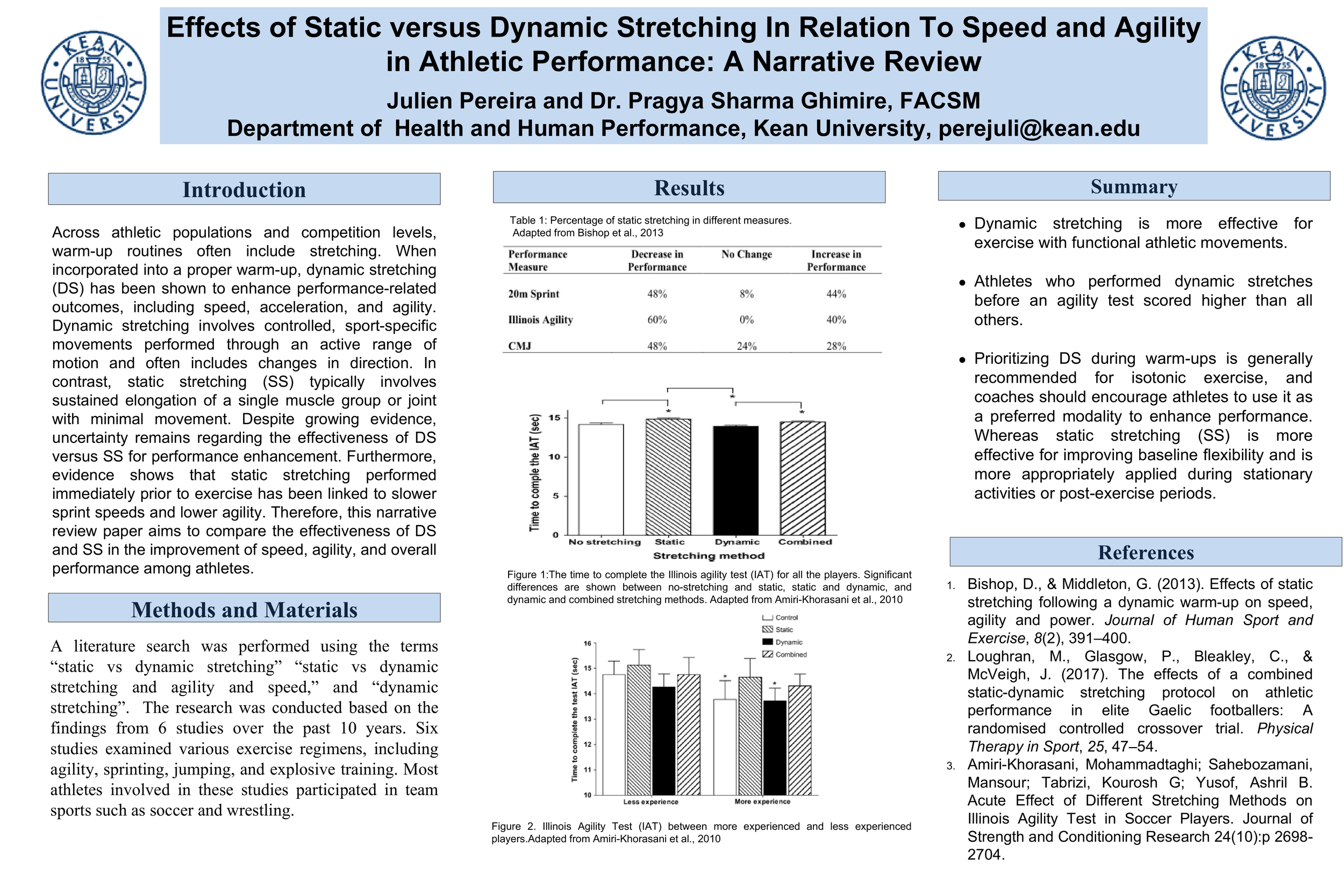
Introduction: Across athletic populations and competition levels, warm-up routines often include stretching. When incorporated into a proper warm-up, dynamic stretching (DS) has been shown to enhance performance-related outcomes, including speed, acceleration, and agility. Dynamic stretching involves controlled, sport-specific movements performed through an active range of motion and often includes changes in direction. In contrast, static stretching (SS) typically involves sustained elongation of a single muscle group or joint with minimal movement. Despite growing evidence, uncertainty remains regarding the effectiveness of DS versus SS for performance enhancement. Furthermore, evidence shows that static stretching performed immediately prior to exercise has been linked to slower sprint speeds and lower agility. Purpose: Therefore, this narrative review paper aims to compare the effectiveness of DS and SS in the improvement of speed, agility, and overall performance among athletes. Methods: A total of 25 Articles were gathered from PubMed, Scopus, and Google Scholar databases. Of the 35 articles, 15 were published in the past 10 years and were included in this narrative review. Results: We found that a warm-up with DS improves agility test times compared with static stretching or no warm-up. However, some evidence suggests that SS performed for a short duration (<30 seconds) makes no difference or, in rare cases, yields a small improvement in sprint performance compared to DS. However, evidence also indicates that short-duration static stretching (<30 s per muscle group) does not adversely affect performance and elicited marginal improvements in sprint performance when compared with dynamic stretching (DS). Performance outcomes in agility remained largely unchanged following static stretching (SS). Moreover, DS showed improvements in acceleration, sprint speed, and agility compared with the SS protocol in the team-sports population. Conclusions: Prioritizing DS during warm-ups is generally recommended for isotonic exercise, and coaches should encourage athletes to use it as a preferred modality to enhance performance. Whereas static stretching (SS) is more effective for improving baseline flexibility and is more appropriately applied during stationary activities or post-exercise periods.
Key Words: Stretching, Athletes, and Performance