
Deep Learning-Based Classification of Breast Cancer in Ultrasound Videos
Braulio Lora
Co-Presenters: Individual Presentation
College: Hennings College of Science Mathematics and Technology
Major: BS.COMPUTER/SCI
Faculty Research Mentor: Kuan Huang
Abstract:
Abstract:
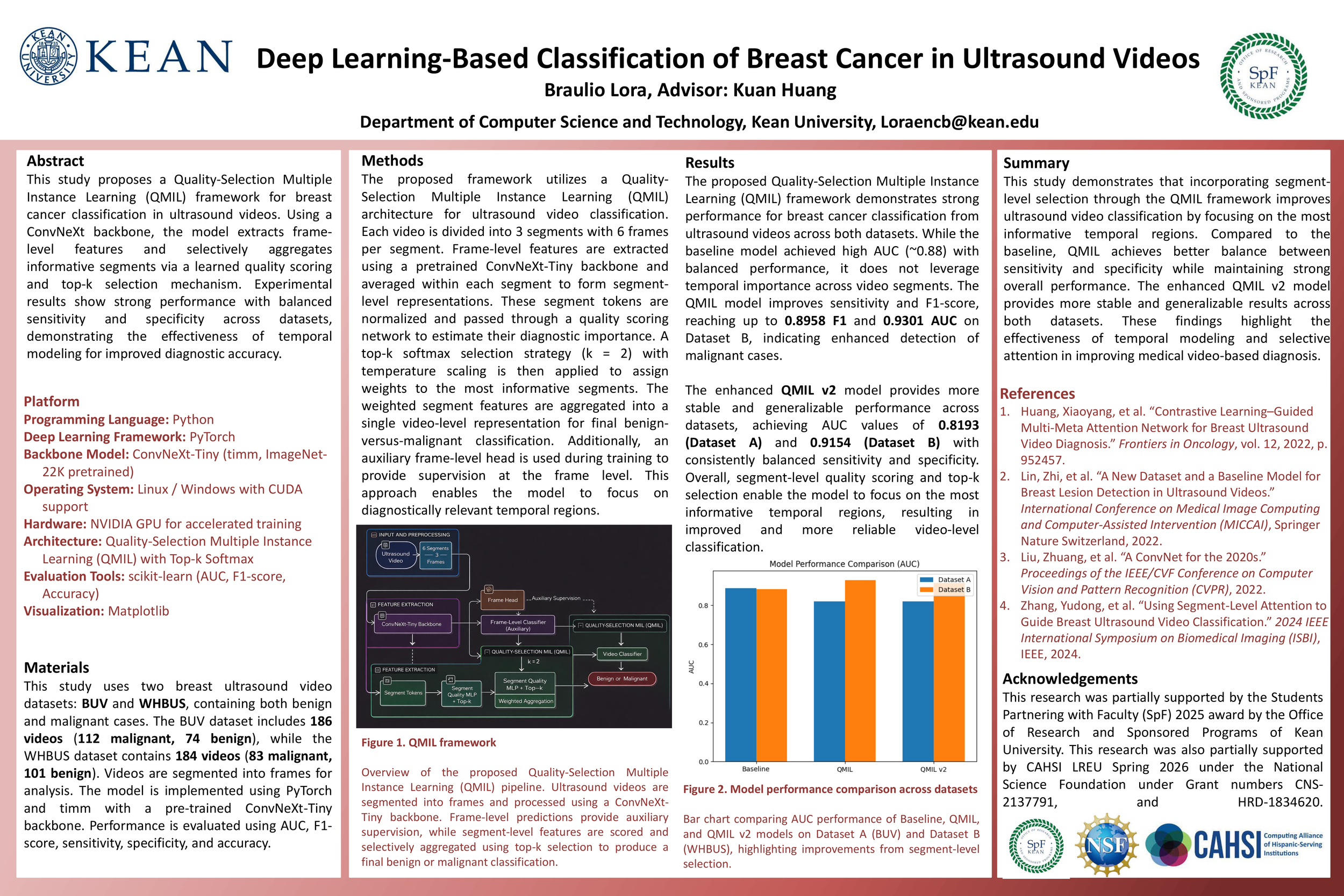
Breast cancer is still one of the most common types of cancer that kills women around the world. This is why it is so important to diagnose it early and correctly to improve patient outcomes. Ultrasound imaging is a popular way to diagnose conditions because it is easy to get, cheap, and doesn't hurt. But it can be hard to understand ultrasound data because of noise in the images, low contrast, and the fact that it depends on the operator. This study examines the application of deep learning methodologies to enhance the classification of breast cancer within ultrasound video data.
The primary objective of this study is to develop and evaluate a deep learning framework for distinguishing between benign and malignant breast tumors using ultrasound video data. Most existing research focuses on static ultrasound images; however, in clinical practice, ultrasound examinations are acquired as videos, making direct video-based classification more clinically meaningful. The proposed approach employs a hybrid convolutional and transformer-based neural network to model both spatial and temporal information. The framework is trained and evaluated on two publicly available breast ultrasound video datasets for cancer versus non-cancer classification. Model performance is assessed using standard classification metrics, including accuracy, precision, recall, F1-score, and the area under the receiver operating characteristic curve (AUC).
Initial findings indicate that integrating temporal data from ultrasound videos enhances classification efficacy relative to single-frame image-based methods. The model demonstrates significant potential in precisely detecting malignant tumors while preserving elevated sensitivity, which is essential in clinical screening environments. These results indicate that deep learning-based analysis of ultrasound videos can improve diagnostic accuracy and assist clinicians in the detection of breast cancer. Future efforts will concentrate on enhancing temporal modeling techniques, increasing dataset diversity, and investigating the real-time clinical implementation of the proposed system.
Keywords: Breast Cancer, Ultrasound Videos, Deep Learning, Medical Imaging, Tumor Classification