
Digital government Development: comparing United States and Bangladesh
Reshat Sultana Joty
Co-Presenters: Individual Presentation
College: College of Business and Public Management
Major: MPA.PUBAD-HEALTHMGMT
Faculty Research Mentor: Bok Gyo Jeong
Abstract:
Abstract:
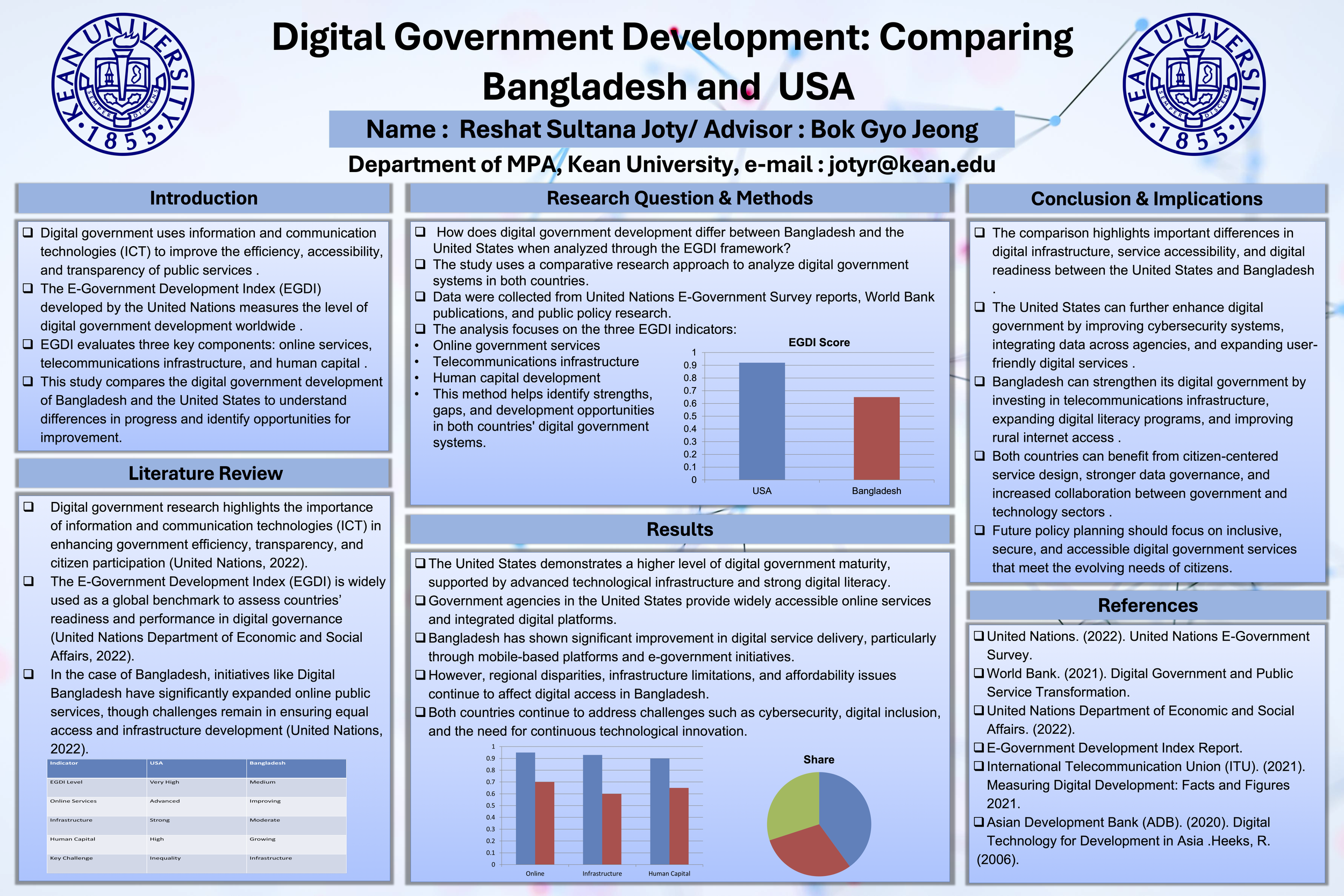
Digital government plays a critical role in improving public service delivery, transparency, and citizen
engagement. This poster presents a comparative analysis of digital government development in
Bangladesh and the United States using the E-Government Development Index (EGDI) as a key
framework. The EGDI measures a country’s digital readiness based on online services,
telecommunications infrastructure, and human capital.
The United States demonstrates a high level of digital maturity, supported by advanced infrastructure, a
skilled workforce, and a wide range of online public services. However, challenges remain, including
service fragmentation across states, digital divides affecting rural and low-income populations, and
complex user interfaces. In contrast, Bangladesh, while ranking at a mid-level EGDI score, has made
rapid progress through mobile-first strategies, centralized platforms, and expanding digital access.
Ongoing challenges include infrastructure limitations, affordability, digital skills gaps, and cybersecurity
needs.
This comparison highlights how different development paths shape digital governance outcomes.
Bangladesh can benefit from the U.S.’s experience in cybersecurity, data protection, and long-term
infrastructure planning, while the United States can learn from Bangladesh’s simplified, centralized, and
mobile-friendly service models. Overall, the findings suggest that successful digital government depends
not only on technological advancement but also on accessibility, usability, and inclusive design