
Do Speakers Who Produce More Words in a Category Fluency Task Also Rate Themselves as More Fluent
Kamer Othman
Co-Presenters: Emely Conza, Nicole Acevedo
College: College of Health Professions and Human Services
Major: MA.SPEECH-LNGPATH
Faculty Research Mentor: Anne Neveu
Abstract:
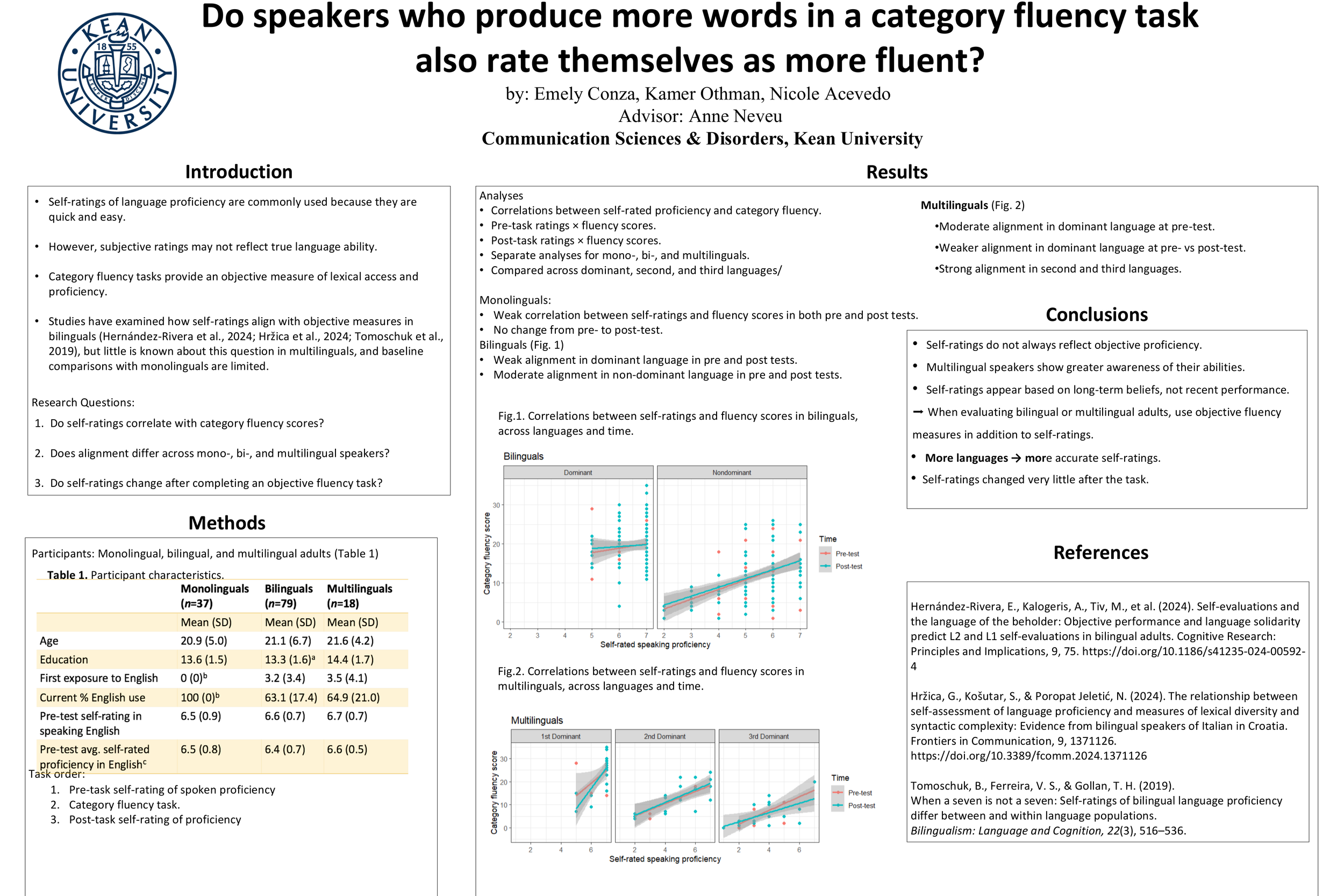
Self-rated language proficiency scales are widely used in multilingual research due to their efficiency and ease of administration; however, evidence suggests that these ratings may not consistently reflect objective language performance. Category fluency tasks are used to objectively assess lexical access and language proficiency in adults by measuring how many words an individual can rapidly produce within a semantic category. The present quantitative study examines changes in self-rated language proficiency from pre-task to post-task and their alignment with category fluency performance. Participants include monolingual, bilingual, and multilingual adults aged who completed a language background questionnaire, with self-ratings of proficiency collected both before and after performing a category fluency task. Planned analyses include correlations between pre-task self-rated proficiency and category fluency scores, as well as correlations between post-task self-rated proficiency and category fluency scores in order to evaluate whether exposure to an objective measure influences self-perception of language ability. It is hypothesized that pre-task self-ratings will vary in accuracy and may not reflect participants’ objective proficiency, whereas post-task self-ratings will show stronger alignment with category fluency performance. These expected findings will help clarify whether perceived language ability more closely reflects actual performance after completing an objective task. Practically, this work will inform the extent to which self-reported proficiency can serve as a meaningful descriptor of language ability when interpreted alongside an objective measure in both research and clinical decision-making contexts, particularly in studies involving multilingual populations.
Keywords
Self-rated proficiency; Multilingualism; Lexical access; Category fluency