
Does High Passive ETF Concentration Impact Stock Market Efficiency?
Andy Gavino
Co-Presenters: Brandon Perez, Christian Bernabe, Shion Mabuchi
College: College of Business and Public Management
Major: BS.FINANCE
Faculty Research Mentor: Bo Wang
Abstract:
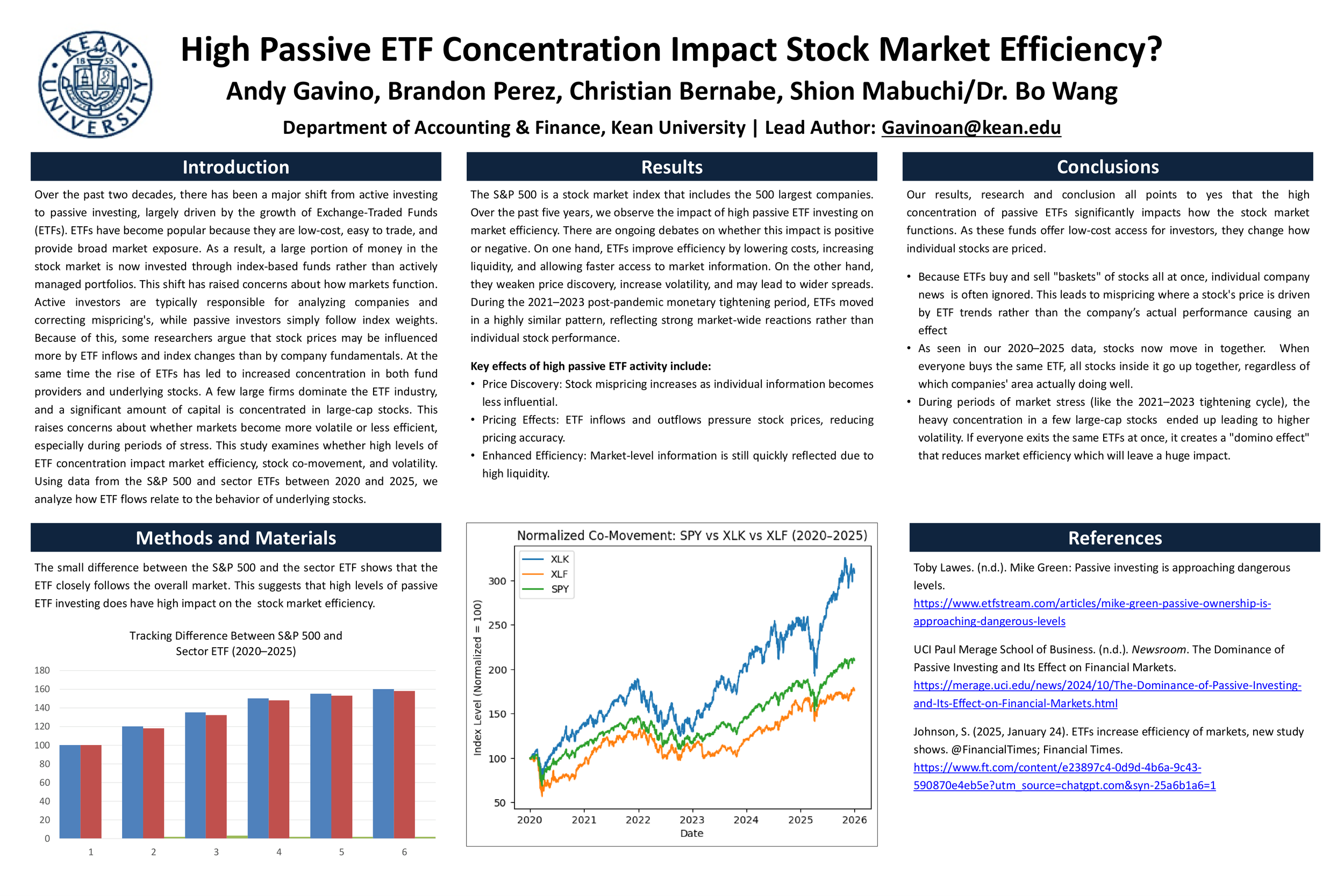
Since the global financial shift toward passive management, Exchange Traded Funds(ETF's) have become central to modern portfolio construction. This growth has led to dual layered concentration: the dominance of a few large providers (Blackrock, Vanguard, State Street) and the concentration of capital into a narrow subset of underlying mega cap securities. This research investigates how ETF concentration influences market liquidity and price discovery during periods of volatility.
Using comparative analysis of the S&P 500 and sector specific ETFs from 2020 to 2025, this study employs a regression-based approach to measure the "beta herding" effect. The research design analyzes the correlation between ETF flows and the volatility of the underlying "basket" securities, specifically focusing on whether concentrated ownership intensifies liquidity dry ups during market stress.
Preliminary findings suggest that high ETF concentration creates a "liquidity mismatch," where the perceived liquidity of the ETF share does not reflect the increasing illiquidity of the underlying assets. The results indicate that when a small number of Authorized Participants (APs) dominate primary market activity, systemic risk increases due to potential bottlenecks in the creation and redemption process. These findings offer critical insights for regulators and institutional investors who must account for concentration risk in an increasingly top heavy market.