
Does Social Media Use and Perceived Loneliness Predict Student FoMO?
Zunaira Khan
Co-Presenters: Individual Presentation
College: College of Liberal Arts
Major: BA.PSYCHOLOGY
Faculty Research Mentor: Peri Yuksel, Nicolas Zapparrata
Abstract:
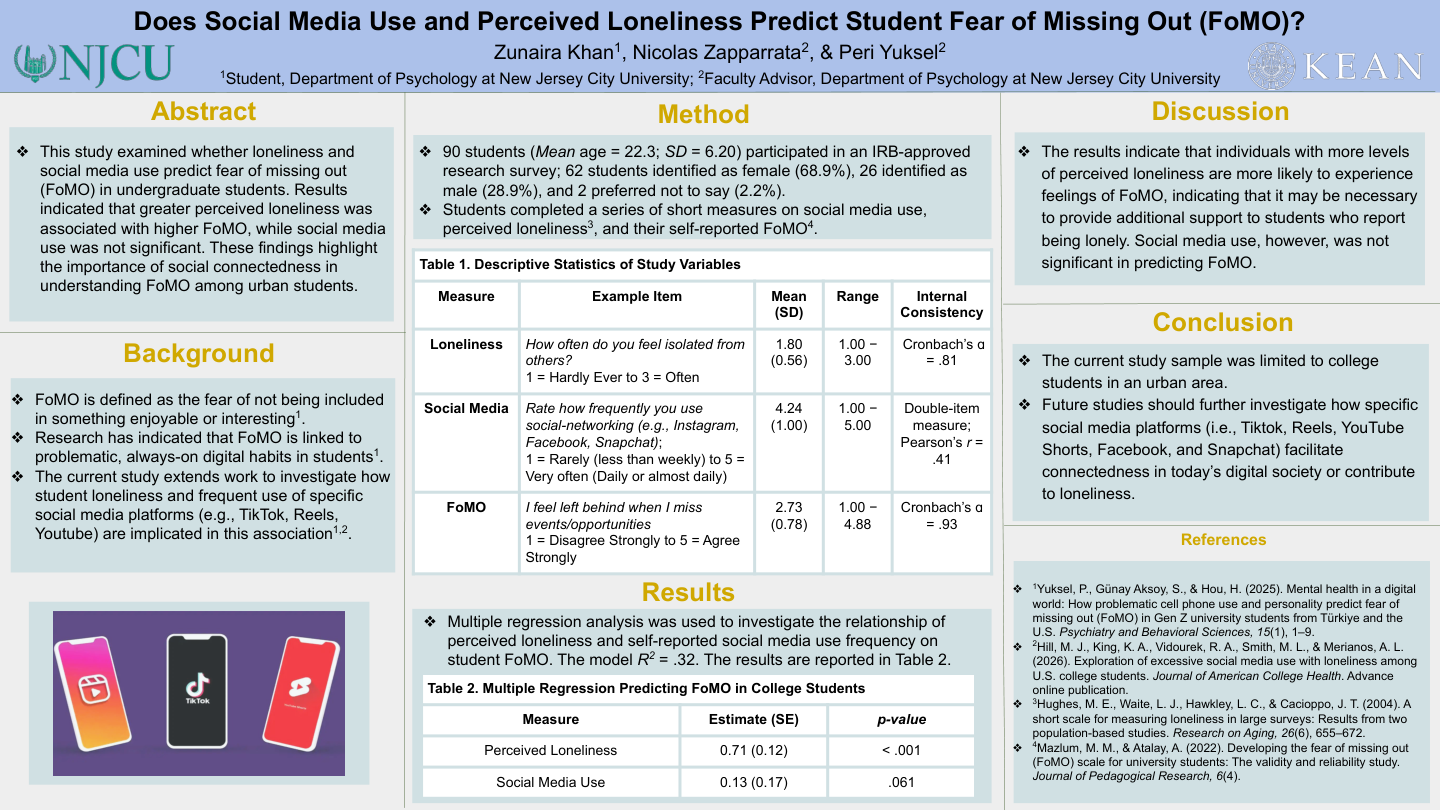
Research has indicated that fear of missing out (FoMO or the fear of not being included in something enjoyable or interesting) is linked to problematic, always-on digital habits in Gen-Z students. The current study extends work on FoMO to investigate how student loneliness and frequent use of specific social media platforms (e.g., TikTok, Reels, Youtube) are implicated in this association.
A total of 91 undergraduate students participated in an IRB-approved research survey. Students completed a series of short, validated measures on social media use and their self-reported FoMO and perceived loneliness.
Multiple linear regression was conducted in RStudio using social media use and loneliness as variables in predicting FoMO. The results indicated that high rates of perceived loneliness are associated with more FoMO (beta = .73; p-value < .001), as is increased social media use (beta = .16; p-value = .021).
The results indicate that individuals with more levels of perceived loneliness are more likely to experience feelings of FoMO, indicating that it may be necessary to provide additional support to students who report being lonely. Social media use, however, was not significant in predicting FoMO. Future studies should further investigate how specific social media platforms (i.e., Tiktok, Reels, YouTube Shorts, Facebook, and Snapchat) facilitate connectedness in today’s digital society or contribute to loneliness.
Keywords: FoMO, Social media, Loneliness, Technology