
Economic Policy Uncertainty and Chinese Housing Prices
Yanan Li
Co-Presenters: Individual Presentation
College: College of Business and Public Management
Major: BS.FINANCE
Faculty Research Mentor: Nazif Durmaz
Abstract:
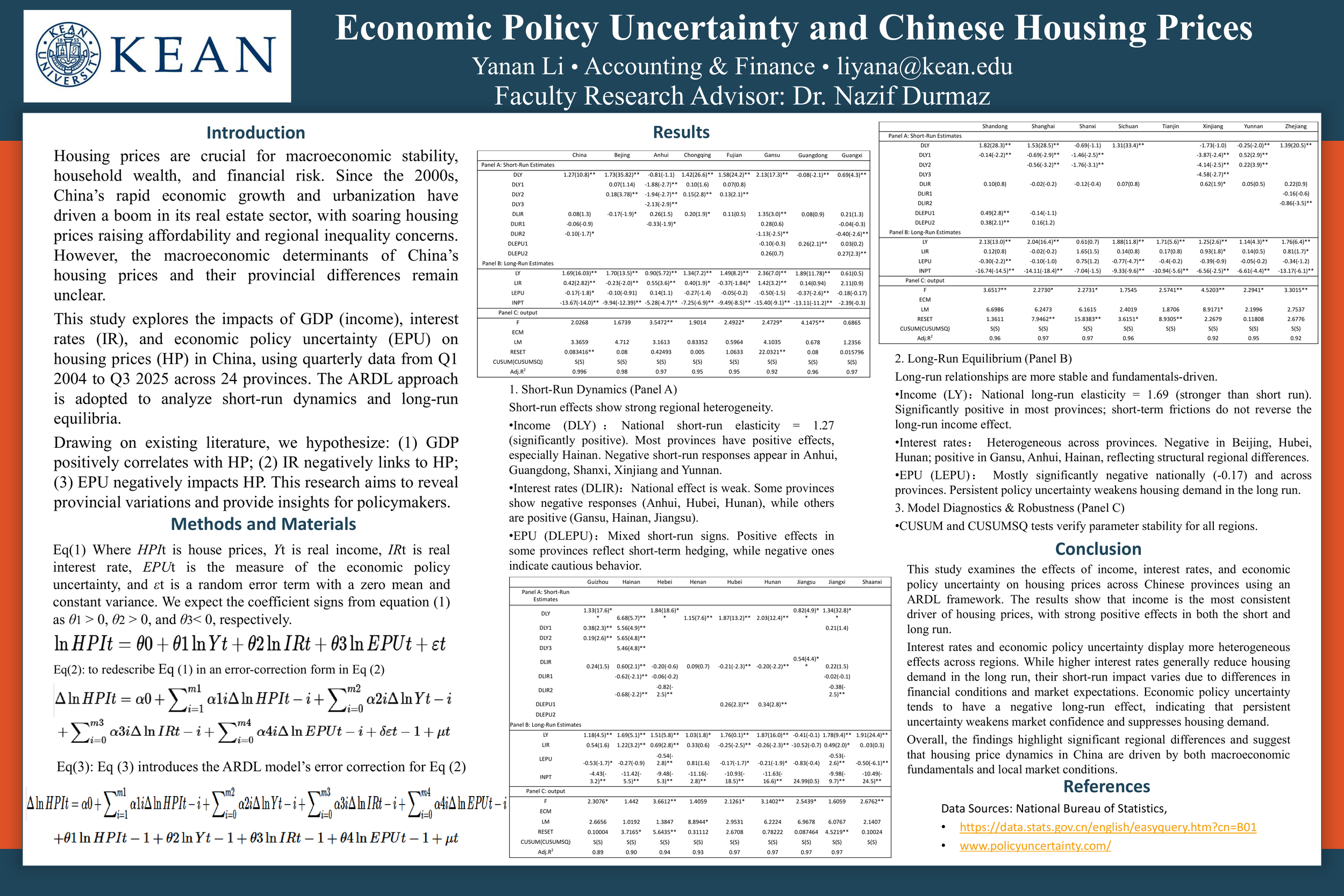
This study examines the impacts of income (GDP), interest rates (IR), and economic policy uncertainty (EPU) on housing prices (HP) in China, using quarterly data from Q1 2004 to Q3 2025. The analysis spans 22 provinces, excluding Inner Mongolia, Jilin, Liaoning, Ningxia, Shaanxi, Tianjin, Tibet, Taiwan, Hong Kong, and Macao. To model short-run dynamics and long-run equilibria, the paper applies the Autoregressive Distributed Lag (ARDL) approach, ideal for time-series with mixed integration orders and capable of estimating adjustments and effects simultaneously.
A robust literature emphasizes macroeconomic fundamentals like income growth and interest rates in driving housing prices (Égert & Mihaljek, 2007; Goodhart & Hofmann, 2008). Rising incomes boost purchasing power and borrowing, fueling demand and upward price pressure. In China, housing dominates household wealth, making price shifts vital for finances and consumption (Xie & Jin, 2015). Interest rates influence prices via mortgage costs, with elevations curbing borrowing and growth (Iacoviello, 2005). Beyond these, EPU has gained prominence in affecting activity and assets (Bloom, 2009). Baker, Bloom, and Davis (2016) developed a key EPU measure, linking spikes to reduced investment and output. While EPU's effects on finance and firms are established, its housing implications are emerging.
Drawing on theory and evidence, this study hypothesizes: (1) GDP positively correlates with housing prices due to growth-driven demand; (2) Interest rates negatively link to prices via higher costs suppressing demand; and (3) EPU negatively impacts prices by eroding confidence and delaying decisions.
China's housing market shows marked regional differences in development, finance, and policy response. National data may mask provincial variations. Using provincial data in an ARDL framework, this research offers fresh insights into these factors' effects, aiding policymakers in navigating risks amid uncertainty.