
Effects of Light Intensity and Nitrogen Deficiency in Greenhouse Grown Bean Crops
Anastasia Grubyak
Co-Presenters: Individual Presentation
College: Hennings College of Science Mathematics and Technology
Major: BS.BIO/CELL/MOLEC
Faculty Research Mentor: Sasmita Mishra
Abstract:
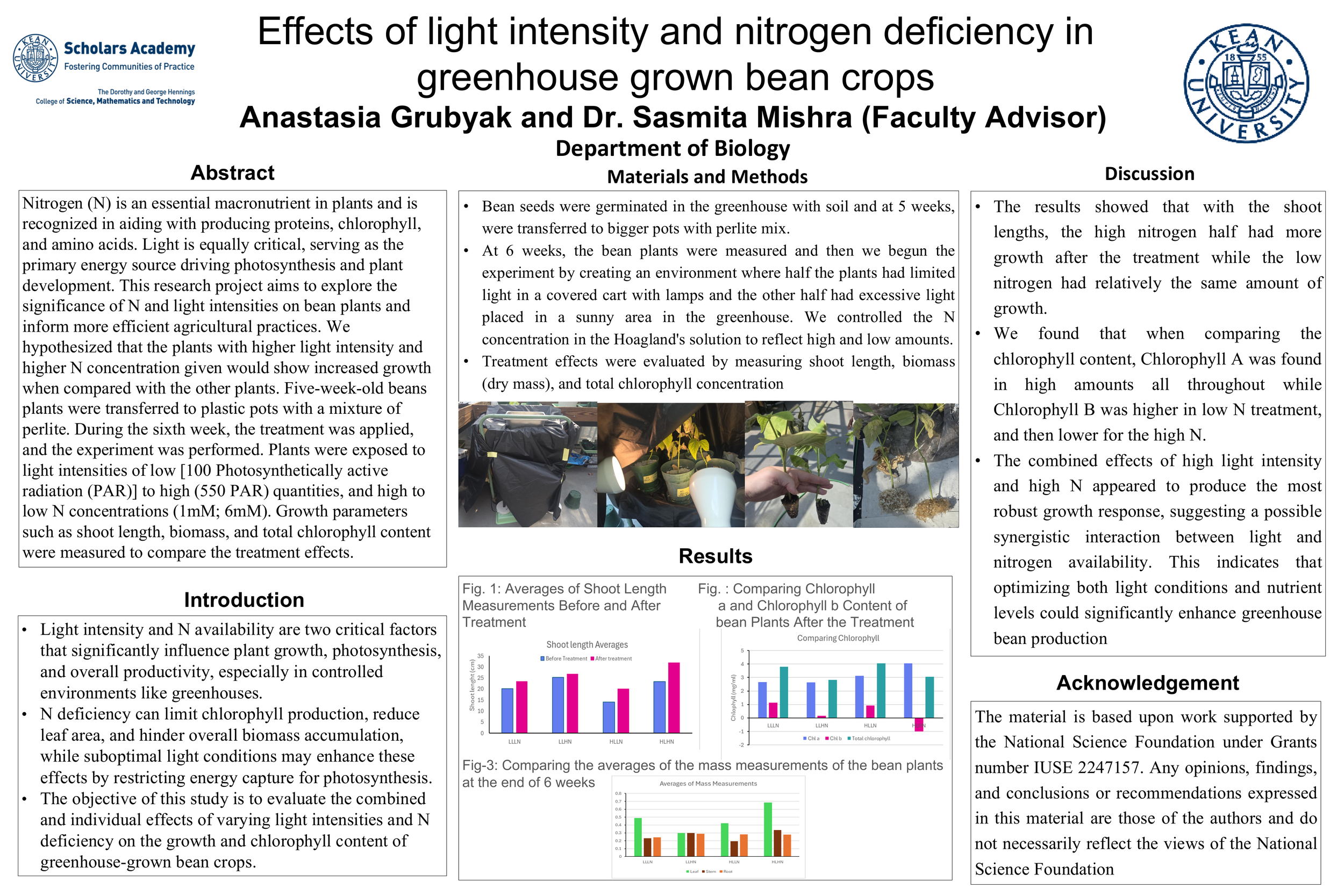
Nitrogen (N) is an essential macronutrient in plants and is recognized for aiding with producing proteins, chlorophyll, and amino acids. Light is equally critical, serving as the primary energy source driving photosynthesis and plant development. This research project aims to explore the significance of nitrogen and light intensities on bean plants and inform more efficient agricultural practices. We hypothesized that plants with higher light intensity and higher nitrogen concentration given would show increased growth when compared with the other plants. Five-week-old bean plants were transferred to plastic pots with a mixture of perlite. A subset of plants was exposed to light intensities of low (LL, 1.0 kflux) to high quantities (HL, 5.5 kflux), and high (6mM) to low (1mM) N concentrations. Growth parameters, including shoot length, biomass, and total chlorophyll content, were measured to compare the treatment effects. High light and high N supported longer shoots than low light. Similarly, leaf mass was maximum under high-light intensity, and high N-treated plants. Surprisingly, root biomass remained almost the same in both light intensity and N-treated plants. Our study conclude that light intensity does affect the N-uptake, and in our future study, we will compare N- uptake proteins to correlate the effects of light intensity on overall. N-uptake.
Key Words: Biomass, Light, Nitrogen