
Effects of silibinin and silymarin on the olfactory learning in Caenorhabditis elegans
Aneri Mehta
Co-Presenters: Individual Presentation
College: Hennings College of Science Mathematics and Technology
Major: MS.BIOTECH/SCI
Faculty Research Mentor: Renalison Farias Pereira
Abstract:
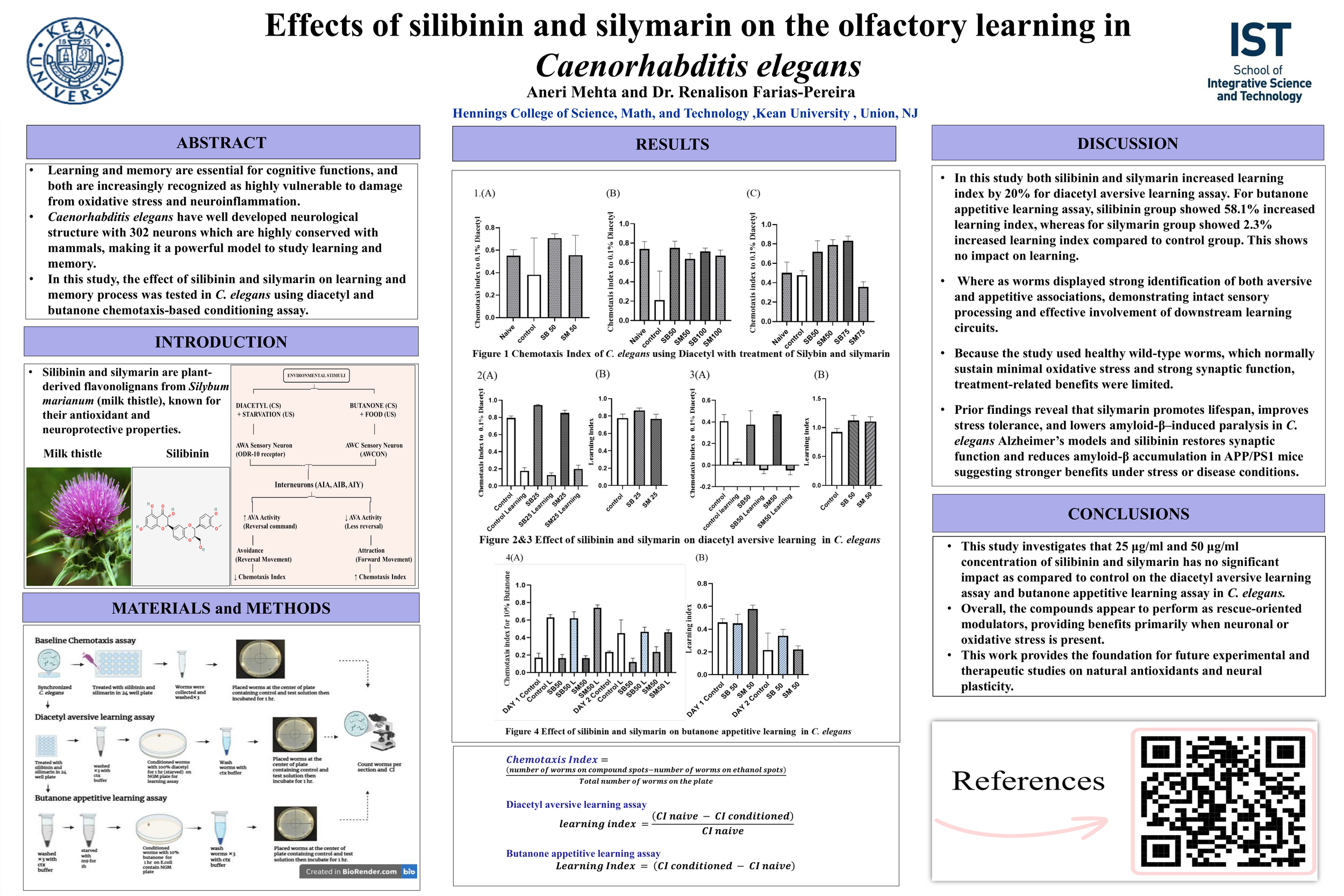
Learning and memory are internal neural processes that can observe and analyze behavioral responses with the change of environment. Learning and memory are essential for cognitive functions, and both are increasingly recognized as highly vulnerable to damage from oxidative stress and neuroinflammation. The natural flavonoid silibinin and silymarin from Silybum marianum show promising results in neuroprotection. Caenorhabditis elegans have well developed neurological structure with 302 neurons which are highly conserved with mammals, makes it a powerful model to study learning and memory. In this study, the effect of silibinin and silymarin on learning and memory process was tested in C. elegans using diacetyl and butanone chemotaxis-based learning assay. This behavioral paradigm of associative learning is measured by placing worms on chemotaxis plate at the center containing odor spots (diacetyl or butanone) and 95% ethanol placed opposite each other. After incubation, number of worms are counted then chemotaxis index and learning index are calculated for each group. Worms were treated with 50 µg/µL silibinin or silymarin then tested for chemotaxis processes. In a diacetyl aversive learning assay, worms that were conditioned with starvation paired with diacetyl showed reduced chemotaxis response as compared to without conditioning. The butanone pairing with food as conditioning strengthens the attraction towards butanone and shows butanone appetitive learning in C. elegans as compared to non-conditioned group. In comparison to the control, both silibinin and silymarin increased by 20% learning index for diacetyl aversive learning assay. For butanone appetitive learning assay, silibinin group showed 58.1% increased learning index, whereas for silymarin group showed 2.3% increased learning index compared to control group. The treated groups had a slightly higher learning index than the control group, but the difference was not statistically significant. These results suggest that silibinin and silymarin may have subtle or context-dependent effects on learning-related behaviors in C. elegans, and highlight the importance of investigating how these antioxidants alter neuronal activity under various situations or stresses.
Keywords: Caenorhabditis elegans, Learning and memory, Silibinin, Silymarin, Chemotaxis behavioral