
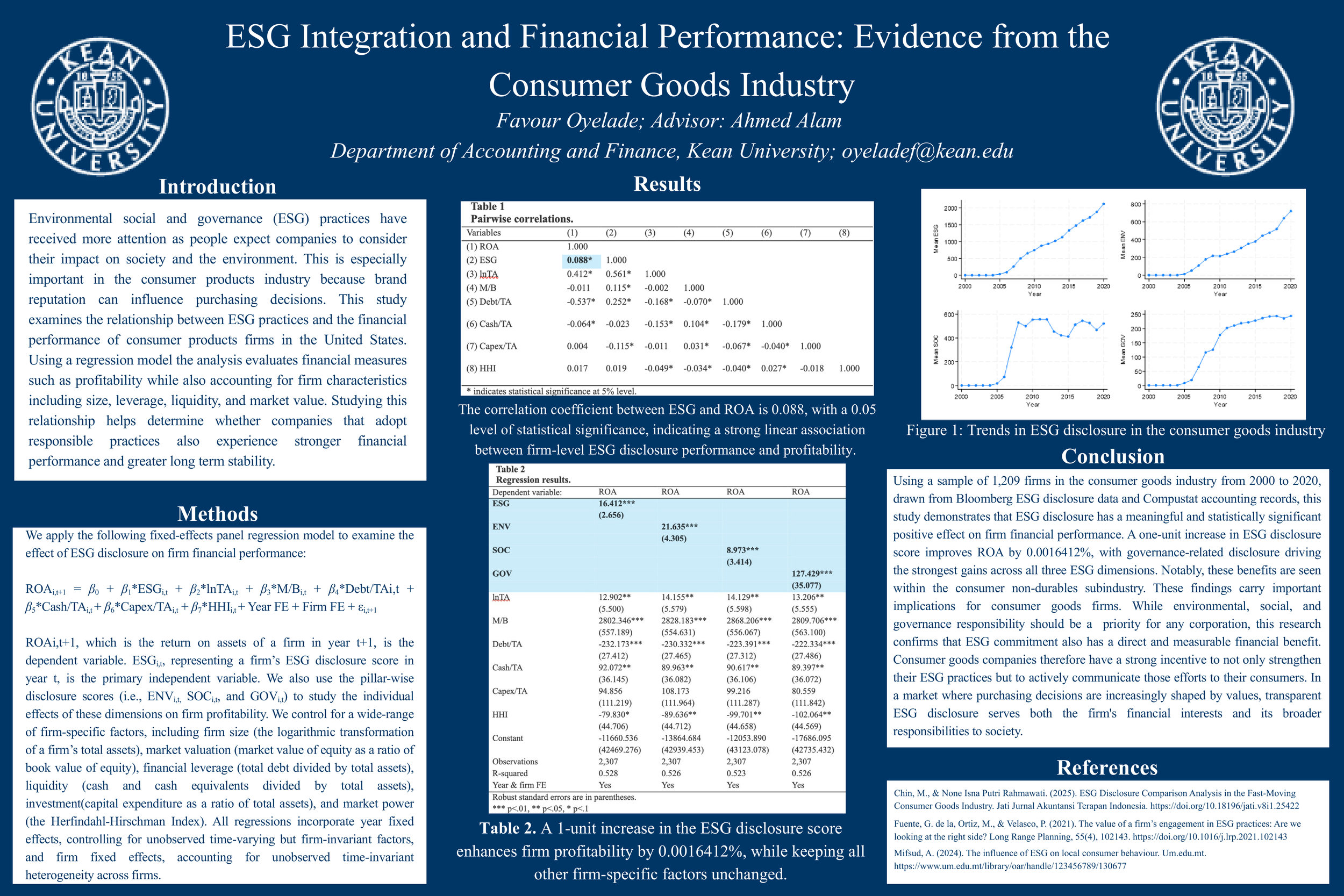
ESG Integration and Financial Performance: Evidence from the Consumer Goods Industry
Favour Oyelade
Co-Presenters: Individual Presentation
College: College of Business and Public Management
Major: BS.ACCOUNTING
Faculty Research Mentor: Ahmed Alam
Abstract:
Environmental, social, and governance (ESG) integration has become an essential component of corporate strategy as consumers increasingly expect companies to operate responsibly and address environmental, social, and ethical concerns. These expectations are especially pronounced in the consumer products industry, where brand reputation significantly influences purchasing decisions. This study investigates the relationship between ESG integration and the financial performance of U.S. consumer products firms. Using panel data models and performance metrics such as profitability and operational efficiency, the analysis assesses whether higher ESG ratings are associated with stronger corporate performance. The empirical framework incorporates a broad set of firm-level characteristics—including size, debt, liquidity, market value—and relevant macroeconomic factors to ensure robust results. Findings are expected to show that firms with stronger ESG profiles exhibit greater profitability and financial stability, highlighting the tangible economic benefits of ethical and sustainable business practices. Overall, the study argues that ESG integration should be a strategic priority not only for ethical reasons but also for promoting long‑term financial sustainability
Keywords: ESG, Consumer Goods Industry, Sustainable Financial Performance