
Evaluating Anti-Inflammatory Potential of Oryza Sativa Extract Against Triple Negative Breast Cancer Cells
Ashley Crespo
Co-Presenters: Individual Presentation
College: Hennings College of Science Mathematics and Technology
Major: BA.CHEMISTRY
Faculty Research Mentor: Donald Ross
Abstract:
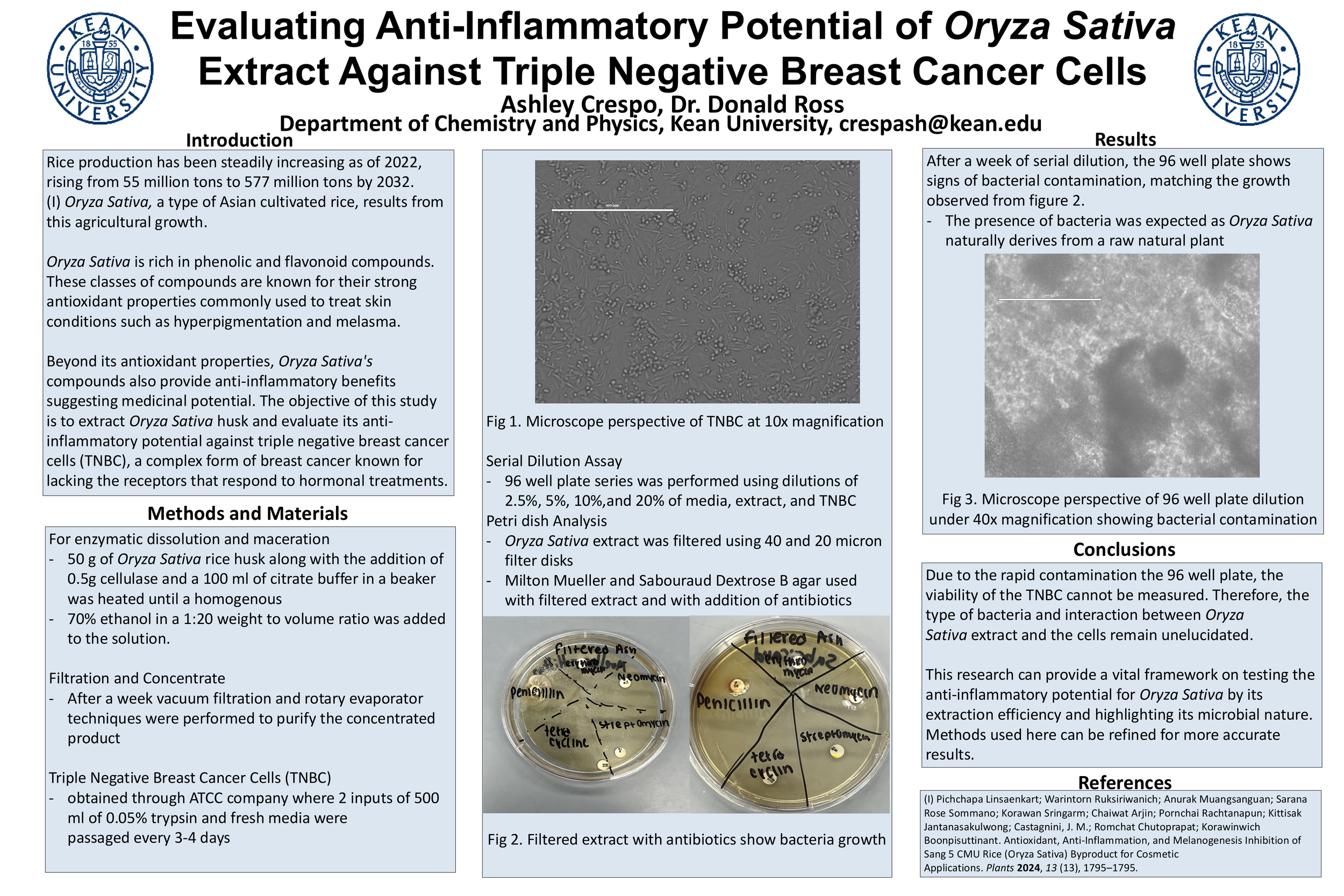
Oryza Sativa is an Asian cultivated rice that is rich in antioxidants. The antioxidant properties are utilized cosmetically against uncontrolled melanogenesis, such as hyperpigmentation. Recent studies suggested that flavonoids and phenolic compounds play a role in anti-inflammatory properties as well as potential anticancer activity. Focusing on triple-negative breast cancer cells, this is a type of cancer that lacks receptors that respond to known hormonal treatments, making it challenging to treat. This study focuses on exploring the antioxidant effects of Oryza Sativa husk on triple-negative breast cancer cells through microbiological techniques.
Finely powdered rice husks were heated along with the addition of cellulase with a citrate buffer. 70% ethanol, following a 1:20 weight-to-volume ratio, was added for maceration of the husk. The rice husk was subjected to vacuum filtration and physical separation processes to obtain rice oil. To remove residual alcohol, a rotary evaporator was used to concentrate the liquid rice husk extract. Triple-negative breast cancer cells were obtained from Kean University following a passaging process of trypsin and media every 3-4 days. TN-BC cells were evaluated with a dilution of rice husk in a 96-well plate series. Petri dish analysis using various agar media tested against concentrated risk husk extract was performed to identify the risk of bacterial growth.
Analysis of the petri dishes revealed variable growth of bacteria with rice husk oil. In terms of TN-BC comparison, a rise in bacterial growth was seen in different dilutions of breast cancer and extract mixtures. Results on high and low concentrations of the rice husk remained elusive due to unidentified bacterial contamination days after the investigation began. Identification of bacterial species will need specialized bacterial profiling to differentiate extracts of natural microbial products and environmental contamination. Overall, the study aims to provide a foundation supporting the potential effects of Oryza Sativa husk on breast cancer cells. Further research that prioritizes aseptic refinement is recommended to evaluate this relationship and find other links with diverse types of cancer.
Keywords: Oryza Sativa, Breast Cancer, Cell Viability, Extraction, Cytotoxicity