
Examining the Presence and Survivability Threshold of Tropical Fish at Manasquan River, PPB, NJ
Kevin Billy
Co-Presenters: Individual Presentation
College: Hennings College of Science Mathematics and Technology
Major: BS.ENVIRSCI
Faculty Research Mentor: John Wnek
Abstract:
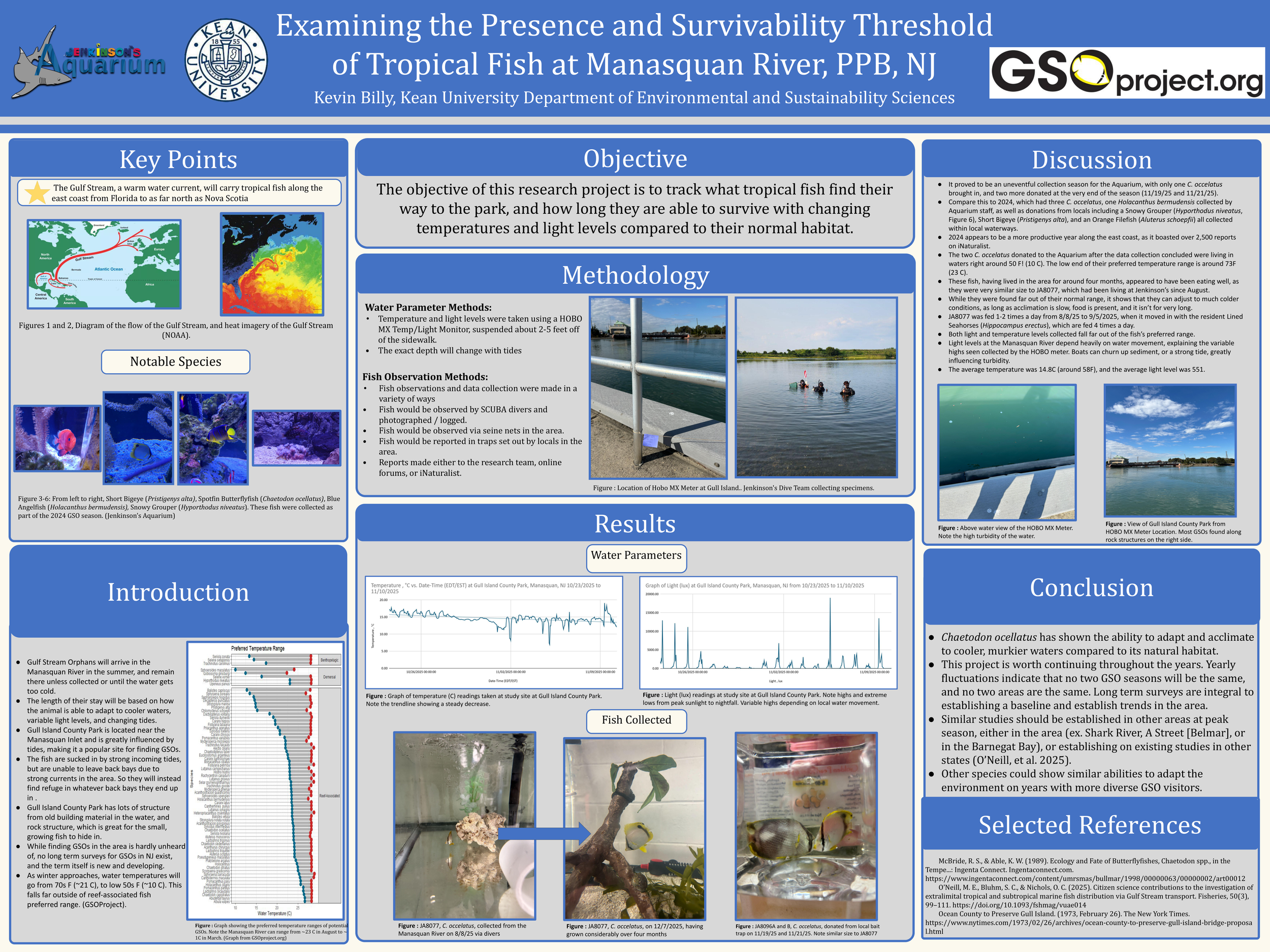
The Gulf Stream is a warm water current that begins in the Gulf of Mexico and flows along the eastern seaboard of the United States. This brings warm water up the coast, and in some places it has a great effect on the local climates. Another effect of this is that the current will carry tropical fish and other organisms with it as it travels. These fish can be seen as far south as Florida, to as north as Massachusetts, and in some cases even the edge of Nova Scotia. These fish, commonly referred to as “Gulf Stream Orphans” or GSOs, add a novel level of biodiversity to the east coast, as it showcases their ability to adapt to new habitats. Unfortunately, these favorable conditions do not last as winter approaches and water temperature drastically drops. This will usually lead to the death of the fish after a certain point, without the intervention of local hobbyists or professional aquarists. This project will explore the tropical fish population in the Manasquan River, which is on the border of Monmouth and Ocean counties, NJ. Thanks to increased citizen science and an increased understanding of the Gulf Stream, the data around this topic is becoming much more attainable. We found that certain species, such as Chaetodon ocellatus (Spotfin Butterflyfish), continued to survive despite decreasing temperatures, with specimens being found even after data collection ceased.