
From Structure to Redox: The Chemistry of Niacinamide
Aseel Albibi
Co-Presenters: Individual Presentation
College: Hennings College of Science Mathematics and Technology
Major: BS.FORENSIC/SCI/CHEM
Faculty Research Mentor: Matthew Mongelli, Heather L Stokes-Huby
Abstract:
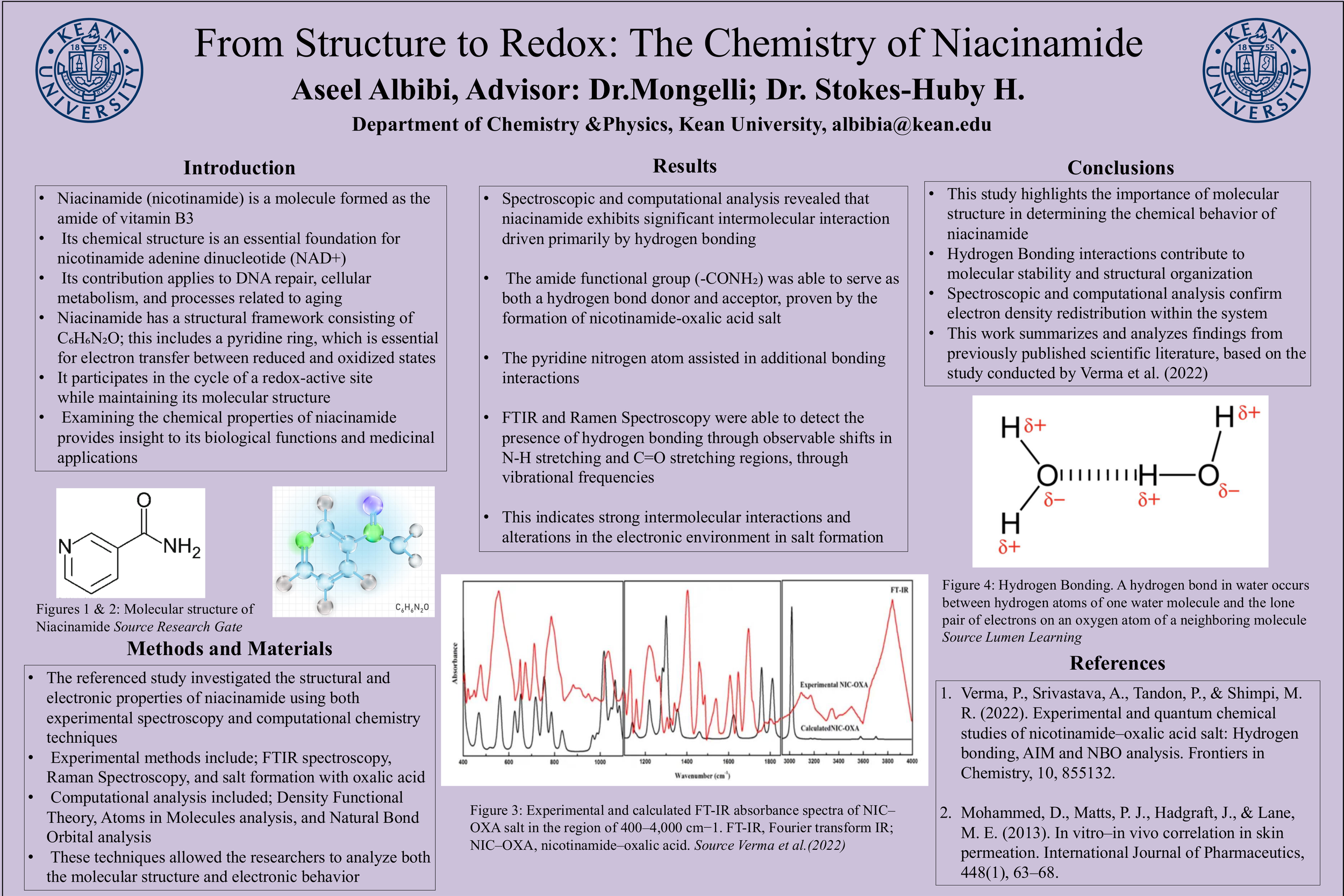
Niacinamide (Nicotinamide) is a molecule formed as the amide of vitamin B3, and its chemical structure is an essential foundation for nicotinamide adenine dinucleotide, NAD+. Its contribution applies to DNA repair, metabolism, and processes related to aging. Niacinamide has a structural framework consisting of C6H6N2O; this includes a pyridine ring, which is an essential factor in balancing back and forth between the reduced and oxidized states of electrons. In other words, it participates in the cycle of a redox-active site while maintaining its molecular structure. The objective of exploring nicotinamide is to focus on the ability of the molecules’ binding interactions with various solvents and environments to repair skin disorders, including modulating inflammatory conditions, acting as a protective property that enhances clinical outcomes. This paper dives deep into the chemical structure, stability, reactivity, synthesis, and medicinal relevance of niacinamide (vitamin B3). The continuation of its research is necessary to maximize its full range of benefits as a foundation for comprehending how chemical environments influence molecular behavior.