
Hybrid-DP Diffusion for Privacy-Preserving WiFi CSI Biometric Template Generation
Chang Lu
Co-Presenters: Individual Presentation
College: Hennings College of Science Mathematics and Technology
Major: BS.COMPUTER/SCI
Faculty Research Mentor: Bin Hu, Daehan Kwak
Abstract:
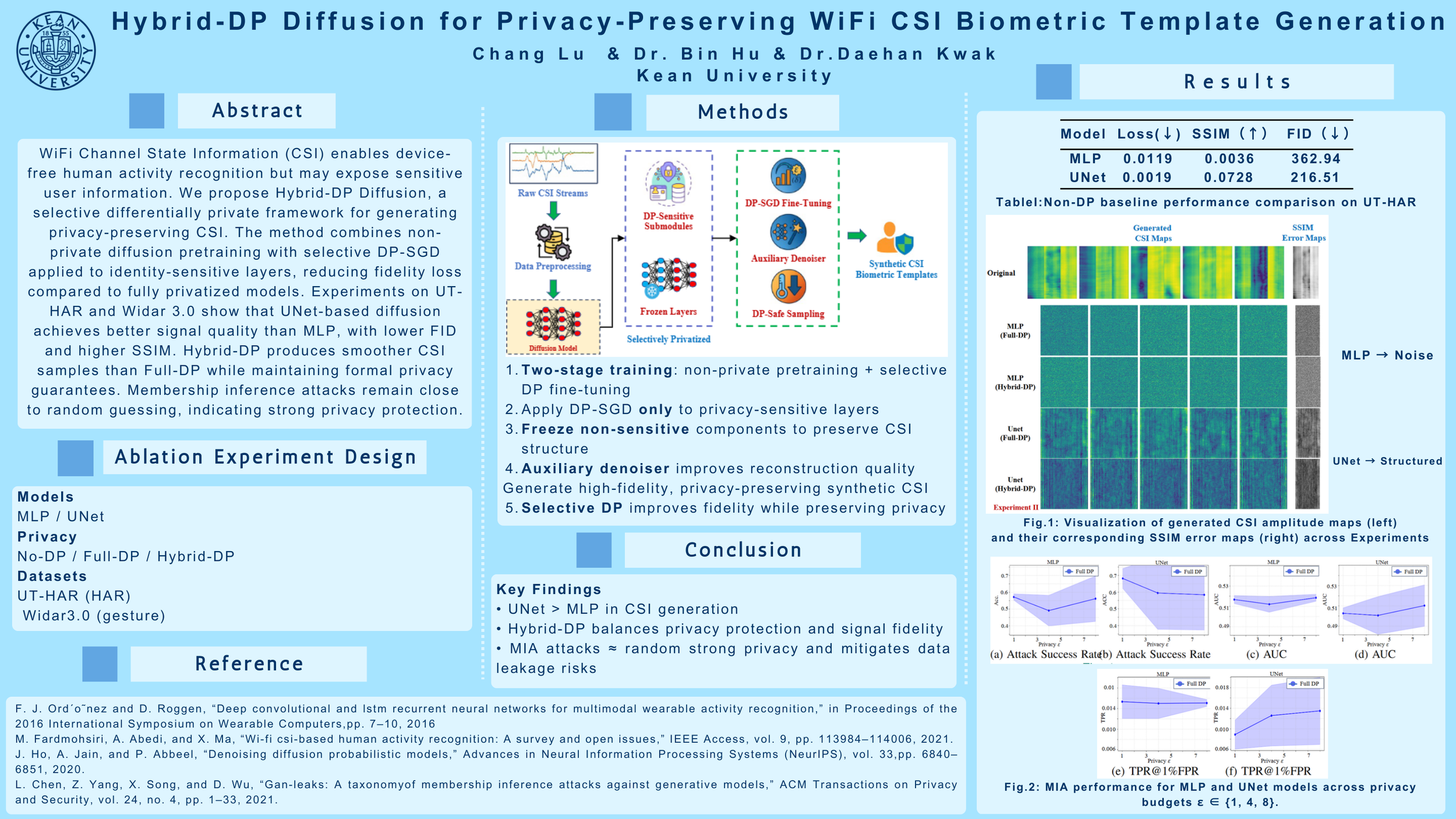
This work examines how differential privacy (DP) affects diffusion-based generation of WiFi Channel State In-formation (CSI) for privacy preserving biometric template synthesis. We introduce a Hybrid-DP Diffusion framework that combines non-private pretraining with selectively privatized DP-SGD applied only to embedding and attention layers. Using MLP and UNet backbones under identical privacy budgets, we quantify the privacy–utility trade-off on UT-HAR and Widar 3.0. Results show that architectural inductive bias is critical: the UNet consistently achieves lower FID, higher SSIM, and more stable convergence than the MLP in both non-DP and DP settings. Hybrid-DP yields smoother, less artifact-prone templates while preserving key spatial–temporal biometric patterns and improving cross-domain robustness over Full-DP. Membership inference attacks operate near random guessing across all configurations, indicating no detectable privacy leakage. Overall, Hybrid-DP diffusion provides a strong balance of generative fidelity, formal DP protection, and cross-environment stability, making it well-suited for privacy-preserving wireless biometric systems.
Keywords: Differential Privacy, Generative Diffusion Models, WiFi CSI, Human Activity Recognition, Privacy-Preserving Sensing, Membership Inference Attacks