
Impact of Energy Uncertainty on AI-Invested Stock
Xinyou Zhang
Co-Presenters: Individual Presentation
College: College of Business and Public Management
Major: BS.ECONOMICS
Faculty Research Mentor: Nazif Durmaz
Abstract:
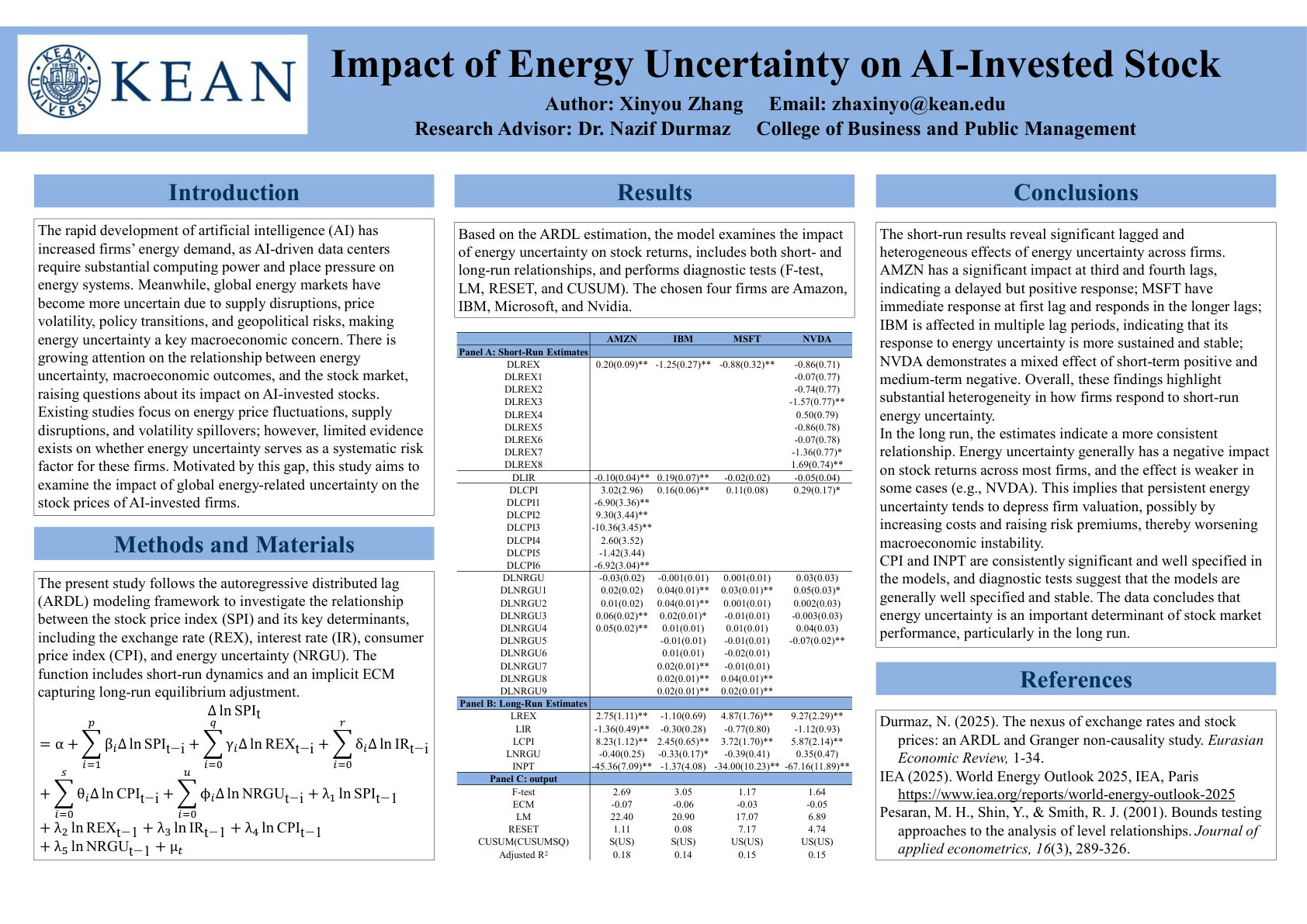
Motivated by the current researches on energy policy and stock market, this article seeks to provide new evidence on the how energy uncertainty transmitted influence to finance markets. This study aims to examine the impact of uncertainty from global energy on the stocks prices and returns of AI-invested firms, while controlling key macroeconomic factors includes inflation, investment rates and exchange rates. There is an increasing attention on connection between energy uncertainty and macroeconomic results, and stock market. Current literature documented how these energy factors shape the stock market performance, such as the report from European Central Bank (2025) have examined the implications of AI-related energy demand to natural gas and fossil fuels prices, and policy-orientedly emphasized the possibilities to replace traditional energy with renewable energy to cope with the growing demand on electricity consumption when build large language model (LLM). Previous studies mainly discussed fluctuations in energy prices, supply disruptions, and policy uncertainty can significantly affect stock returns, volatility, and risk transmission. Important existing evidence explored volatility spillovers between AI-related tokens and fossil fuel markets (Yousaf et al., 2024), but it doesn’t address whether the role of energy uncertainty constitutes a systematic risk factor for AI-invested stocks. Similarly, many studies also tried to focus on energy markets or energy-producing firms, such as oil, gas, and clean energy corporations (Dutta, 2017; Zhao, 2020; Adekoya, 2022). However, there is still relatively short of direct evidence on how energy uncertainty influences the returns of AI-invested stocks. As a result, it is essential to address this macroeconomic issue and understand transmission from energy-related risks and high AI-exposed stocks, which help to assess the vulnerability of technology-driven financial assets to energy market uncertainty.