
Importance of Progressive Rehabilitation Program after ACL Surgery in a Female Basketball Player: A Case Study
Betsy De La Cruz Mestanza
Co-Presenters: Individual Presentation
College: College of Health Professions and Human Services
Major: MS.EXERCISESCI
Faculty Research Mentor: Pragya Sharma
Abstract:
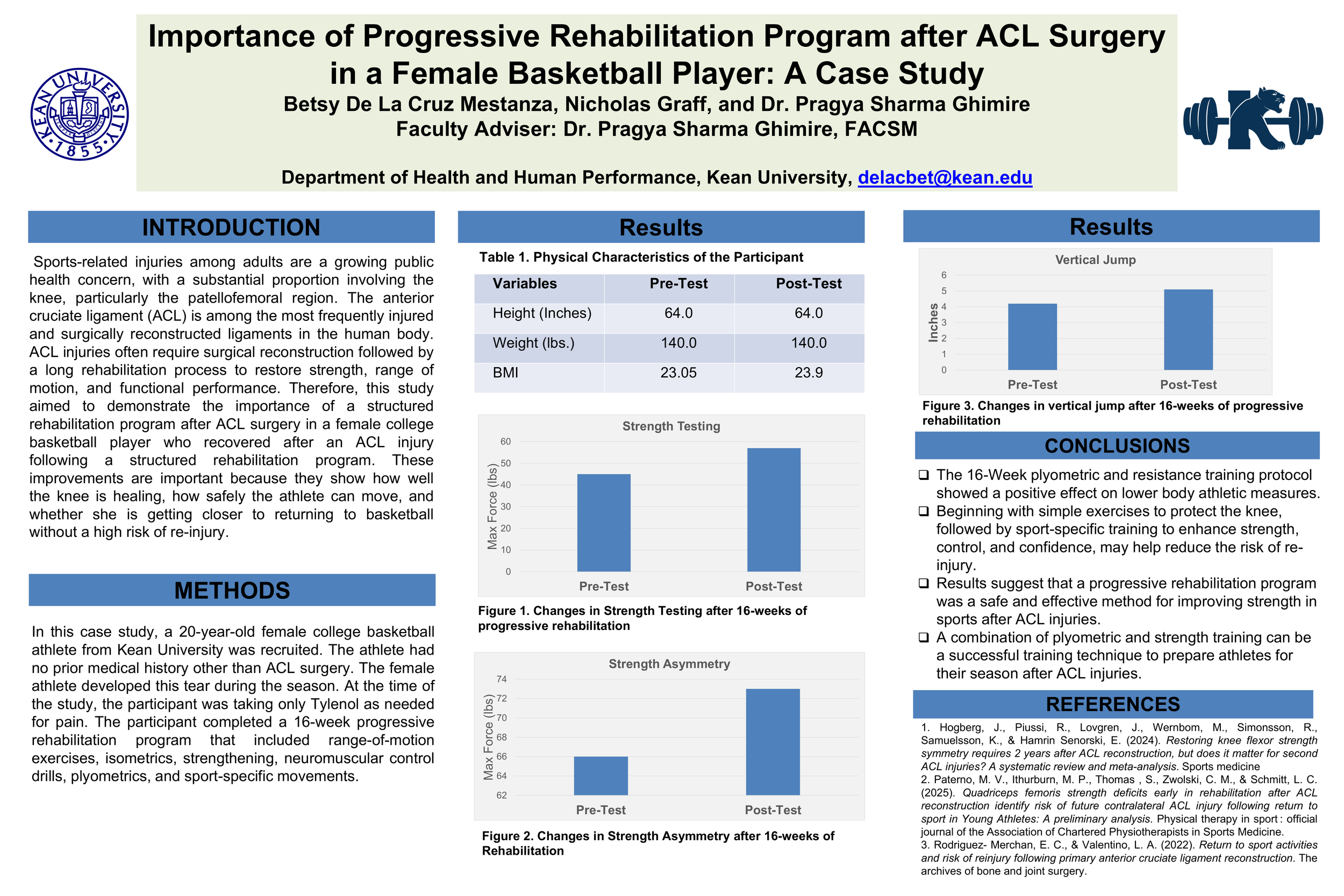
Introduction: Sports- related injuries among adults are a growing public health concern, with a substantial proportion involving the knee, particularly the patellofemoral region. The anterior cruciate ligament (ACL) is among the most frequently injured and surgically reconstructed ligaments in the human body. ACL injuries often require surgical reconstruction followed by a long rehabilitation process to restore strength, range of motion, and functional performance. Purpose: This study aimed to demonstrate the importance of a structured rehabilitation program after ACL surgery in a female college basketball player who recovered after an ACL injury following a structured rehabilitation program. Improvements were examined to assess knee healing, movement safety, and readiness to return to basketball with a reduced risk of re-injury. Methods: In this case study, a 20-year-old female college basketball player from Kean University was recruited. The athlete had no prior medical history other than ACL surgery. The female athlete developed this tear during the season. At the time of the study, the participant was taking only Tylenol as needed for pain. The participant completed a 16-week progressive rehabilitation program that included range-of-motion exercises, isometrics, strengthening, neuromuscular control drills, plyometrics, and sport-specific movements. Results: After16 weeks of rehabilitation, pain levels decreased to 2 out of 10 depending on movement. Strength testing showed improvement, with the weaker leg increasing from approximately 45 lbs. to 57 lbs., and impulse increasing from 197 lbs. to 279lbs., although strength asymmetry increased from 66lbs. to 73lbs. Jump performance also improved, with countermovement jump height increasing from 4.2 to 5.1 inches. RSI- modified improved from 0.11 to 0.14 m/s, and concentric force asymmetry decreased from about 25% to 7%. We did not find any changes in BMI pre to post-conditions. Conclusions: The results suggest that a progressive rehabilitation program was a safe and effective method for improving strength in sports with high mechanical demands. Beginning with simple exercises to protect the knee, followed by sport-specific training to enhance strength, control, and confidence, may help reduce the risk of re-injury.
Key Words: ACL, Sports Injury, Exercise Training