
Improving Student Attendance at Kean University Hynes Hall
Angeryca Concepcion
Co-Presenters: Angeryca Concepcion, Krupali Soni, Reginald Cosmeus, Keegan Rollins, Amer Mohamed
College: College of Business and Public Management
Major: BS.MANAGEMENT-ANALYT
Faculty Research Mentor: Kyung Lee
Abstract:
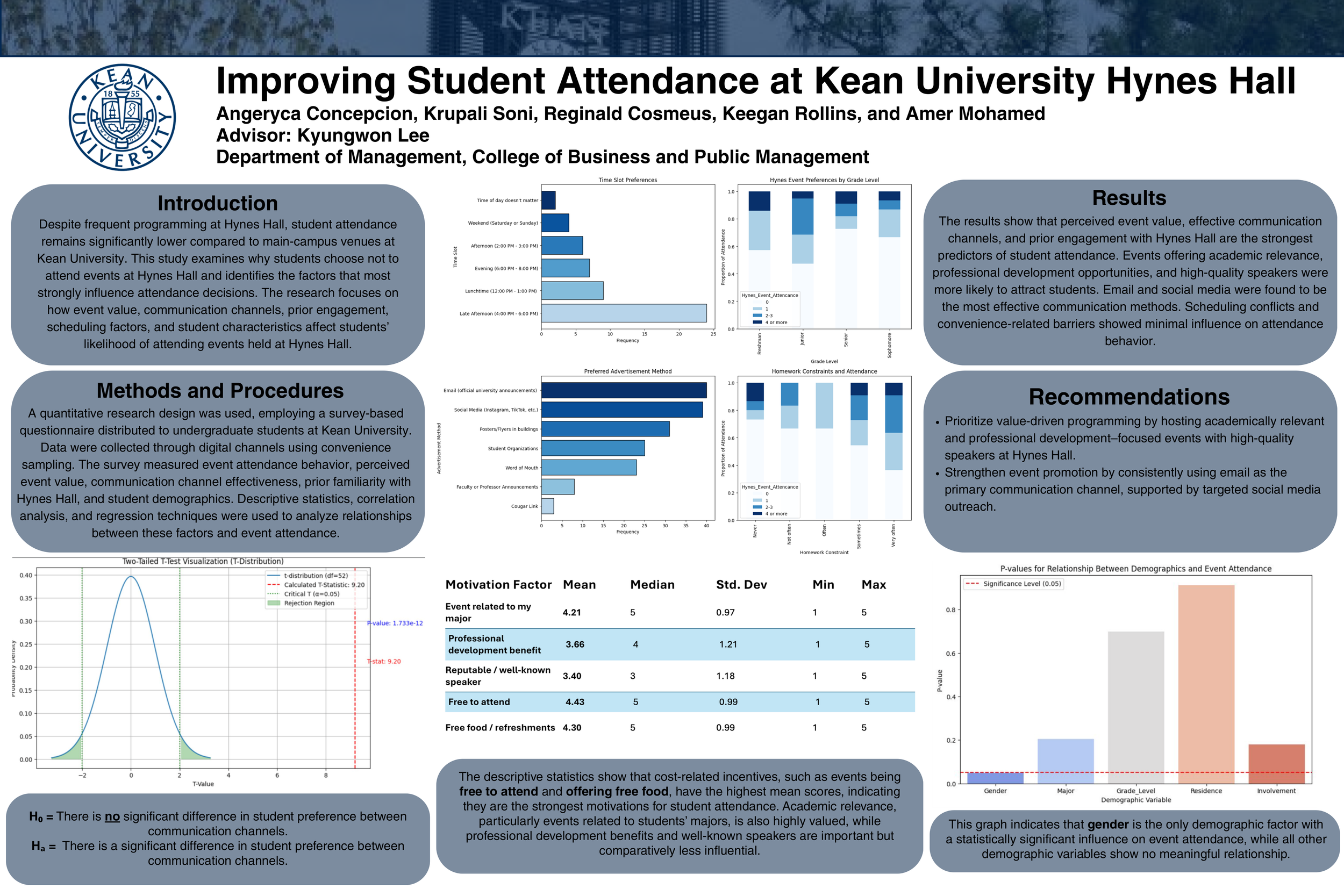
Student engagement through campus events is an essential component of the undergraduate experience, contributing to academic involvement, professional development, and a sense of community. At Kean University, events are hosted across multiple campus locations; however, attendance at Hynes Hall, the primary academic building for the College of Business and Public Management, remains consistently lower than at main-campus venues. This imbalance limits cross-campus engagement and reduces the effectiveness of programming efforts. The purpose of this study is to identify the key factors influencing student attendance at events held in Hynes Hall and to develop data-driven recommendations to improve participation.
This study employed a quantitative, survey-based research design. Data were collected from 53 undergraduate students using a structured questionnaire distributed through digital channels. Survey measures assessed perceived event value, communication channel effectiveness, prior engagement with Hynes Hall, attendance behavior, and student demographics. Descriptive statistics, correlation analyses, and regression techniques were used to examine relationships between attendance and the factors studied.
The findings indicate that student attendance at Hynes Hall events is primarily driven by three factors: perceived event value, effective communication channels, and prior familiarity with the venue. Events offering academic relevance, professional development opportunities, and high-quality speakers were significantly more likely to attract students. Email and social media emerged as the most effective methods for event promotion, while prior attendance strongly predicted future participation. Scheduling conflicts and convenience-related barriers showed minimal influence. These results suggest that universities can improve engagement by prioritizing value-driven programming, focusing promotional efforts on preferred communication channels, and increasing early exposure to underutilized campus spaces. Future research should expand the sample size, explore longitudinal attendance patterns, and assess the effectiveness of implemented engagement strategies.
Keywords: Student Engagement, Event Attendance, Campus Programming, Marketing Communication, Higher Education