
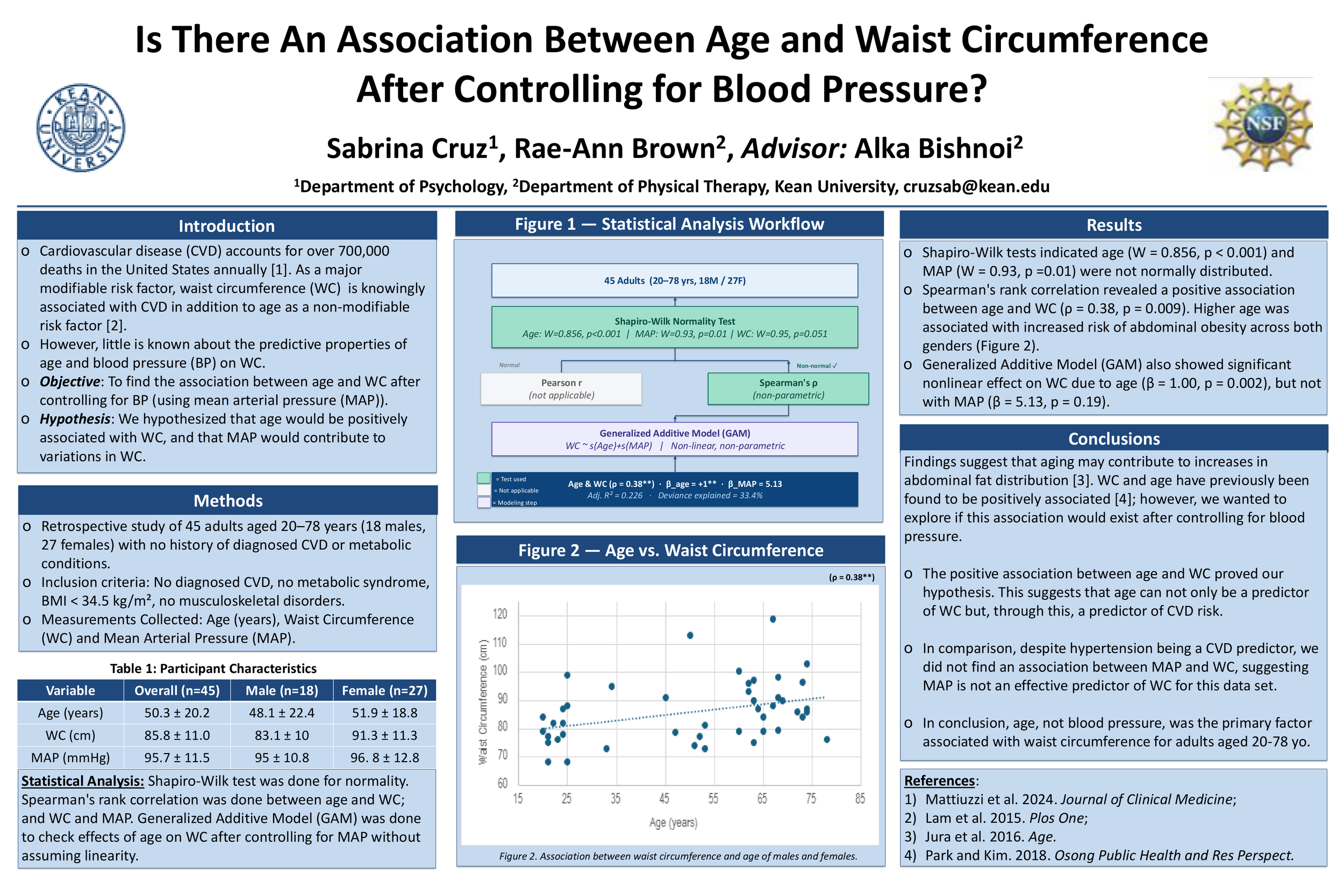
Is There An Association Between Age and Waist Circumference After Controlling for Blood Pressure?
Sabrina Cruz
Co-Presenters: Rae-Ann Brown
College: College of Liberal Arts
Major: BA.PSYCHOLOGY
Faculty Research Mentor: Alka Bishnoi
Abstract:
Cardiovascular disease continues to be the leading cause of mortality in the US, with the risk increasing alongside global life expectancy. Waist circumference is a major modifiable risk factor for cardiovascular disease, while age is a key non-modifiable contributor. This exploratory study examines the association between age and waist circumference after controlling for mean arterial pressure.
A retrospective data of 45 adults (18 males and 27 females) between the ages of 18-75 years old was used. Measurements included age, waist circumference (WC), and mean arterial pressure (MAP). Statistical analysis included Shapiro-Wilk test for normality which showed abnormal data distribution, spearman correlations for abnormal data, and generalized additive model analysis to test the association between that age, WC after controlling for MAP.
Results demonstrated an upward trend in waist circumference with aging. Age was positively correlated with waist circumference (p=0.381, p=0.009) while mean arterial pressure was not significantly associated (p=0.156, p=0.308). The generalized additive model analysis confirmed that there was a significant effect of age on waist circumference.
This analysis examined whether age and mean arterial pressure were interlinked with waist circumference. Consistent with prior literature, age demonstrated a positive association with waist circumference, illustrating that aging corresponded with greater central adiposity. The regression findings support age as a powerful predictor of waist circumference and cardiovascular disease risk. In contrast, mean arterial pressure was not significantly associated with waist circumference within the sample, suggesting limited predictive value for central adiposity within the dataset.
Keywords: waist circumference, cardiovascular disease, age