
Mechanistic Origins of Regioselectivity in Copper(I)-Catalyzed Azide-Alkyne Cycloaddition
Bhavesh Desireddy
Co-Presenters: Individual Presentation
College: Hennings College of Science Mathematics and Technology
Major: BA.CHEM/PREPROF
Faculty Research Mentor: Matthew Mongelli
Abstract:
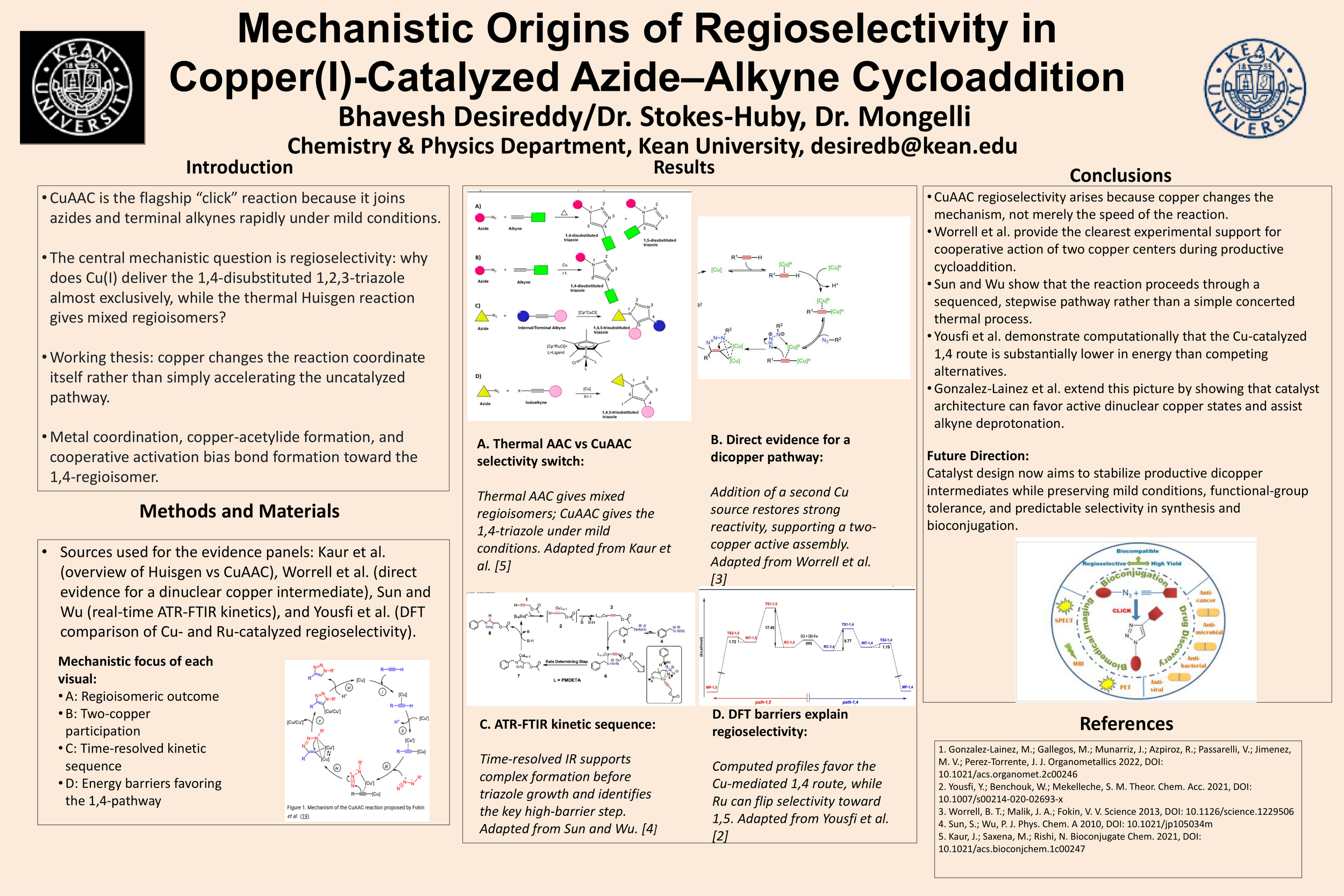
The copper(I)-catalyzed azide–alkyne cycloaddition (CuAAC) is a cornerstone of click chemistry, distinguished by its rapid kinetics, mild reaction conditions, and exclusive formation of 1,4-disubstituted 1,2,3-triazoles. In contrast to the uncatalyzed thermal Huisgen cycloaddition, which proceeds through a concerted pericyclic mechanism and yields mixtures of regioisomers, CuAAC exhibits complete regioselectivity. This paper examines the mechanistic origins of this selectivity, focusing on the role of copper(I) in altering the reaction pathway. Formation of a copper acetylide intermediate, followed by azide coordination and stepwise bond formation, imposes geometric and electronic constraints that favor the 1,4-regioisomer. Experimental observations and computational studies support a stepwise, metal-mediated mechanism rather than a concerted process. Understanding these mechanistic features provides insight into how metal catalysis enforces regioselectivity and informs the rational design of selective cycloaddition reactions. A detailed understanding of these mechanistic features explains the reliability of CuAAC and also offers broader insight into calayst-controlled cycloadditions, leading to the rational design of selective and efficient reactions in modern synthetic chemistry.