
Optimal Capital Structure of Estée Lauder (EL)
Rosanna M Sanchez Binet
Co-Presenters: Individual Presentation
College: College of Business and Public Management
Major: BS.ACCOUNTING
Faculty Research Mentor: Andreas Kakolyris
Abstract:
Estée Lauder Companies: An Analysis of Capital Structure and Cost of Capital Sensitivities
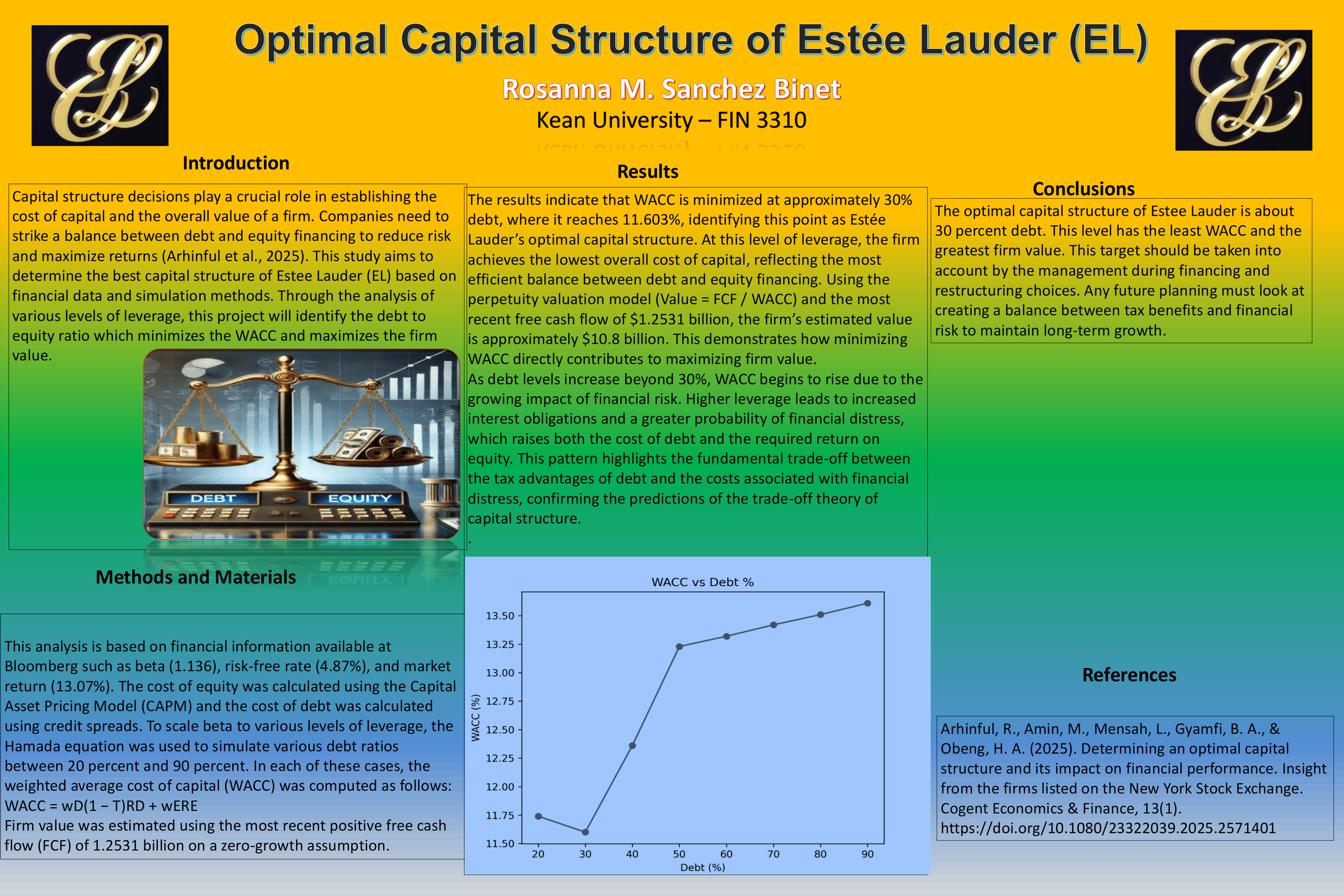
This project discusses the capital structure of The Estee Lauder Companies Inc. and the impact of variation of financial leverage on the weighted average cost of capital (WACC) and the overall market value of the firm. Since Estee Lauder is a top international corporation in the beauty and cosmetics market, it presents an excellent case study on how the choice of financing affects the shareholder wealth. The main aim of the current research is to determine the optimal capital structure of the company by simulating different debt-to-equity ratios and quantifying the effects of such transitions on the cost of capital of the company. This relationship is crucial to understand since risk, return, and firm valuation are all directly related to capital structure choices.
This analysis estimates the leveraged beta, cost of equity, and cost of debt of the company under various leverage conditions using publicly available financial data and the synthetic credit rating method. The estimation is then applied to estimate WACC under different capital structures to establish where firm value can be optimized. The approximated findings are likely to reveal that moderate changes in leverage will yield minimal alteration in total cost of capital, whereas overdependence on debt will escalate financial risk and the expense of borrowing.