
Parent Age Group Differences in Self-Reported Praise and Criticism
Wanda Siqueira
Co-Presenters: Individual Presentation
College: College of Liberal Arts
Major: BA.PSYCHOLOGY
Faculty Research Mentor: Shai Tabib
Abstract:
The parent-child relationship is influenced by parental feedback, such as praise and
criticism, which can be beneficial in moderation, but counterproductive when excessive.
Previous studies have found that parenting patterns characterized by more criticism than praise
are more common among older parents. However, these studies rely on limited samples and do
not examine the excessive forms of praise and criticism. This study aimed to address this gap by
examining the association between parental age and excessive parenting tendencies in a
nationally representative sample. For the present study, archival survey data from Pew Research
Center’s American Trends Panel Wave 115 were obtained. Participants (N = 3,724) identified
their age category and responded to items assessing their tendency to criticize or praise their
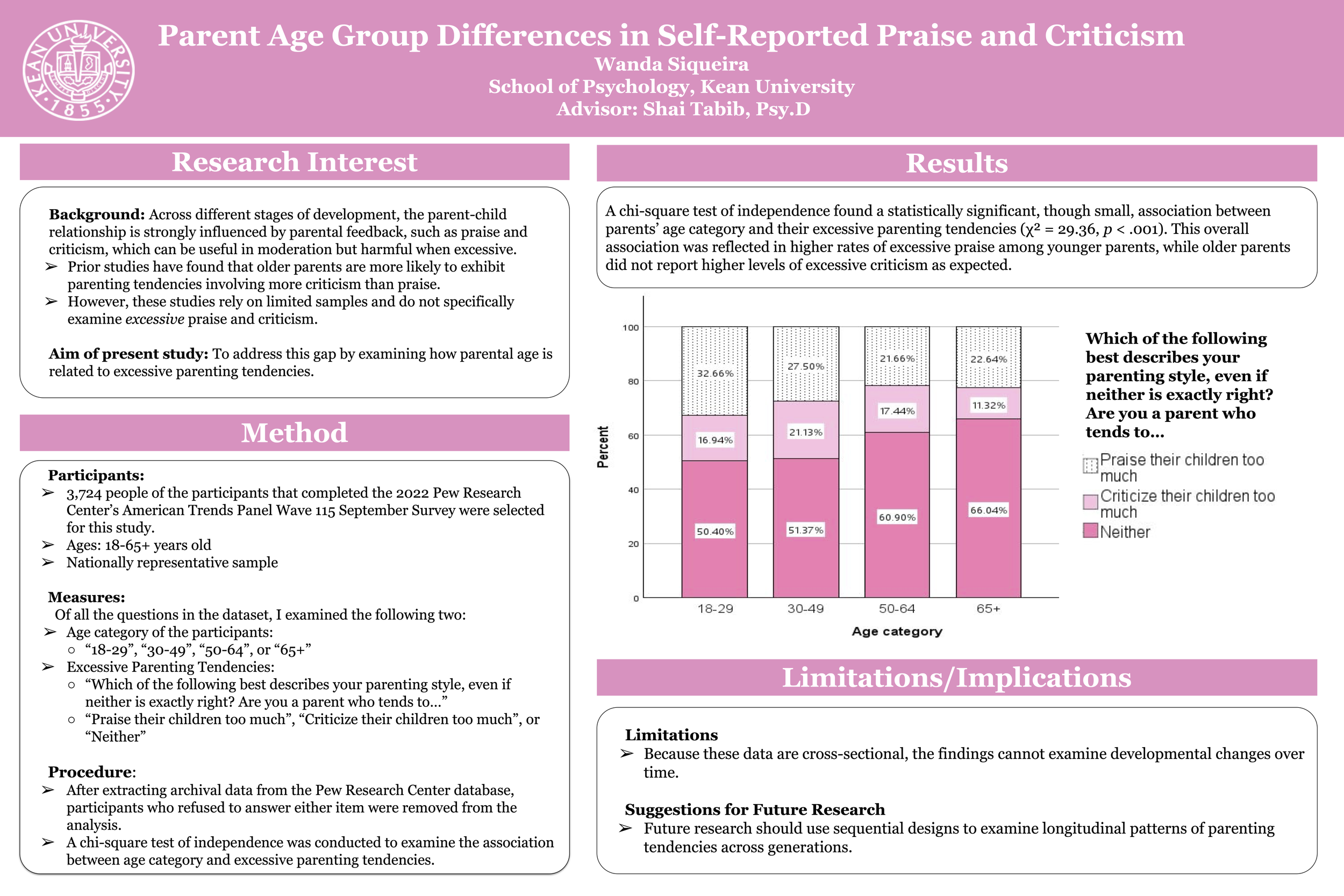
children excessively. A chi-square test of independence found a statistically significant, though
small, association between the two variables. Parents in younger age groups endorsed excessive
praise at higher rates, but older age groups were not more likely to endorse excessive criticism.
Because the data are cross-sectional, the findings cannot examine developmental changes over
time. Future research should employ sequential designs to examine longitudinal patterns in
parenting tendencies across generations.