
Perceptions of Crime Severity and Sentencing Based on Race and Victim Characteristics
Onikepo Ezekiel
Co-Presenters: Individual Presentation
College: College of Liberal Arts
Major: BA.PSY/FORENSICPSY
Faculty Research Mentor: Franklin Turner
Abstract:
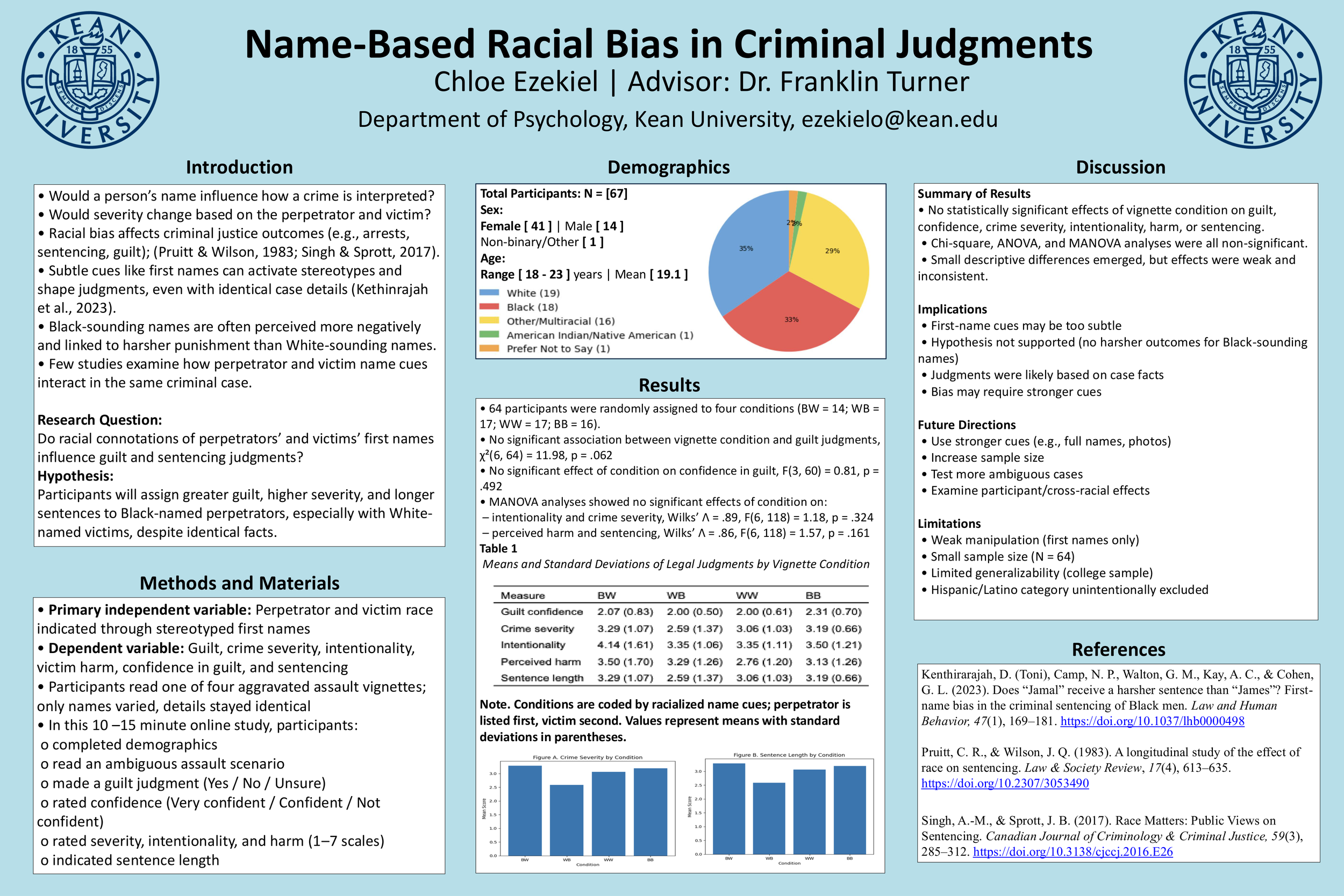
Racial bias has been repeatedly recorded within the criminal justice system, influencing perceptions of guilt and sentencing outcomes. Although overt racial disparities in sentencing have been widely studied, there has been less focus on the subtle mechanisms in which racial bias might be invoked. One mechanism involves racially stereotyped first names, which can serve as implicit cues that influence judgment even when case facts are identical.
The objective of this study is to examine how the racial connotation of a perpetrator’s first name influences perceptions of guilt and sentencing length. It is hypothesized that perpetrators with racially stereotyped Black-sounding names will be perceived as more guilty and assigned longer sentences than perpetrators with White-sounding names, despite identical case details.
This study utilizes a between-subjects experimental design in which 200 undergraduate students are randomly assigned to read one version of an aggravated assault vignette. The scenario will remain constant across conditions, while the racialized first names of the perpetrator vary. After reading the vignette, participants provide ratings of guilt, confidence in judgment, and recommended sentencing length.
It is hypothesized that perpetrators possessing racially stereotyped Black-sounding names will receive higher guilt ratings and longer recommended sentences compared to those with White-sounding names.
By isolating name-based racial cues, this research aims to clarify how implicit racial stereotypes shape legal judgments and may guide future interventions intended to reduce racial bias in criminal sentencing.
Keywords: Racial Bias, Sentencing Decisions, Implicit Bias, Criminal Justice