
Predicting Overconsumption Risk from Social Media Exposure Using Machine Learning
Angeryca Concepcion
Co-Presenters: Individual Presentation
College: College of Business and Public Management
Major: BS.MANAGEMENT-ANALYT
Faculty Research Mentor: Md Golam Kibria
Abstract:
The rapid growth of social media marketing, influencer promotion, and affiliate advertising has significantly reshaped consumer shopping behavior. While these strategies improve brand visibility and sales, they may also contribute to overconsumption and impulse purchasing. Understanding how digital marketing exposure influences consumer behavior is increasingly important for developing responsible and effective marketing strategies. The purpose of this study is to examine how social media exposure and digital marketing channels predict consumer purchasing behavior and overconsumption risk using predictive analytics.
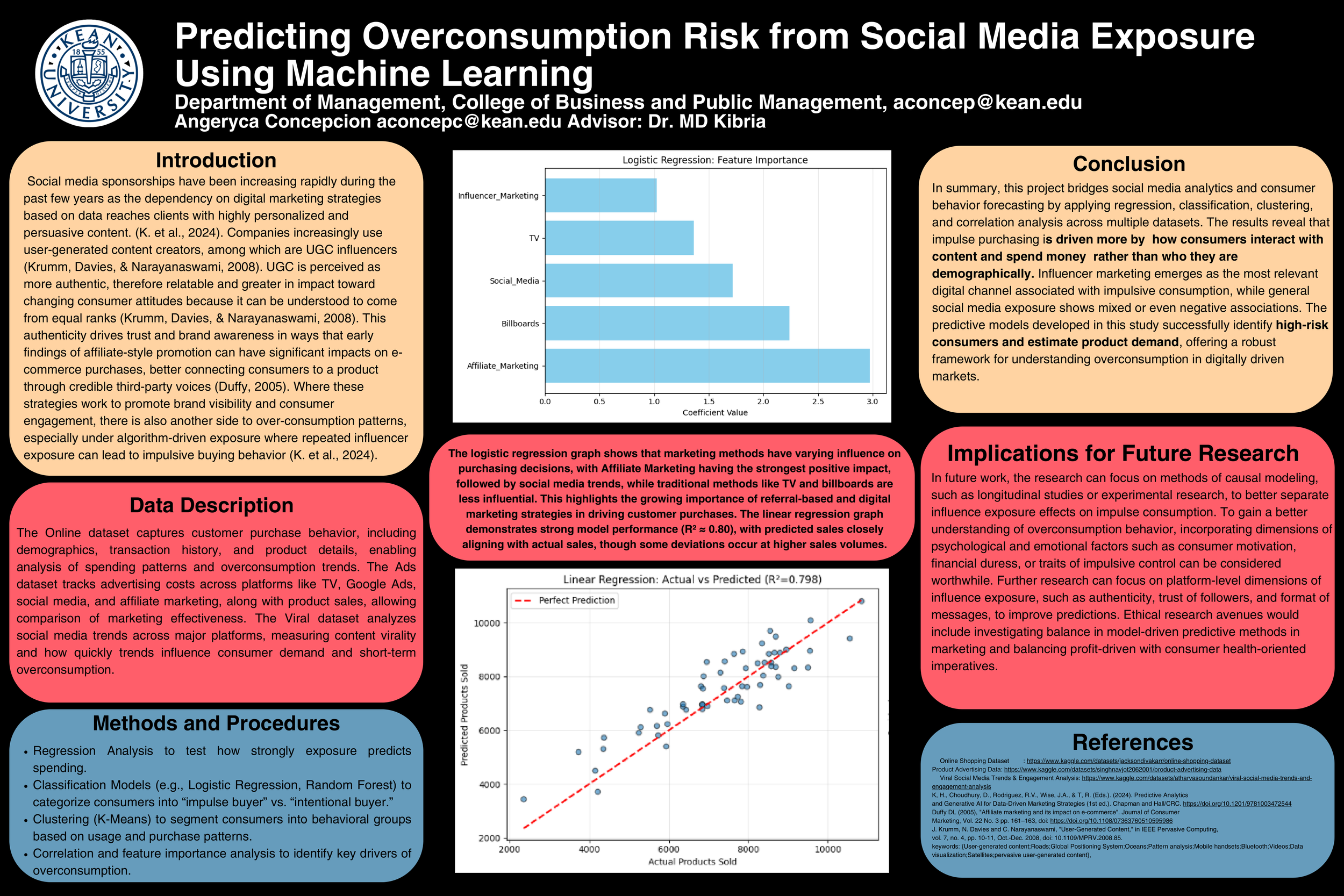
This study employed a machine learning–driven analytical approach using multiple datasets, including online purchase records, advertising spend across major marketing platforms, and social media trend metrics. Regression, classification, clustering, and correlation analyses were applied to evaluate relationships between marketing exposure, spending behavior, and impulse purchasing. A Consumer Risk Score model was developed to classify consumers as impulse or intentional buyers, and linear regression was used to predict product sales based on marketing inputs.
The results show that spending-related variables, including total online spending, average item price, quantity purchased, and transaction value, are the strongest predictors of overconsumption risk and are more influential than demographic characteristics. The classification model achieved near perfect accuracy in identifying impulse buyers, and regression analysis explained approximately 80 percent of the variation in product sales. Affiliate marketing was the most influential channel affecting purchasing behavior, while influencer marketing showed a clear relationship with impulse buying. Overall, these findings highlight the effectiveness of machine learning in connecting social media exposure to consumer behavior prediction and provide practical insights for developing data driven and more responsible digital marketing strategies. Future research may build on this work by incorporating psychological factors and causal modeling approaches.
Keywords: Overconsumption, Social Media Marketing, Predictive Analytics, Machine Learning, Consumer Behavior