
Race and Gender: How Do They Influence One’s Perception of Wrongdoing?
Kayla Booker
Co-Presenters: Individual Presentation
College: College of Liberal Arts
Major: BA.PSYCHOLOGY
Faculty Research Mentor: Franklin Turner
Abstract:
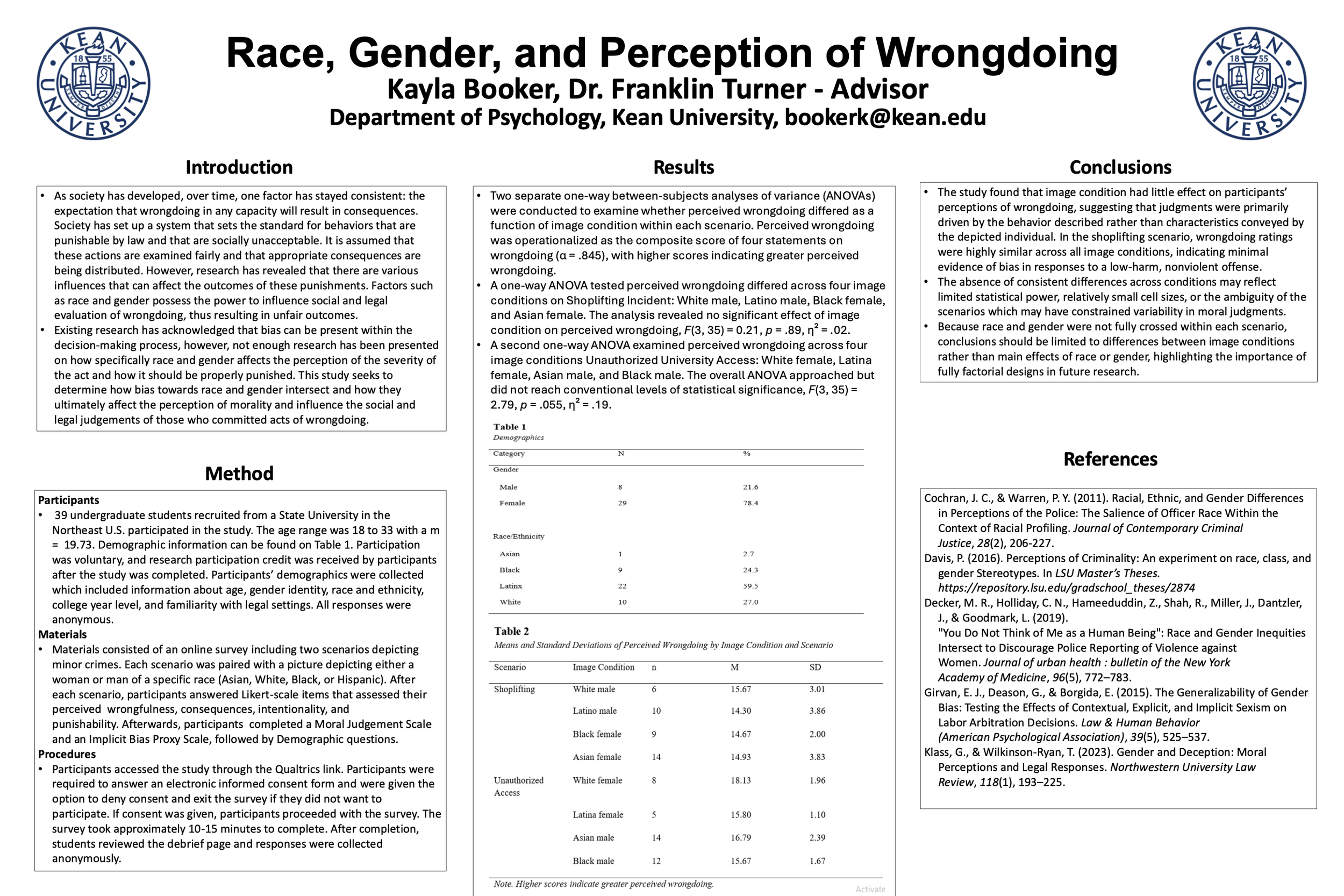
Social and legal repercussions for wrongful acts are vital to upholding a functioning society; however, there are unfair factors that can influence the outcome for those who committed the acts. Existing research has demonstrated that two of these unethical factors that directly impact society’s moral system are race and gender. This study seeks to reveal the hidden biases associated with determining social and legal outcomes for the person who committed the act and how these judgments vary depending on the person’s race and gender identity.
A total of 150 undergraduate students will participate in this study and complete an online Qualtrics survey in which they will be randomly assigned scenarios with varying race and gender photo conditions. Afterwards, participants will be expected to rate the level of wrongfulness, intent, and the proper ramifications for each scenario. Participants will also be expected to complete a Moral Judgement Scale and an Implicit Bias Scale, as well as demographic questions.
Based on existing research, it is hypothesized that participants will rate wrongdoing more harshly when pertaining to an offender who is a part of a marginalized group, whether through gender or race. This study seeks to determine how racial and gender bias exist within the legal, moral, and social evaluation of wrongdoing, exhibiting the growing need for methods to decrease bias within decision-making.
Keywords: race, gender, perception, bias, moral judgement.