
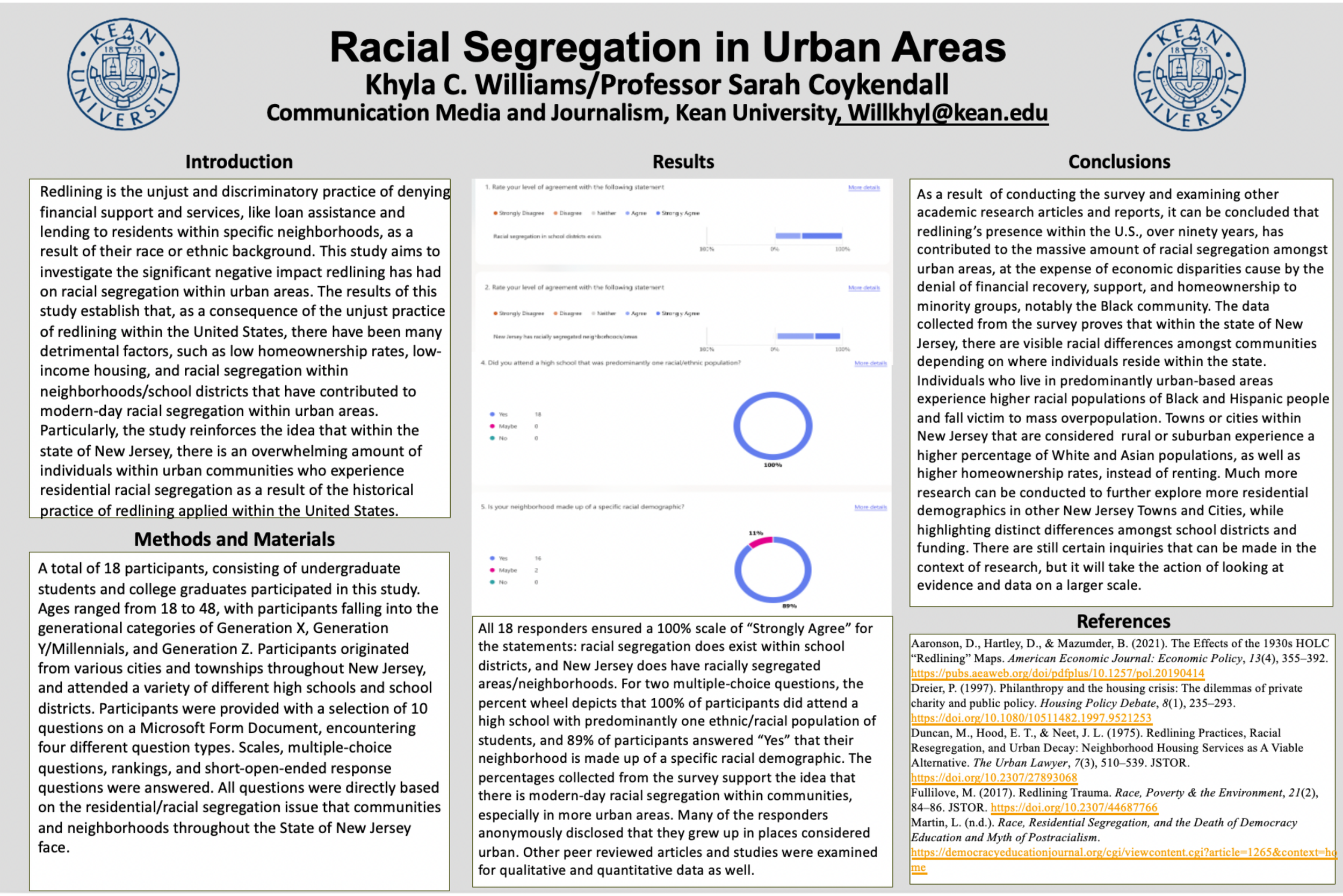
Racial Segregation in Urban Areas
Khyla Williams
Co-Presenters: Individual Presentation
College: College of Liberal Arts
Major: BA.COMM/MED/FILM
Faculty Research Mentor: Sarah Coykendall
Abstract:
Thinking of the economic state of America today, many individuals find different things to blame. Economic opportunities, access to education, income, and housing, hold major weight when it comes to the economic state Americans face. One factor that constantly gets overlooked, that contributes the social and economic status certain individuals have, is racial segregation. Specifically, the discriminatory practice of redlining is the reason why racial segregation in urban areas has happened over time and still happens in the world today. Being able to obtain wealth within a society that breeds off of economic accomplishment and success starts with holding property ownership, which rarely occurs within heavily populated urban areas. Within American history and life, homeownership has been extremely limited for African American people. Specifically, Black individuals and other immigrant groups, who occupy urban-based communities, encounter a lack of access to knowledge and funds. They are not as susceptible to owning properties and paying mortgages, as a result of the racist practice of “Redlining” enforcing racial segregation in the country and within these urban areas. The purpose of this paper is to highlight the negative influence the creation of redlining has had on the rates of black homeownership from 1934 to 2025, enabling racial segregation within urban areas as well as a continuous economic divide.