
Renting vs. Owning in NJ: Cost Comparison
Felix Molina
Co-Presenters: Timothy Nguyen
College: Hennings College of Science Mathematics and Technology
Major: BS.COMPSCI/CYBERS
Faculty Research Mentor: Ching-Yu Huang
Abstract:
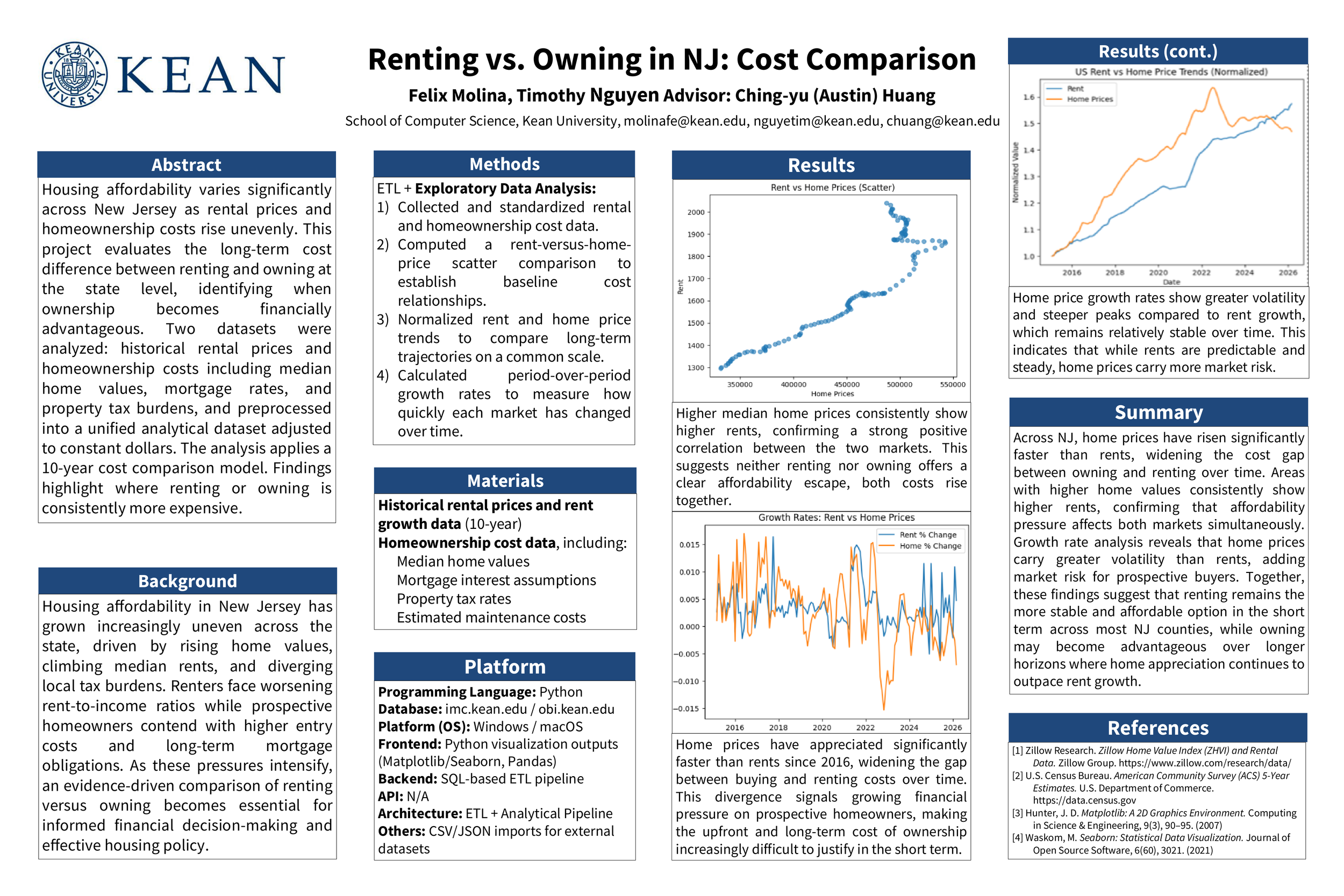
Housing affordability in New Jersey has become an increasingly complex issue as rental prices and home ownership costs continue to rise unevenly across counties. The objective of this research is to quantitatively evaluate the long-term cost differences between renting and owning residential property at the county level in New Jersey, and to identify conditions under which home ownership becomes more financially advantageous than renting. To address this problem, two county-level datasets are analyzed: (1) historical rental price and rent growth data, and (2) home ownership cost data including median home values, mortgage interest rates, and property tax rates. Data will be extracted from publicly available housing, economic, and government sources in structured formats such as CSV and JSON. The datasets will span multiple years and include numerical and temporal attributes for each county.
Data preprocessing will be performed to ensure consistency and accuracy. County names and identifiers will be standardized to enable correct dataset integration. Missing values will be handled using interpolation for time-series rental data and removal of records with insufficient coverage. All monetary values will be adjusted for inflation to constant dollars to support long-term comparisons. Feature engineering will be applied to compute cumulative rental costs using historical rents and growth rates, and estimated homeownership costs using mortgage payment formulas, property tax rates, and assumed maintenance expenses. Data normalization will be applied where appropriate. The transformed data will be loaded into a unified county-level analytical dataset for further analysis.
Exploratory data analysis will be used to summarize housing cost distributions, identify regional trends, and detect outliers. A comparative cost model will be developed to evaluate cumulative renting versus owning costs over fixed time horizons, with break-even analysis used to determine when ownership becomes more cost-effective. Unsupervised clustering techniques will group counties based on affordability characteristics such as rent growth, home value appreciation, tax burden, and long-term cost differences.
The anticipated results include the identification of county clusters where renting or owning is consistently more cost-effective, providing a data-driven framework for housing cost comparison and regional financial analysis.