
Separation & Determination of Cannabinoids and Its Metabolites in Wastewater Treatment Plants (WWTP)
Gabriela Amaya
Co-Presenters: Diya Patel
College: Hennings College of Science Mathematics and Technology
Major: BS.BIO/FORENS/SCI
Faculty Research Mentor: Mingjing Sun
Abstract:
As the use of Cannabis continues to increase, the amount released into various environments also increases. This starts to raise questions about monitoring its presence in the environment in terms of how much is being used and what impacts it has caused. One way to monitor community-level cannabis use is through wastewater collection and analysis. Once cannabis is consumed in any form, it is metabolized by the bodies functions and expelled, with presence of metabolites found in wastewater. Cannabinoids such as THC and CBD, in addition to their metabolites, enter wastewater systems and can be measured to estimate usage patterns. This study focuses on identifying and measuring these compounds and their presence in wastewater treatment plants (WWTPs) to further understand their occurrence of current and future environmental contaminants.
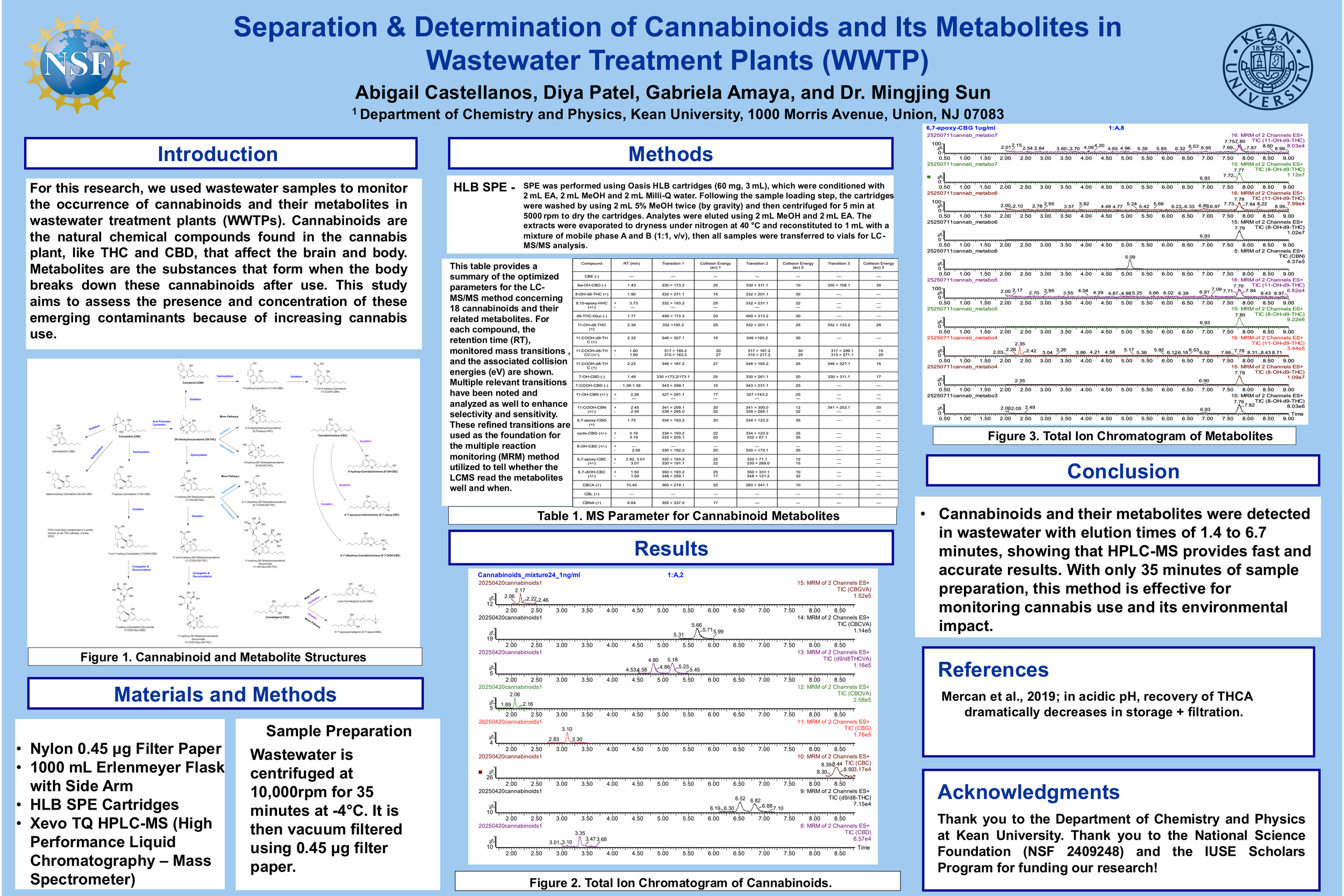
The main objective of this research was to detect and evaluate cannabinoids and their metabolites in wastewater samples utilizing a dependable and effective analytical approach Solid-phase extraction (SPE) utilizing Oasis HLB cartridges was used to concentrate the analytes. Following elution and evaporation, the samples were reconstituted and analyzed through high-performance liquid chromatography coupled with tandem mass spectrometry (HPLC–MS/MS). Optimized multiple reaction monitoring (MRM) transitions were established for 18 cannabinoids and their related metabolites to guarantee both sensitivity and selectivity.
The results indicated that various cannabinoids and their metabolites were effectively detected in wastewater samples, with elution times varying from 1.4 to 6.7 minutes. The method required approximately 35 minutes for sample preparation and yielded rapid, precise chromatographic separation and detection. These results show that the combination of HPLC–MS/MS with SPE represents a effective strategy for monitoring cannabis-related compounds in wastewater.
This research highlights the significance of wastewater-based analysis as a way of tracking substance use trends and understanding environmental exposure to emerging contaminants. The methodology developed in this study can facilitate future monitoring initiatives and assist public health and environmental agencies in better evaluating the effects of the rising cannabis use. Future studies may extend this approach to additional treatment facilities and longer monitoring durations to identify trends over time.