
Substandard Housing and its Influence on Criminal Behavior
Fabianny Alejo
Co-Presenters: Individual Presentation
College: College of Liberal Arts
Major: BA.PSY/FORENSICPSY
Faculty Research Mentor: H. Jacob Carlson
Abstract:
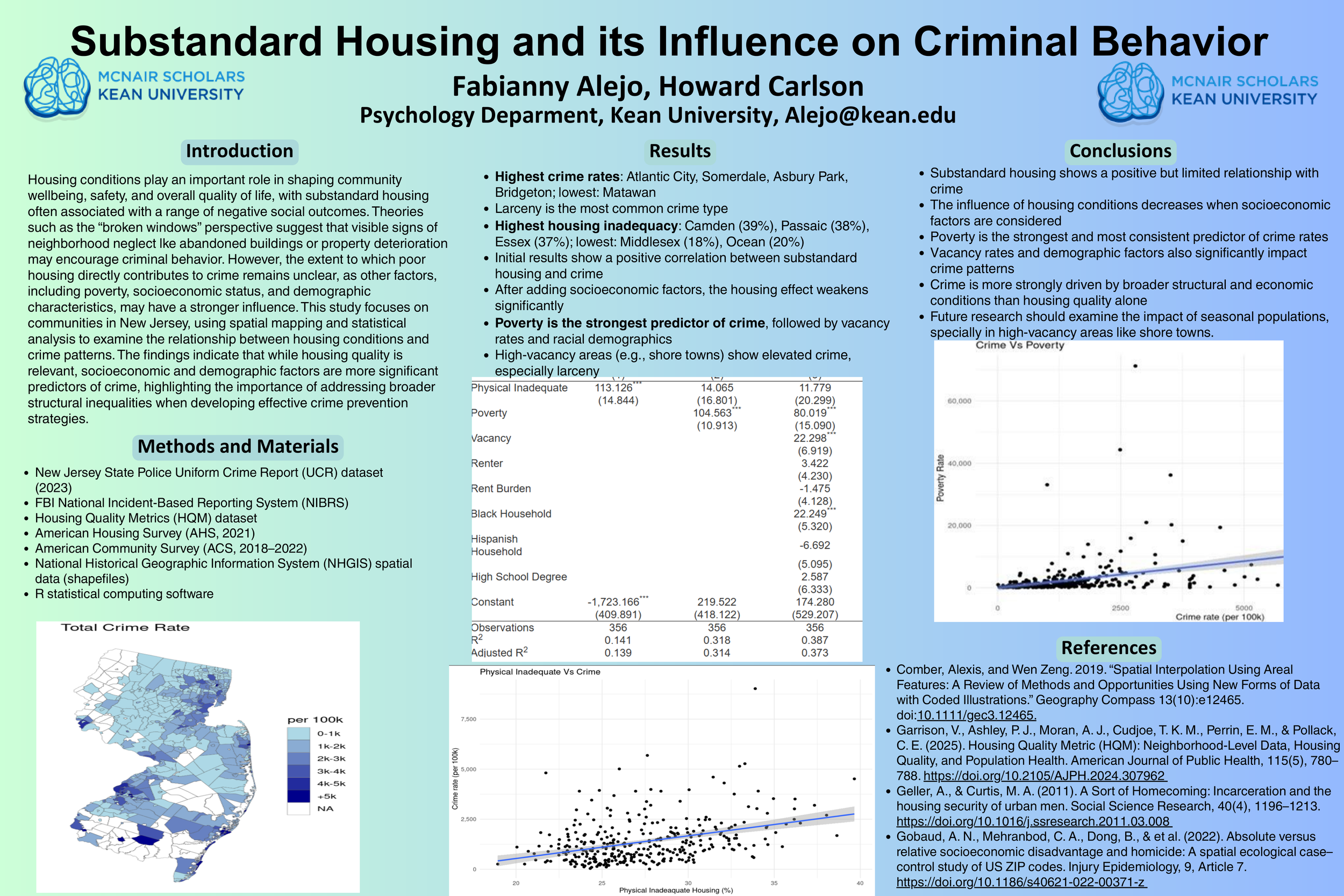
This study examines the relationship between substandard housing conditions and crime rates in New Jersey communities, while utilizing publicly available data from the Housing Quality Metrics (HQM), the American Housing
Survey (2021), the American Community Survey (2018-2022), and the Uniform Crime Report statistics from the New Jersey State Police. Using spatial visualization and regression analysis in R, findings show a positive correlation between physically inadequate housing and crime at the municipal level. However, this relationship weakens significantly when controlling poverty and other socioeconomics variables. Poverty emerged as the most consistent and significant predictor of crime, followed by vacancy rates and racial demographics, while the influence of housing inadequacy decreased. These findings suggest that while poor housing contributes to social vulnerability, economic conditions such as poverty are more critical in predicting crime. The findings highlight the need for targeted policy intervention focusing on poverty reduction and community development as part of improving public safety.