
Testing KU124 Synergism with Compounds Relevant to Cancer Therapy
Ana Dumani
Co-Presenters: Sofiia Korotka, Gianna Kiszka, Omar Ahmed, Amanda Obszarny, Lily Dworak
College: Hennings College of Science Mathematics and Technology
Major: BS.SCI/TEC/MOLBIO
Faculty Research Mentor: Thomas Comollo
Abstract:
TASK-1 is a two-pore domain potassium channel encoded by the KCNK3 gene and has been implicated in cancer cell survival by contributing to resistance against apoptosis in non-small cell lung cancer. Inhibition of TASK-1 has therefore emerged as a potential strategy to lower the apoptotic threshold and enhance the efficacy of chemotherapeutic agents. KU124 is a recently identified TASK-1 inhibitor that has been validated in vitro by us, but its therapeutic potential and combinatorial effects with existing drugs remain insufficiently characterized.
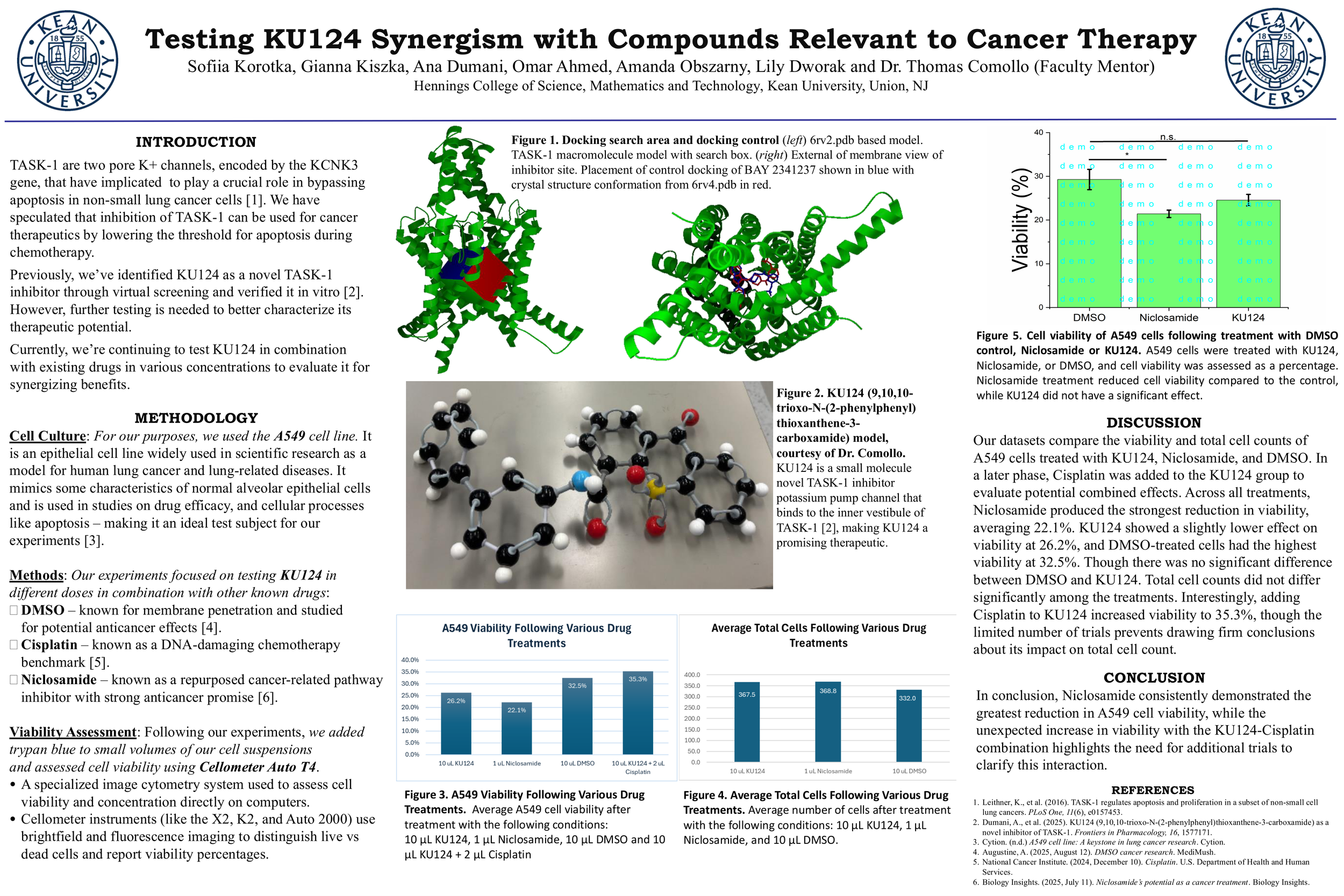
The objective of this study was to evaluate whether KU124 exhibits synergistic or modulatory effects when combined with known compounds relevant to cancer therapy. Human A549 lung adenocarcinoma cells were used as an in vitro model due to their relevance in lung cancer research and apoptosis studies. Cells were treated with KU124 alone or in combination with dimethyl sulfoxide (DMSO), niclosamide, or cisplatin across defined concentrations. Following treatment, cell viability and total cell counts were assessed using trypan blue exclusion and automated image-based cytometry.
Results demonstrated that niclosamide produced the strongest reduction in cell viability, followed by KU124 and DMSO. While total cell counts did not differ significantly across treatment groups, distinct differences in viability were observed. Notably, the addition of cisplatin to KU124 treatment resulted in increased cell viability compared to KU124 alone, suggesting a potential antagonistic or protective interaction rather than synergy under the tested conditions.
These findings highlight the importance of systematically evaluating drug–drug interactions when exploring TASK-1–targeted therapies. Ongoing and future studies with increased replicates and expanded dosing regimens are necessary to better define the combinatorial effects of KU124 and its potential role in enhancing or modulating chemotherapy responses.
Keywords: TASK-1, KU124, lung cancer, drug combinations, cell viability