
The Impact of Cognitive Biases on Economic Decision-Making
Kayla Anicette
Co-Presenters: Individual Presentation
College: College of Business and Public Management
Major: BS.ECONOMICS
Faculty Research Mentor: Chen Meng
Abstract:
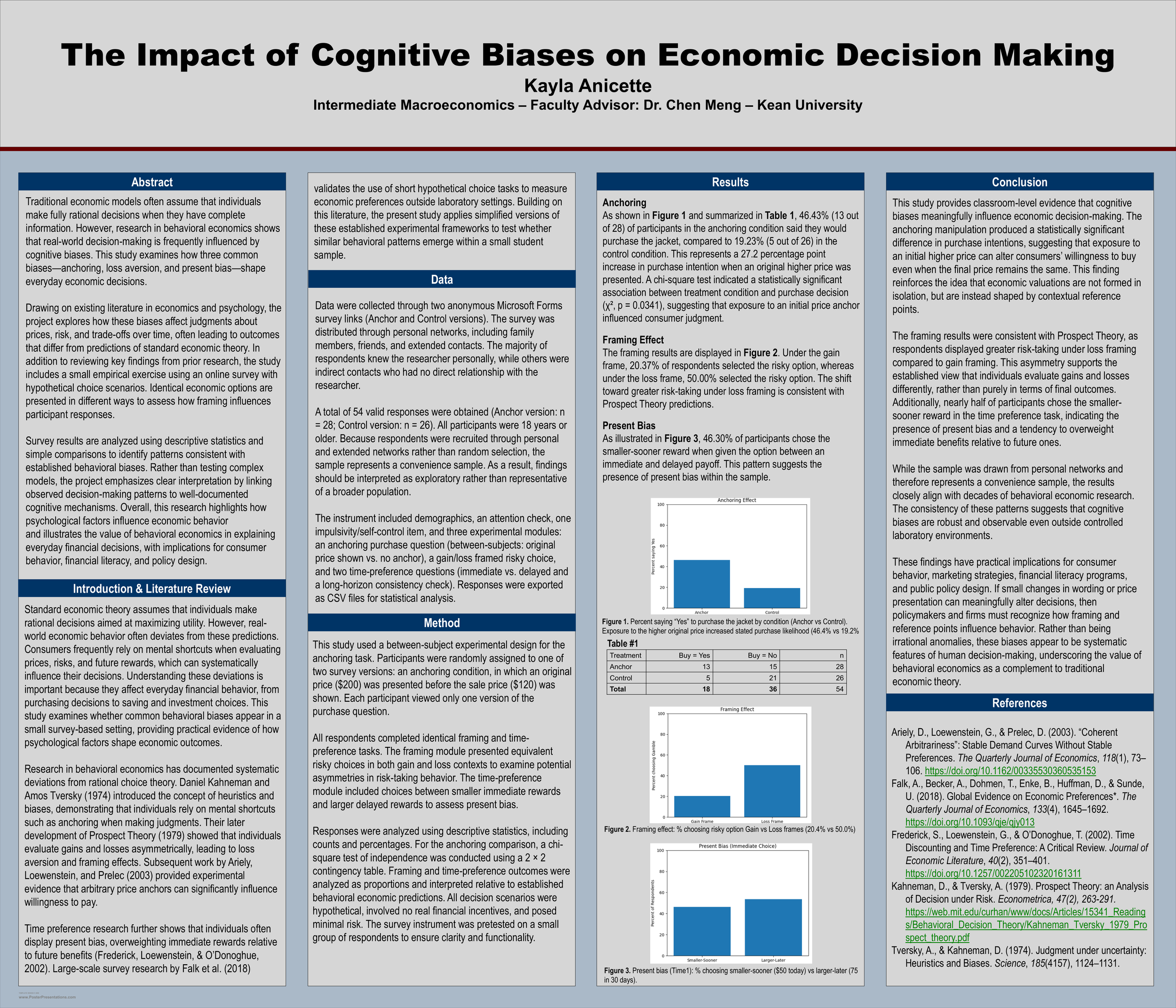
Traditional economic models often assume that individuals make fully rational decisions when they have complete information. However, research in behavioral economics shows that real-world decision-making is frequently influenced by cognitive biases. This study examines how three common biases—anchoring, loss aversion, and present bias—shape everyday economic decisions.
Drawing on existing literature in economics and psychology, the project explores how these biases affect judgments about prices, risk, and trade-offs over time, often leading to outcomes that differ from predictions of standard economic theory. In addition to reviewing key findings from prior research, the study includes a small empirical exercise using an online survey with hypothetical choice scenarios. Identical economic options are presented in different ways to assess how framing influences participant responses.
Survey results are analyzed using descriptive statistics and simple comparisons to identify patterns consistent with established behavioral biases. Rather than testing complex models, the project emphasizes clear interpretation by linking observed decision-making patterns to well-documented cognitive mechanisms. Overall, this research highlights how psychological factors influence economic behavior and illustrates the value of behavioral economics in explaining everyday financial decisions, with implications for consumer behavior, financial literacy, and policy design.