
The Impact of Federal Reserve Interest Rate Changes on S&P 500 Market Volatility (2020–2025)
Ava Assorgi
Co-Presenters: Individual Presentation
College: College of Business and Public Management
Major: BS.FINANCE
Faculty Research Mentor: Huaibing Yu
Abstract:
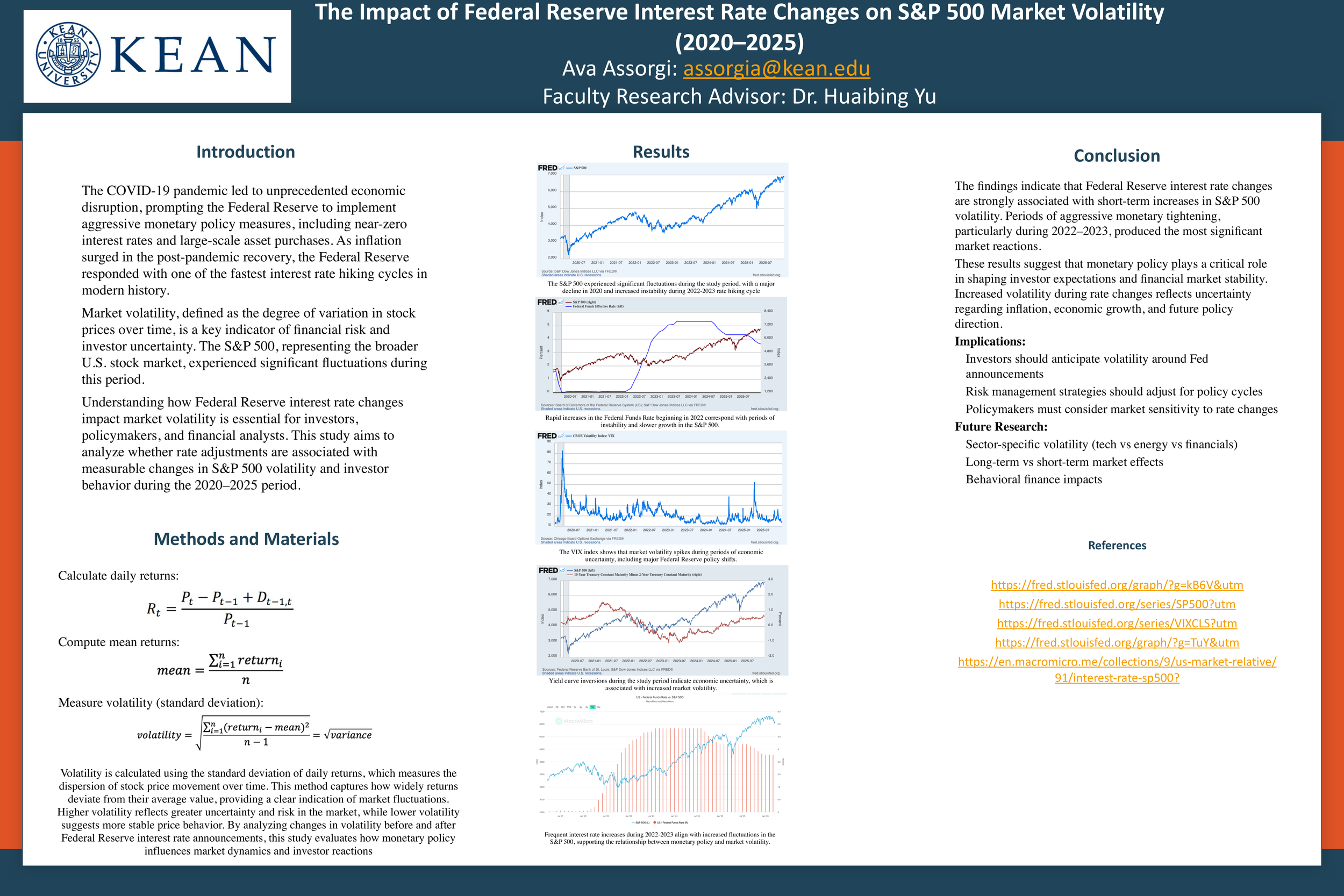
The COVID-19 pandemic triggered unprecedented monetary policy actions by the Federal Reserve, followed by one of the most aggressive interest rate hiking cycles in recent history. These rapid policy shifts created significant uncertainty in financial markets and raised questions about how interest rate changes influence stock market volatility. This study examines the relationship between Federal Reserve interest rate changes and S&P 500 volatility during the post-COVID economic period from 2020 to 2025. The objective is to determine whether rate adjustments are associated with measurable changes in market volatility and investor behavior.
A quantitative research design was used to analyze historical data on Federal Reserve interest rate announcements and daily S&P 500 index movements. Volatility was measured using standard deviation and market fluctuation indicators across key announcement periods. The study compares volatility levels before and after major rate changes to identify patterns and trends in market reactions.
The findings indicate that periods surrounding interest rate announcements are associated with increased short-term volatility in the S&P 500, particularly during rapid rate hikes. These results suggest that monetary policy shifts play a significant role in shaping investor expectations and market stability. Understanding this relationship provides valuable insight for investors, policymakers, and financial analysts seeking to manage risk during periods of economic uncertainty. Future research may explore how sector-specific markets respond differently to monetary policy changes.
Keywords: Federal Reserve, Interest Rates, S&P 500, Market Volatility, Monetary Policy