
The Potential and Limitations of ChatGPT in Picking Stocks for Individual Investors
Zhuohang Ying
Co-Presenters: Individual Presentation
College: College of Business and Public Management
Major: BS.FINANCE
Faculty Research Mentor: Paula Horii
Abstract:
Title: The Potential and Limitations of ChatGPT in Picking Stocks for Individual Investors
Author: Zhuohang Ying, Department of Finance, Kean University
Abstract:
The use of artificial intelligence tools has become more common among individual investors. One popular tool is ChatGPT, which can analyze information and give investment suggestions. However, it is still unclear how accurate ChatGPT is in helping individual investors pick stocks. This study examines the potential and limitations of ChatGPT in stock-picking decisions.
In this research, an experimental mixed-methods approach was used. ChatGPT was asked to make predictions for 100 U.S. stocks using only historical price data from January 2, 2024, to December 31, 2024. For each stock, ChatGPT predicted the future price direction and gave a buy, hold, or sell recommendation. These predictions were then compared with the actual market results. In addition, the explanations provided by ChatGPT were reviewed to identify common patterns and problems.
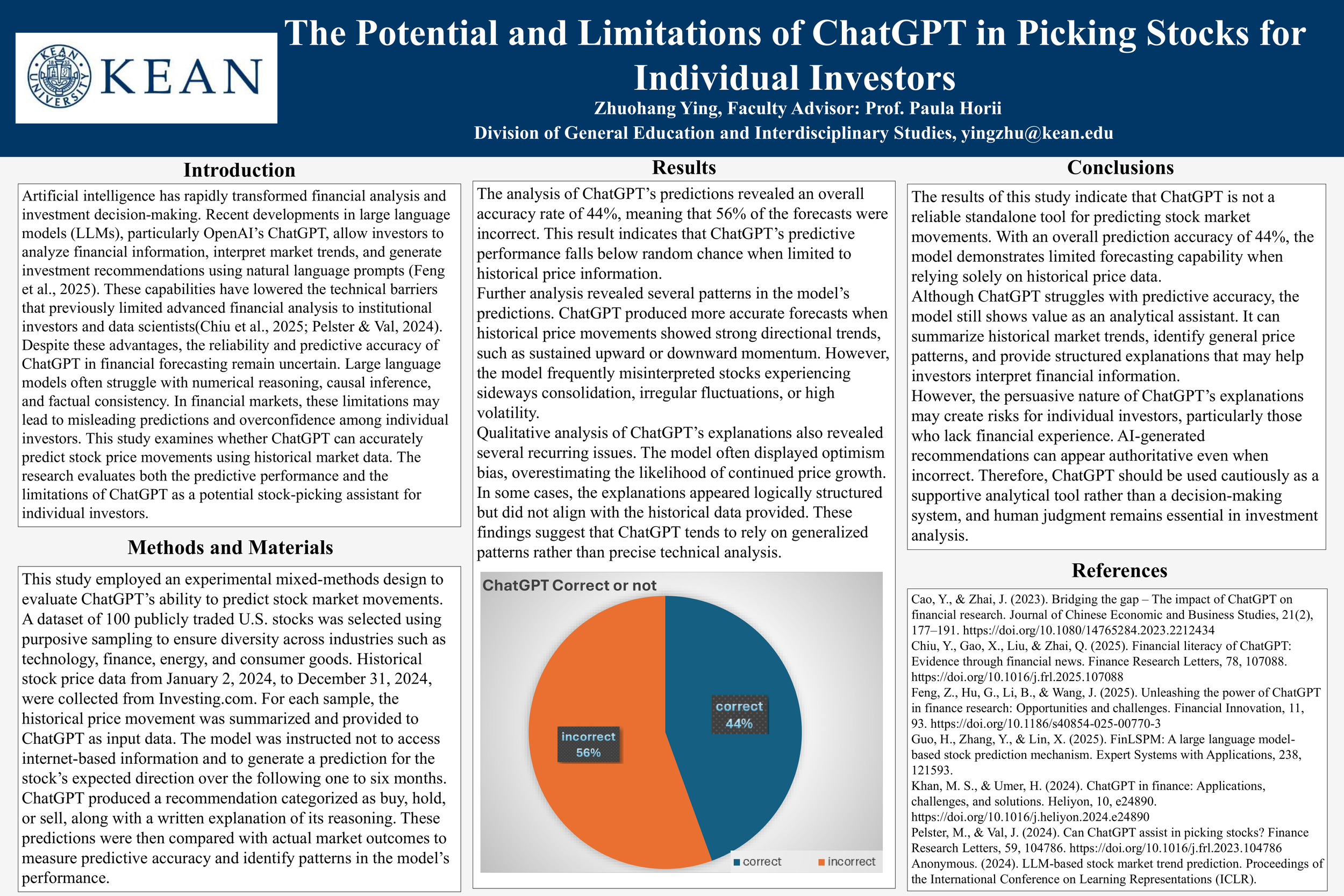
The results show that ChatGPT achieved an overall accuracy rate of 44%, which is lower than random chance. ChatGPT performed better when stock price trends were clear and stable, but it often failed during periods of high volatility or unclear trends. The analysis also found issues such as optimism bias and explanations that did not fully match the data.
Overall, the findings suggest that ChatGPT has limited reliability as a stock-picking tool for individual investors. While it may be useful for summarizing past trends, it should not be used as a standalone tool for predicting stock market performance.
Keywords: ChatGPT, Artificial Intelligence, Stock Picking, Individual Investors, Investment Decisions